Share
Public Holidays in Brazil 2027: Official Dates and Long Weekends
10/30/2026
9 min

Brazil's 2027 public holiday calendar delivers seven national holidays on working days, down from nine in 2026. Of the ten dates fixed by statute, three (1 May, 20 November and 25 December) land on Saturdays, and Lei nº 662/1949 ties each date to its calendar day with no provision for a substitute weekday off. If you are mapping out your leave strategy for next year, that single number, seven, is where every plan begins.
The drop from nine weekday holidays to seven is worth putting in context. In 2026, the Proclamação da República on 15 November was the only national holiday that did not fall on a working day. In 2027 you lose the equivalent of two extra rest days at a national level, so the placement of the holidays you do have matters more than usual.
The practical upside sits in the long-weekend potential: two Friday holidays at New Year and Good Friday, one Monday holiday in November, and three Tuesday dates in September, October and November that each create a four-day run with a single day of arranged leave.
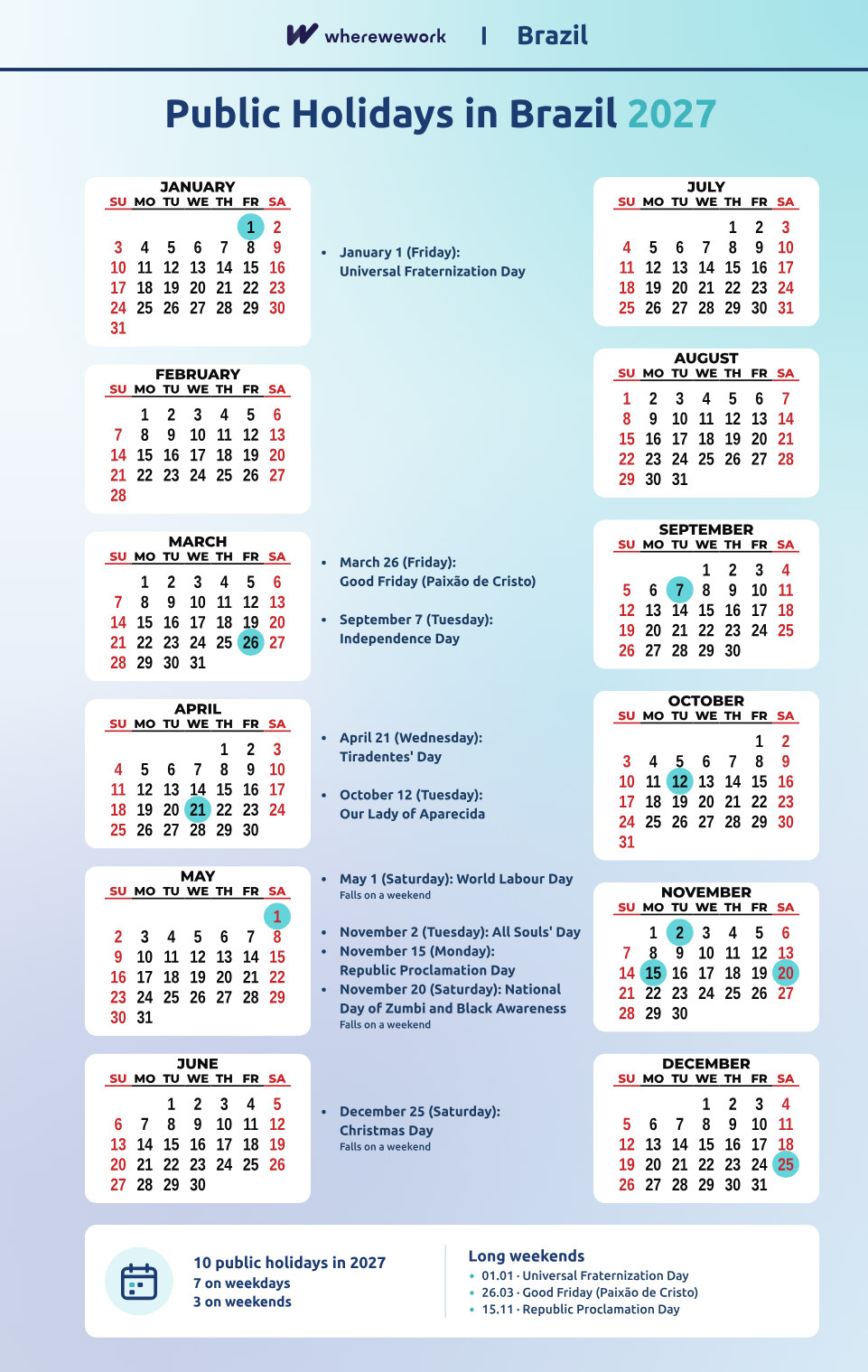
Brazil's ten national holidays in 2027: the full statutory list
Every national holiday date is fixed by federal law. Lei nº 662/1949 (Art. 1, wording given by Lei nº 10.607/2002) anchors seven of them on set calendar dates. Lei nº 6.802/1980 adds 12 October as Nossa Senhora Aparecida (Our Lady of Aparecida, Patroness of Brazil). Lei nº 14.759/2023 brought 20 November into the national calendar as the Dia Nacional de Zumbi e da Consciência Negra (National Day of Zumbi and Black Awareness) from December 2023 onward. Good Friday is a movable date: Easter Sunday in 2027 falls on 28 March, placing Good Friday on 26 March, a date confirmed in the CNJ Portaria Secretaria-Geral nº 81 of 4 December 2025 covering the National Council of Justice's own units from January 2026 to September 2027.
- 1 January (Friday): Confraternização Universal (New Year's Day)
- 26 March (Friday): Paixão de Cristo (Good Friday)
- 21 April (Wednesday): Tiradentes
- 1 May (Saturday): Dia Mundial do Trabalho (World Labour Day)
- 7 September (Tuesday): Independência do Brasil (Independence Day)
- 12 October (Tuesday): Nossa Senhora Aparecida (Our Lady of Aparecida)
- 2 November (Tuesday): Finados (All Souls' Day)
- 15 November (Monday): Proclamação da República (Republic Proclamation Day)
- 20 November (Saturday): Dia Nacional de Zumbi e da Consciência Negra
- 25 December (Saturday): Natal (Christmas Day)
That produces seven national holidays on working days and three on Saturdays, with none on a Sunday in 2027. The 2027 calendar published by BNews São Paulo on 8 September 2026 confirms the weekday placements listed above.
Two dates that often appear on popular calendar apps alongside the national holidays deserve a clear distinction. Carnival (Monday 8 and Tuesday 9 February 2027) is a ponto facultativo, an optional day off, at the national level; it is not a national holiday for private-sector workers, even though the CNJ lists those dates as holidays for its own units under Lei nº 5.010/1966, which covers only the federal courts. Corpus Christi (Thursday 27 May 2027) is a holiday only where state or municipal law makes it one. Under Lei nº 9.093/1995, states and municipalities may add their own observance days on top of the federal list, so your local calendar may extend well beyond these ten. São Paulo city, for instance, adds the city's anniversary on Monday 25 January, treats Corpus Christi as a municipal holiday, and the state of São Paulo observes 9 July as its data magna under Lei Estadual nº 9.497/1997. Always check your own state and city calendar first.
Working on a public holiday: double pay or a day off in lieu
The baseline rule is that working on a holiday is prohibited. The CLT (Consolidação das Leis do Trabalho, Decreto-Lei 5.452/1943), Art. 70, forbids work on national and religious holidays except in activities authorised under Arts. 68 and 69. Lei nº 605/1949, Art. 8, reinforces this: holiday work is off limits unless the technical requirements of the business make it unavoidable, and employees retain their normal pay for the day either way.
When operations cannot stop, Lei nº 605/1949, Art. 9, sets the compensation rule: the day is paid at double the normal rate unless the employer arranges a compensatory day off instead. The Tribunal Superior do Trabalho (TST), Brazil's top labour court, confirmed in Súmula 146 that uncompensated holiday work attracts double pay on top of the normal rest pay for that day; where a compensatory day off is granted, nothing further is owed on that account. Workers on a 12x36 schedule (twelve hours on, thirty-six off) are treated differently: CLT Art. 59-A provides that the agreed monthly pay already covers weekly rest and holidays worked, so no additional holiday premium applies in that arrangement.
Retail has its own framework, clarified significantly in 2026. Shops and general retail businesses may roster staff on holidays only when a collective labour agreement (convenção coletiva de trabalho) expressly authorises it and municipal law is also respected, per Lei nº 10.101/2000, Art. 6-A, added by Lei nº 11.603/2007. According to the law firm Cescon Barrieu, Portaria MTE nº 1.316 of 21 July 2026, issued by the Ministério do Trabalho e Emprego (MTE, the labour ministry re-created in January 2023), put an end to prolonged uncertainty in this area by defining the rules cleanly. Under that ordinance, activities such as supermarkets, hypermarkets, and clothing, footwear and appliance stores require that express collective-agreement authorisation, while 15 categories, including pharmacies, fuel stations, hotels, restaurants and funeral-service providers, can open on holidays subject only to municipal law.
Employers who breach the weekly rest and holiday pay rules under Lei nº 605/1949 face fines of R$ 40.25 to R$ 4,025.33 per infringement, doubled for repeat offences or for obstructing an inspection (Art. 12, wording of Lei nº 12.544/2011).
If you are scheduled to work on a 2027 holiday, starting from your gross salary and calculating what the double rate actually adds to your take-home gives you a concrete number to raise with your manager. Checking how your base pay compares with what colleagues in the same function earn is useful context for any of those conversations.
Bridge days, vacation splitting and the hour bank
A bridge day (emenda de feriado) is not a statutory right in Brazil's private sector. The employer decides whether to grant one, unless a collective agreement (convenção coletiva de trabalho or acordo coletivo de trabalho) provides otherwise. An employer who does grant a bridge day can legitimately ask for the hours back, typically through the hour bank (banco de horas), through work on a different day, or by adding up to two extra hours to the daily schedule within legal limits. If the employer releases staff on a bridge day without any compensation arrangement, that counts as a spontaneous concession: no salary deduction is permitted and the hours cannot be reclaimed later.
Using split vacation to build bridges is more constrained than many workers expect. After each 12-month work period, the CLT (Arts. 129 and 130) entitles you to 30 calendar days of paid vacation, which can be broken into up to three periods with your agreement: one of at least fourteen calendar days and the others of at least five calendar days each. The timing is set by whatever best suits the employer's interests (CLT Art. 136). The 2017 labour reform (Lei 13.467/2017) added a further constraint, now at CLT Art. 134 § 3:
"É vedado o início das férias no período de dois dias que antecede feriado ou dia de repouso semanal remunerado." (CLT, Art. 134 § 3)
In plain terms, vacation cannot start within the two days before a holiday or a paid weekly rest day, ruling out, for example, a Monday start before a Tuesday holiday. For single-day bridges, the hour bank is usually the practical route. Under CLT Art. 59 §§ 5 and 6, an hour bank can be set up by individual written agreement provided the hours are compensated within six months; compensation within the same calendar month can rest on a tacit or written individual arrangement.
Public sector, Carnival and paternity leave in 2027
Public bodies extend the holiday calendar through pontos facultativos. The CNJ (Conselho Nacional de Justiça, the National Council of Justice) has already published its calendar covering January 2026 to September 2027 via Portaria Secretaria-Geral nº 81 of 4 December 2025. For 2027 it lists Carnival (8 and 9 February) as holidays for CNJ units under Lei nº 5.010/1966, Ash Wednesday (10 February) as optional until 14:00, Corpus Christi (27 May) and the following Friday (28 May) as pontos facultativos, and Monday 6 September, the day before Independence Day, as an optional day as well. These apply only within CNJ administrative units, not to private employers.
For the wider federal civil service, the annual MGI ordinance sets the pontos facultativos each year. The 2026 edition (Portaria MGI nº 11.460/2025, published in the Diário Oficial da União on 30 December 2025) covered Carnival, Corpus Christi and the Friday after it, among others. The equivalent 2027 ordinance had not been published as of October 2026, so the list of federal optional days for next year is still to be confirmed.
One significant change takes effect on 1 January 2027 regardless of any ordinance. Under Lei nº 15.371 of 31 March 2026, paternity leave (licença-paternidade) rises from 5 days to 10 consecutive days from 1 January 2027, reaching 15 days from 1 January 2028 and 20 days from 1 January 2029 (the 20-day stage is subject to a fiscal target being met). The same law requires the employee to notify the employer of the planned leave period at least 30 days in advance, and prohibits dismissal without just cause from the start of the leave until one month after it ends. A new provision added to CLT Art. 134 § 4 by Lei nº 15.371/2026 also allows the employee to take vacation immediately after paternity leave, provided the request is made at least 30 days before the expected birth or guardianship order. If a new child is part of your 2027 plans, factor those windows into your vacation scheduling now.
Seven long-weekend strategies for 2027
The plans below treat bridge days as days to arrange with your employer, not as statutory rights. Days listed as leave days are regular working days that are not national holidays. Always check your own state and city calendar first, since a local holiday can extend or complicate any of these windows.
- New Year (Friday 1 January). A free three-day weekend from Friday 1 to Sunday 3 January requires zero leave days. For a ten-day run, arrange Monday 28, Tuesday 29, Wednesday 30 and Thursday 31 December 2026 as leave or bridges (4 days) to go from Friday 25 December to Sunday 3 January.
- Good Friday (Friday 26 March). A free three-day weekend from Friday 26 to Sunday 28 March costs zero leave days. For a nine-day stretch, arrange Monday 22 through Thursday 25 March (4 days) for a run from Saturday 20 to Sunday 28 March.
- Tiradentes (Wednesday 21 April). Arrange Thursday 22 and Friday 23 April (2 days) for five days off, Wednesday to Sunday. For a full nine-day block, add Monday 19 and Tuesday 20 April (4 total arranged days) from Saturday 17 to Sunday 25 April.
- Independence Day (Tuesday 7 September). Arrange Monday 6 September (1 day) for a four-day run from Saturday 4 to Tuesday 7 September. CNJ staff already have that Monday as an optional day under the 2025 ordinance. For nine days, add Wednesday 8 through Friday 10 September (4 total arranged days) from Saturday 4 to Sunday 12 September.
- Our Lady of Aparecida (Tuesday 12 October). Arrange Monday 11 October (1 day) for four days from Saturday 9 to Tuesday 12 October. For nine days, add Wednesday 13 through Friday 15 October (4 total arranged days) from Saturday 9 to Sunday 17 October.
- All Souls' Day (Tuesday 2 November). Arrange Monday 1 November (1 day) for four days from Saturday 30 October to Tuesday 2 November. For nine days, add Wednesday 3 through Friday 5 November (4 total arranged days) from Saturday 30 October to Sunday 7 November.
- Republic Proclamation Day (Monday 15 November). A free three-day weekend from Saturday 13 to Monday 15 November costs zero leave days. For nine days, arrange Tuesday 16 through Friday 19 November (4 days) from Saturday 13 to Sunday 21 November. Note that 20 November, the day after that window, falls on a Saturday in 2027.
Because a bridge day depends on your employer, raising the request early and coming with a concrete proposal, the specific day you want and how you will make up the hours, gives the conversation a much better chance. The quieter stretches around the holidays are also a practical time to refresh your CV and look at what roles are open in your field.
A leaner calendar in terms of weekday holidays rewards workers who plan ahead. If you head into a job interview during 2027, asking how the employer handles holiday shifts and extra days off gives you real information about how the team treats your time outside work.
Share
What I read is worth it:
Read all the articles about
About the crafts Balance Career planning Economic Employee experience Entrepreneurs HR Coach HR Metrics Guide Labour market Negotiation Workforce planning Students LegislativeArticle written by:
 wherewework.com

Comments
0 comments
No comments! Be the first to comment on this article!

Access your account and add your comment
Subscribe to the Newsletter
Read articles of interest from wherewework.com contributors
