Share
Minimum Wage in Germany 2026: New Levels, Inflation, and the 60% Rule
05/12/2026
3 min
The statutory minimum wage in Germany is a critical pillar of social protection and a major economic indicator for the Eurozone's largest economy. In 2026, the minimum wage reaches a new milestone, reflecting a deliberate political and economic strategy to protect low-income earners while balancing the needs of a modern industrial sector.
1. What is the minimum wage in 2026 and who does it apply to?
Starting January 1, 2026, the legal minimum wage (Mindestlohn) in Germany is set at €13.90 per hour. This represents a significant step up from previous years, aimed at maintaining purchasing power in a post-inflationary environment.
Key figures for 2026:
-
Hourly Rate: €13.90.
-
Monthly Equivalent (Gross): Approximately €2,409 (based on a standard 40-hour workweek and the official average of 173.3 hours per month).
-
Applicability: Applies to almost all employees over 18, including "mini-jobbers," seasonal workers, and foreign employees working in Germany.
-
Exemptions: Exceptions include apprentices (who have a separate minimum allowance), long-term unemployed individuals during their first six months back at work, and some mandatory internships.
2. Evolution of the minimum wage in Germany (2022–2026)
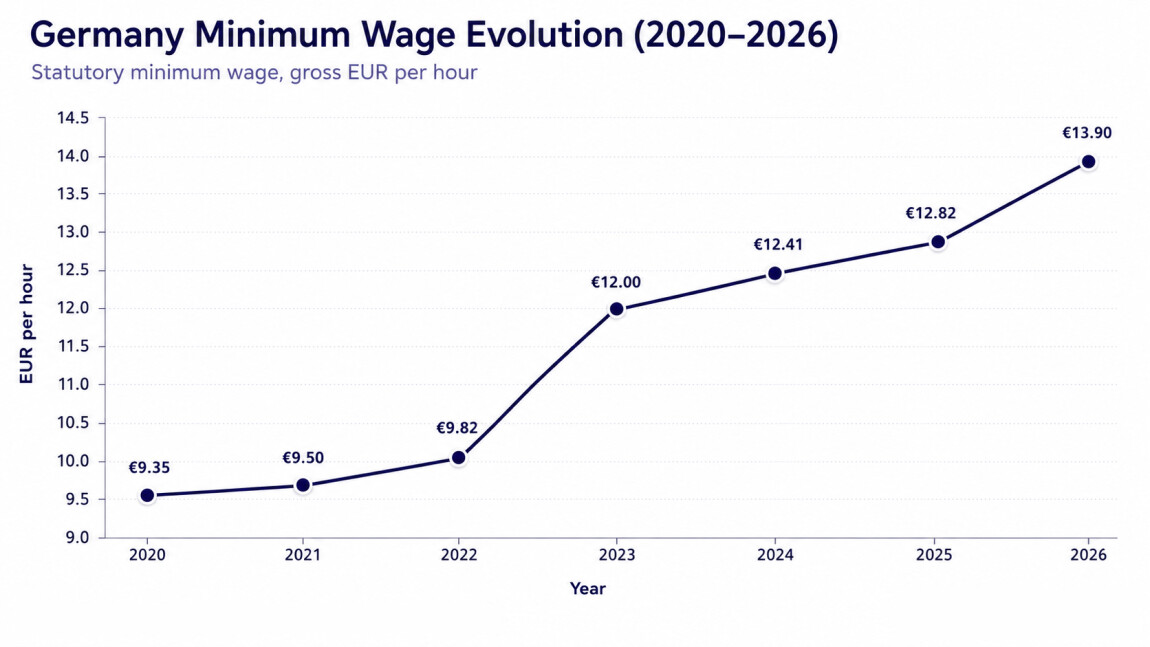
The trajectory of the German minimum wage has been one of the most dynamic in Europe. After a landmark political decision to raise the floor to €12 in late 2022, the adjustments have followed a steady upward path:
-
2022: Started at €9.82 (Jan), rose to €10.45 (July), and jumped to €12.00 (Oct).
-
2023: Remained at €12.00.
-
2024: Increased to €12.41.
-
2025: Increased to €12.82.
-
2026: Reached €13.90, an 8.4% increase over the previous year.
3. Purchasing Power: The 60% Median Goal
For 2026, the German Minimum Wage Commission (Mindestlohnkommission) has aligned the rate with European guidelines suggesting that a "fair" minimum wage should reach roughly 60% of the median gross salary for full-time employees.
In practice, while €2,409 gross per month provides a solid safety net, the high cost of living in cities like Munich, Hamburg, or Berlin continues to put pressure on low-wage households. With the average monthly gross salary for full-time workers in Germany being approximately €5,100, the minimum wage remains a necessary tool to prevent working poverty.
4. Legislative Context and the Commission's Role
Unlike some countries where wage hikes are purely political, Germany uses a permanent, independent body: the Mindestlohnkommission. This commission consists of representatives from employers, trade unions, and academic advisors.
The 2026 increase was decided based on several factors: the evolution of negotiated wages (Tarifverdienste), the need to protect workers from inflation, and the importance of not jeopardizing employment levels. Looking ahead, the commission has already signaled a further increase to €14.60 per hour, effective January 1, 2027.
5. Challenges and Sector-Specific Realities
While there is a single national floor, certain sectors in Germany—such as construction, cleaning services, or specialized care—often have sector-specific minimum wages (Branchenmindestlöhne) that are higher than the national limit.
The primary challenge in 2026 remains the "Mini-job" threshold. As the minimum wage rises, the monthly earning limit for these tax-free positions is automatically adjusted to ensure workers can still work a meaningful number of hours without crossing into standard taxation.
Conclusions
The 2026 minimum wage of €13.90 confirms Germany's commitment to a high-wage, high-productivity economy. While it offers one of the highest hourly rates in the European Union, its success is measured against the persistent rise in housing and energy costs. For workers, it represents a tangible improvement in living standards; for employers, it underscores the need for continued investment in productivity. Ready to take the next step? Create your CV, browse job opportunities, or get ready for your job interview.
FAQ – Frequently Asked Questions
What is the minimum wage in Germany for 2026? The statutory minimum wage is €13.90 per hour as of January 1, 2026.
What is the monthly gross salary for a minimum wage worker in 2026? For a full-time position (40 hours per week), the gross monthly salary is approximately €2,409.
Do students and interns get the minimum wage in Germany? Interns on mandatory internships (required by school/university) or voluntary internships shorter than three months do not necessarily receive the minimum wage. However, voluntary internships longer than three months must be paid at the statutory rate.
Will the minimum wage increase again in 2027? Yes, the German government has already announced that the rate will increase to €14.60 per hour on January 1, 2027.
Share
What I read is worth it:
Article written by:
 wherewework.com

Comments
0 comments
No comments! Be the first to comment on this article!

Access your account and add your comment
Subscribe to the Newsletter
Read articles of interest from wherewework.com contributors
