Share
Denmark 2027: only six weekday public holidays, IDA confirms
10/30/2026
8 min

With the 2026 festive season drawing closer, now is a practical moment to map out your days off for 2027. For workers in Denmark, one number stands out: only 6 of the country's 10 official public holidays (helligdage) fall on working days next year, down from 7 in 2026. Both Christmas Day and Boxing Day land on the weekend, and as IDA, the Danish Society of Engineers, makes clear in its member guidance, a holiday that coincides with a day you would not otherwise work simply disappears.
The compensating good news sits in spring. Easter comes early, and Ascension Day and Whit Monday cluster in May, giving scope for well-timed leave. The December picture is leaner, and the days that matter most, Christmas Eve and New Year's Eve, are not public holidays at all. Whether you get them off depends entirely on your collective agreement (overenskomst) or employment contract.
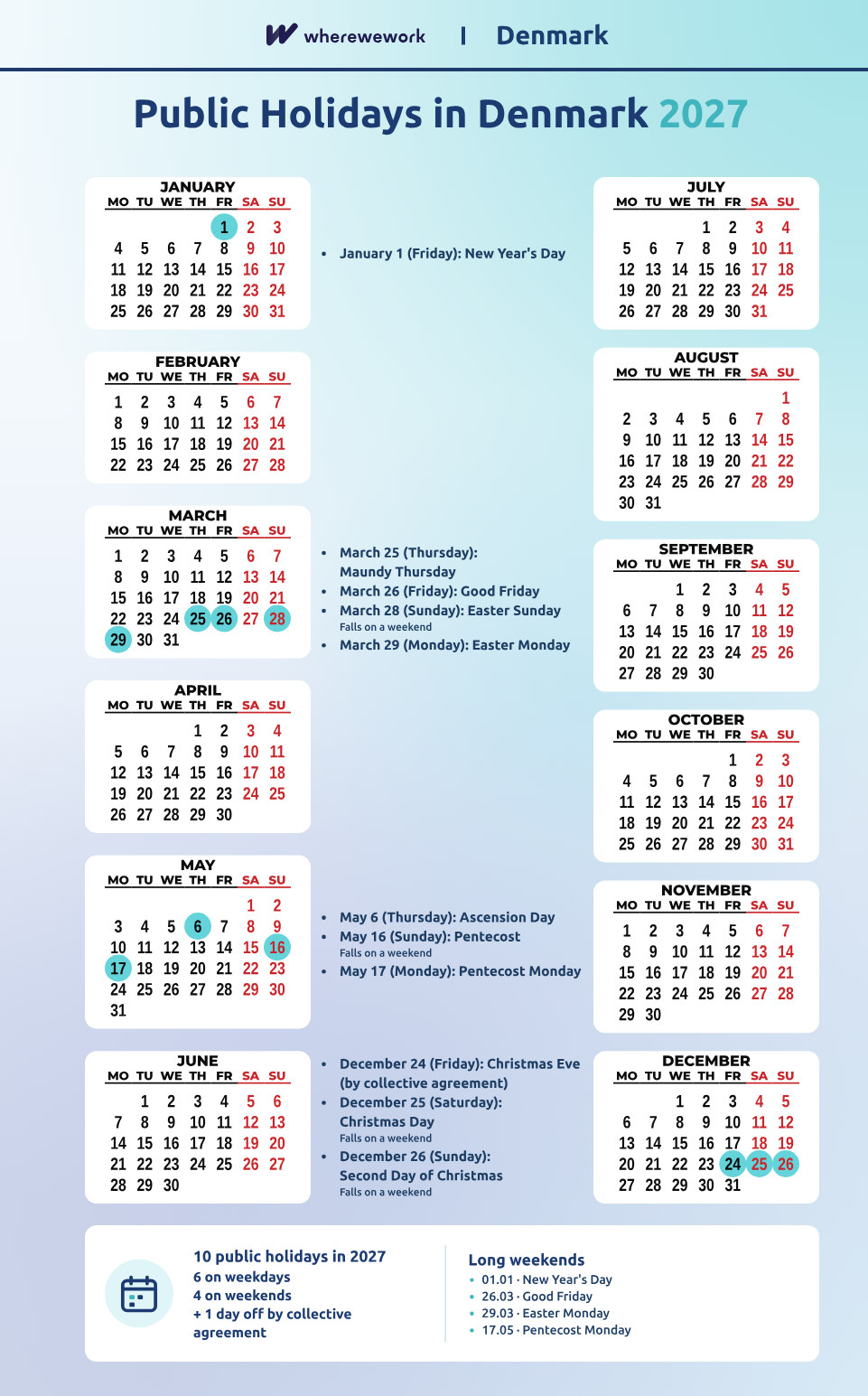
All public holidays in Denmark in 2027
These are the official public holidays for 2027, as confirmed by Øresunddirekt, the Danish-Swedish public information service for cross-border workers, and by Danmarks Nationalbank's list of bank closing days. The same days are named explicitly in the Shop Closing Act (lov om detailsalg fra butikker), as amended by Act no. 214 of 6 March 2023.
- 1 January (Friday): New Year's Day (Nytårsdag)
- 25 March (Thursday): Maundy Thursday (Skærtorsdag)
- 26 March (Friday): Good Friday (Langfredag)
- 28 March (Sunday): Easter Sunday (1. påskedag), weekend
- 29 March (Monday): Easter Monday (2. påskedag)
- 6 May (Thursday): Ascension Day (Kristi himmelfartsdag)
- 16 May (Sunday): Whit Sunday (Pinsedag), weekend
- 17 May (Monday): Whit Monday (2. pinsedag)
- 25 December (Saturday): Christmas Day (1. juledag), weekend
- 26 December (Sunday): Boxing Day (2. juledag), weekend
That gives 6 public holidays on weekdays and 4 on a weekend. In 2026, by comparison, 7 public holidays landed on weekdays, largely because Christmas Day 2026 falls on a Friday, according to Danmarks Nationalbank's closing-day records.
The rule on weekend holidays is unambiguous. IDA puts it this way in its member guidance:
"If a public holiday falls on a day where you are not otherwise working, such as a Saturday or Sunday, you are not entitled to take another day off instead. You just have fewer public holidays that year."
Days off that depend on your contract
Several days that feel like public holidays are not recognised as such in Danish law. According to Info Norden, the Nordic Council of Ministers' information service, whether you get them off depends on your employment contract, staff handbook or collective agreement:
- 1 May (Saturday): International Workers' Day
- 5 June (Saturday): Grundlovsdag (Constitution Day), a flag day rather than a public holiday
- 24 December (Friday): Christmas Eve (Juleaftensdag)
- 31 December (Friday): New Year's Eve (Nytårsaftensdag)
Both 1 May and Grundlovsdag fall on Saturdays in 2027, as Copenhagen Municipality notes in its school holiday plan. The two December Fridays are the real decision point. IDA is specific: you have no legal entitlement to a day off on 24 or 31 December, so without a contract clause or agreement you may need to use holiday days. At most workplaces, 31 December is treated as an employer-financed day off, in full or as a half day, even without a formal obligation. Workers covered by a Finansforbundet (Financial Services Union Denmark) agreement generally receive four extra paid days each year: the Friday after Ascension Day, Grundlovsdag, Christmas Eve and New Year's Eve.
Store Bededag stays abolished in 2027
Store Bededag (General Prayer Day), abolished as a public holiday with effect from 1 January 2024 under royal resolution of 6 March 2023 (Lovtidende A 2023, no. 270), remains an ordinary working day throughout 2027. Under Act no. 214 of 6 March 2023, § 3, employees on a fixed monthly salary receive a pay supplement from their employer worth one working day, set at 0.45% of annual salary, paid either twice yearly with the May and August salaries or continuously with each payment.
The Folketing (Danish parliament) rejected a Danish People's Party motion, B 3 of 14 April 2026, that would have required the government to negotiate a reinstatement of Store Bededag from 2027. The final vote on 1 October 2026 went 62 against and 37 in favour. Employment Minister Ane Halsboe-Jørgensen told the Folketing at the first reading of the motion on 23 June 2026 that under the government platform Store Bededag would come back and be reinstated from 2030. She added that since the abolition, collective agreements, local agreements and pay systems have been adapted, and that setting reinstatement from 2030 gives the social partners time to address the change in the coming bargaining rounds (overenskomstforhandlinger). That is a stated government plan, not enacted law.
Working on a public holiday in Denmark: pay and rules
Denmark has no single statutory premium for holiday work. Pay and time off on public holidays are determined almost entirely by collective agreements and individual contracts, so two colleagues doing the same job can walk away with very different deals. The employers' confederation DI (Dansk Industri) summarises how the main agreements work:
- 3F Fællesoverenskomsten: Christmas Eve and New Year's Eve are agreement-based days off. Work on Christmas Day, Boxing Day or 1 January is paid at normal wage plus the highest overtime rate of 100%.
- Dansk Metal and Dansk El-Forbund skilled-workers agreement: 24 and 31 December are agreement-based days off on full pay, conditional on income being lost. Christmas Day, Boxing Day and 1 January carry a 100% overtime supplement for hours worked.
- Construction sector: hourly-paid workers receive a DKK 1,500 advance from the Søgnehelligdagskontoen (public-holiday account), and work on Maundy Thursday, Good Friday or Easter Monday is paid at wage plus 100% overtime supplement.
- HK retail, transport and service (where the company has signed the agreement): one paid day off on either 24 or 31 December, chosen by the company, and paid time off on Christmas Day, Boxing Day and 1 January.
Without a collective agreement the position changes significantly. Rasmus Nørgaard Høgh, senior consultant in the policy and negotiation team at Finansforbundet, makes the point directly: employees without a collective agreement are typically not entitled to paid time off on any of these days. IDA adds that monthly-paid staff keep their full salary regardless of how many holidays fall in a given month, while the position of hourly-paid staff depends on their individual terms of employment. If you are an expat or an hourly worker without an agreement, reading your contract before December is not optional.
Retail: new opening rules from 1 January 2027
Under the Shop Closing Act (consolidated act no. 515 of 30 April 2019), § 2, retailers may not trade on public holidays, Grundlovsdag or Christmas Eve, or after 15:00 on New Year's Eve. Breaches are punishable by a fine set with particular regard to the economic advantage obtained, and companies can face criminal liability.
From 1 January 2027, Act no. 1754 of 29 December 2025, § 2 a, introduces a change: shops in town centres in towns with fewer than 16,850 inhabitants may trade on those otherwise closing days. Shopping centres and other retail centres are excluded, as are department stores and hypermarkets with more than 15,000 square metres of gross retail floor space. Erhvervsstyrelsen (the Danish Business Authority) sets each year which towns qualify, based on DST (Danmarks Statistik) town counts. For retail staff in smaller towns, holiday shifts could become a more regular feature from 2027.
Before agreeing to a holiday shift, work out what the overtime supplement means for your net pay after Skattestyrelsen (the Tax Agency) takes its share. It also helps to know how your salary compares with what others in the same role earn in your sector.
Long weekends in 2027: bridge day plans
Under the Ferieloven (Holiday Act, consolidated act no. 152 of 20 February 2024), § 4, you earn five weeks of paid holiday per holiday year, which runs from 1 September to 31 August. Holiday accrues at 2.08 days per month of employment. Weekday public holidays (søgnehelligdage) do not count as holiday days, under § 7, stk. 3 of the same act, which is precisely why the spring cluster in 2027 is valuable. All plans below assume a Monday-to-Friday week.
- New Year: Friday 1 January gives a free three-day weekend at zero leave cost. For a full festive break, Thursday 24 December 2026 through Sunday 3 January 2027 is 11 days off for 4 leave days (Monday 28 to Thursday 31 December 2026), provided Christmas Eve is covered by your agreement.
- Easter, free: Maundy Thursday 25 March through Easter Monday 29 March is a five-day break at zero leave cost.
- Easter, extended: Saturday 20 to Monday 29 March is 10 days off for 3 leave days (Monday 22, Tuesday 23, Wednesday 24 March). Alternatively, go after Easter: Thursday 25 March to Sunday 4 April is 11 days off for 4 leave days (Tuesday 30 March to Friday 2 April).
- Ascension Day: Take Friday 7 May off and Thursday 6 to Sunday 9 May becomes 4 days off for 1 leave day. For a full week, Saturday 1 to Sunday 9 May is 9 days off for 4 leave days (Monday 3, Tuesday 4, Wednesday 5 and Friday 7 May).
- Whitsun: Saturday 15 to Monday 17 May is a free three-day weekend. Stretch it to Sunday 23 May for 9 days off using 4 leave days (Tuesday 18 to Friday 21 May).
- Christmas 2027: Friday 24 to Sunday 26 December is 3 days off for zero leave days if your agreement covers Christmas Eve, or 1 leave day if it does not. Bridging through to Sunday 2 January 2028 gives 10 days off for 5 leave days (Monday 27 to Friday 31 December), or 4 leave days if New Year's Eve is also an agreed day off.
Note that your employer may announce a mandatory holiday closure between Christmas and New Year with one month's notice under the Ferieloven, so keep an eye on how many days you have accrued before that window arrives.
Plan early, rest well
2027 rewards planning done now. Spring is generous with free long weekends; winter is lean, and the days that shape a real Christmas break depend on what your agreement says. Book Easter and May leave first, then check your contract on 24 and 31 December before colleagues claim the same slots.
The quieter weeks around the holidays are also a natural moment to update your CV and scan for open roles. At a next interview, asking directly how the employer handles public-holiday work, and whether it gives agreed days off for Christmas Eve or New Year's Eve, tells you a great deal about the culture before you sign anything.
Share
What I read is worth it:
Read all the articles about
About the crafts Balance Career planning Economic Entrepreneurs HR Coach Guide HR Metrics Labour market Workforce planning Students Negotiation Ethics Human behaviorArticle written by:
 wherewework.com

Comments
0 comments
No comments! Be the first to comment on this article!

Access your account and add your comment
Subscribe to the Newsletter
Read articles of interest from wherewework.com contributors
