Share
Public Holidays France 2027 | Calendar and "Ponts" Strategy
10/30/2026
6 min

If you are already circling dates for 2027, start with the arithmetic. France keeps its 11 statutory public holidays, fixed by article L3133-1 of the Code du travail (French Labour Code), but the calendar is not generous: 4 of them land on a Saturday or a Sunday, leaving 7 weekday holidays, against 9 in 2026.
Nothing moves a weekend holiday to a weekday in France, so the value sits in three dates: Ascension on Thursday 6 May, Bastille Day on Wednesday 14 July and Armistice Day on Thursday 11 November. One more thing before you book, especially if you are new to France: a French public holiday is not automatically a paid day off. Only 1 May is guaranteed for everyone.
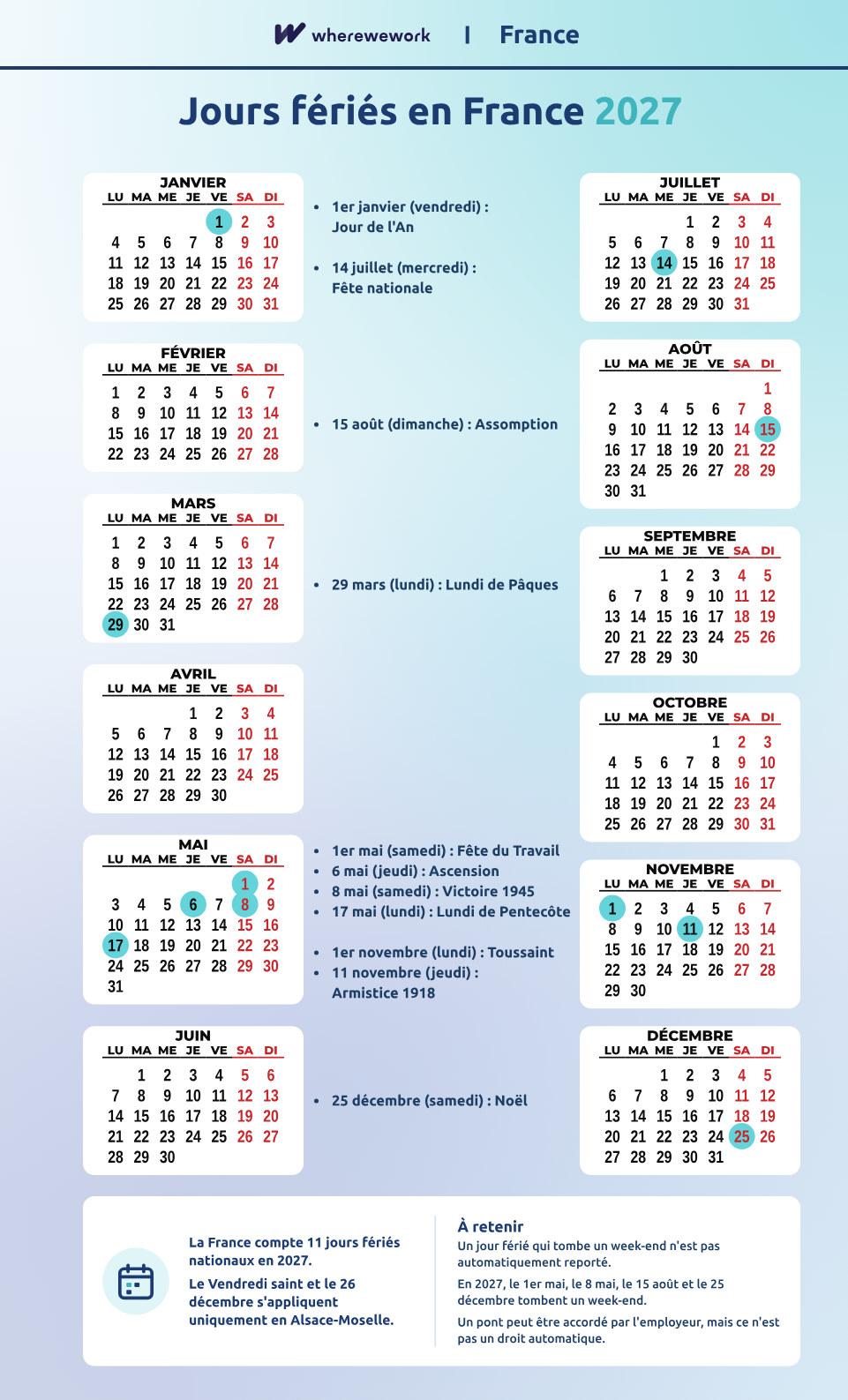
The 11 public holidays in France in 2027
According to the official 2027 table published by Service-Public.fr, the government’s public information service, the national list is:
- 1 January 2027 (Friday): New Year’s Day
- 29 March 2027 (Monday): Easter Monday
- 1 May 2027 (Saturday): Labour Day (Fête du Travail)
- 6 May 2027 (Thursday): Ascension Day
- 8 May 2027 (Saturday): Victory in Europe Day (Victoire 1945)
- 17 May 2027 (Monday): Whit Monday (Lundi de Pentecôte)
- 14 July 2027 (Wednesday): Bastille Day (Fête nationale)
- 15 August 2027 (Sunday): Assumption Day
- 1 November 2027 (Monday): All Saints’ Day (Toussaint)
- 11 November 2027 (Thursday): Armistice Day
- 25 December 2027 (Saturday): Christmas Day
In 2026 only two holidays fell on a weekend (Assumption and All Saints’ Day), which is why the weekday count drops from 9 to 7. The Labour Ministry is clear on the consequence: a holiday on your usual rest day brings no extra pay and no compensatory rest day, although your collective agreement may be more favourable.
The list itself is stable: in September 2025, Prime Minister Sébastien Lecornu withdrew a plan to abolish two public holidays.
Regional extras: Alsace-Moselle and overseas France
In Moselle, Bas-Rhin and Haut-Rhin, local law (article L3134-13 of the labour code) makes two more days non-working: Good Friday, 26 March 2027 (Friday), in communes with a Protestant temple or a mixed church, and the second day of Christmas, 26 December 2027 (Sunday). The solidarity day cannot be scheduled on either, nor on 25 December.
Overseas, article L3422-2 adds a holiday commemorating the abolition of slavery: 27 April (Tuesday) in Mayotte, 22 May (Saturday) in Martinique, 27 May (Thursday) in Guadeloupe and Saint-Martin, 10 June (Thursday) in French Guiana, 9 October (Saturday) in Saint-Barthélemy and 20 December (Monday) in La Réunion.
Working on a public holiday: what the law guarantees
1 May is the only compulsory day off for all employees (article L3133-4). Activities that cannot stop, such as hospitals or public transport, may still operate, and under article L3133-6 anyone working that day receives their wage plus an equal allowance paid by the employer: double pay. Breaking the 1 May rules is a fourth-class offence, with a fine of up to €750 applied for each employee concerned.
For the other ten holidays, a company, establishment or branch agreement decides which are days off; with no agreement, the employer decides (articles L3133-3-1 and L3133-3-2). The Labour Ministry notes that the law sets no pay premium for working them, though some agreements do. When a holiday is given off, you keep your pay if you have at least three months’ seniority (article L3133-3), or whatever your seniority for 1 May, and your employer cannot make you recover the hours. Employees under 18 may not work on holidays, except in sectors such as hotels, restaurants, bakeries, florists and entertainment.
If you are offered a premium for holiday work, work out what it means for your net salary, starting from your gross salary. It also helps to see how your salary compares with what others in the same role earn. And if you work in a sector that keeps running on holidays, such as shops, hospitals, restaurants or transport, check salaries in France for those jobs before you negotiate.
One change is pending, not enacted: a bill letting artisan bakers and florists employ volunteer staff on 1 May passed the Senate on 16 June 2026 and is now before the National Assembly. The government says it could apply from 1 May 2027 once Parliament adopts it, and Labour Minister Jean-Pierre Farandou told senators it would concern less than 1% of French employees even in a maximal scenario.
Whit Monday may be your unpaid solidarity day
Before planning around 17 May, check whether it is your solidarity day (journée de solidarité): one extra unpaid working day a year that funds support for elderly and disabled people (article L3133-7). It can be a previously unworked holiday other than 1 May, such as Whit Monday, an RTT day or another seven-hour arrangement, set by agreement or by the employer after consulting the social and economic committee (CSE). It is unpaid up to seven hours, prorated for part-timers (article L3133-8).
Ponts: the rules before the plans
The Labour Ministry is explicit that no legal provision makes a pont (bridge day) a compulsory day off. It can come from an agreement or an employer decision and, if granted, must be paid, but your employer can ask you to make up the hours within the 12 months before or after, with no premium.
How leave is counted changes what a bridge costs. Jours ouvrables count six days a week, jours ouvrés five. In Service-Public.fr’s example, leave from 12 to 18 August 2024 with Thursday 15 August off cost 5 days under jours ouvrables but 4 under jours ouvrés. The plans below count weekdays only, so check which method your agreement uses.
Seven bridge plans for 2027
Each plan assumes the holiday is a day off where you work.
- New Year: 10 days off for 4 leave days. Friday 1 January alone gives a free 3-day weekend (0 leave days). Take Monday 28, Tuesday 29, Wednesday 30 and Thursday 31 December 2026 to be off from Friday 25 December 2026 to Sunday 3 January 2027. Parents: the Education Ministry’s Christmas school holidays in zones A, B and C run from Saturday 19 December 2026 to Monday 4 January 2027.
- Easter: 9 days off for 4 leave days. Easter Monday gives a free 3-day weekend, Saturday 27 to Monday 29 March. Add Tuesday 30 and Wednesday 31 March plus Thursday 1 and Friday 2 April to stay off until Sunday 4 April. Where Good Friday applies in Alsace-Moselle, you get four days off, Friday 26 to Monday 29 March, without any leave.
- Ascension: 4 days off for 1 leave day. Take Friday 7 May for a break from Thursday 6 to Sunday 9 May. Or take Monday 3, Tuesday 4, Wednesday 5 and Friday 7 May: 4 leave days for 9 days off, Saturday 1 to Sunday 9 May.
- Whit Monday: a free 3-day weekend. Saturday 15 to Monday 17 May costs 0 leave days, unless it is your solidarity day. Add Tuesday 18 to Friday 21 May (4 leave days) for 9 days off, to Sunday 23 May.
- Bastille Day: 5 days off for 2 leave days. Take Thursday 15 and Friday 16 July for a break from Wednesday 14 to Sunday 18 July. Or take Monday 12, Tuesday 13, Thursday 15 and Friday 16 July: 4 leave days for 9 days off, Saturday 10 to Sunday 18 July.
- All Saints’ Day: a free 3-day weekend. Saturday 30 October to Monday 1 November costs 0 leave days. Add Tuesday 2 to Friday 5 November (4 leave days) for 9 days off, to Sunday 7 November.
- Armistice Day: 4 days off for 1 leave day. Take Friday 12 November for a break from Thursday 11 to Sunday 14 November. Or take Monday 8, Tuesday 9, Wednesday 10 and Friday 12 November: 4 leave days for 9 days off, Saturday 6 to Sunday 14 November.
Plan early, then confirm
The Thursday holidays are where leave requests will bunch up, so ask early and confirm with HR which holidays are days off at your company. The quieter weeks around the holidays are also a good moment to update your CV and look at open jobs. And at your next job interview, ask how the employer handles work on public holidays and extra days off: in France the answer depends on the agreement, so it is a fair question.
Share
What I read is worth it:
Read all the articles about
About the crafts Balance Career planning Economic Employee experience Ethics HR Coach HR Metrics Guide Legislative Workforce planning Labour market NegotiationArticle written by:
 wherewework.com

Comments
0 comments
No comments! Be the first to comment on this article!

Access your account and add your comment
About the crafts


Subscribe to the Newsletter
Read articles of interest from wherewework.com contributors
