Share
Public Holidays in Croatia 2027: Official Dates and Long Weekends
10/30/2026
11 min

Of Croatia's 14 statutory public holiday dates in 2027, only 8 fall on a weekday. The remaining 6 land on a Saturday or Sunday and, under the Zakon o blagdanima, spomendanima i neradnim danima u Republici Hrvatskoj (Holidays Act, NN 110/19, amended NN 72/25), they are simply gone: no substitute Monday, no make-up day. That is one fewer weekday holiday than workers had in 2026, and the gap matters when you are planning annual leave for next year.
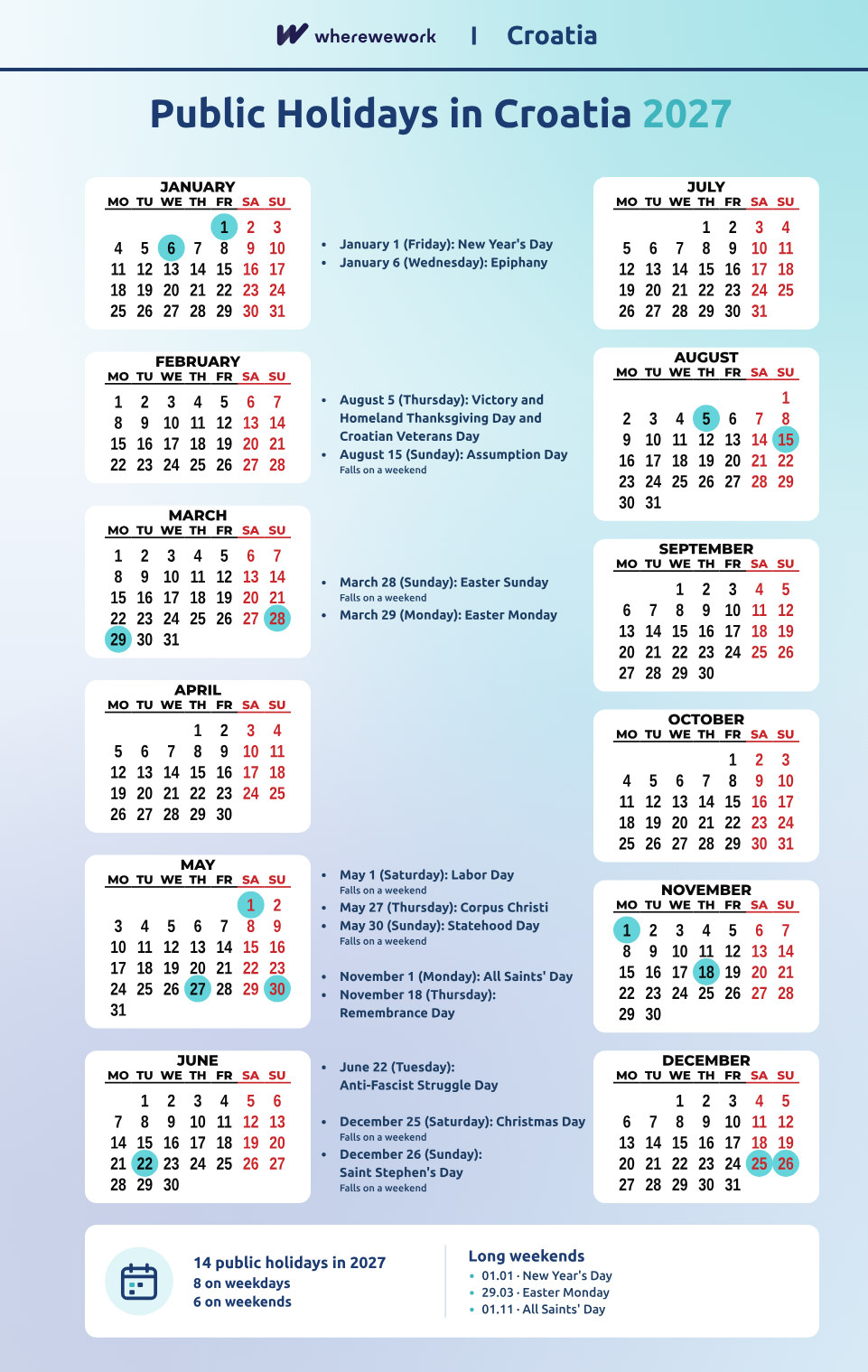
All 14 public holidays in Croatia in 2027
The complete list is anchored in Article 1(1) of the Holidays Act (Narodne novine NN 110/19), adopted by the Hrvatski sabor on 14 November 2019 and in force since 1 January 2020. A 2025 amendment (NN 72/25, in force 1 May 2025) added a new memorial day to Article 2 but left the Article 1 holiday list unchanged, so the 2027 dates are already fixed by statute. The act covers everyone employed in Croatia, including foreign nationals on a Croatian payroll.
- 1 January (Friday): New Year's Day (Nova godina)
- 6 January (Wednesday): Epiphany (Bogojavljenje ili Sveta tri kralja)
- 28 March (Sunday): Easter Sunday (Uskrs) - falls on a weekend
- 29 March (Monday): Easter Monday (Uskrsni ponedjeljak)
- 1 May (Saturday): Labour Day (Praznik rada) - falls on a weekend
- 27 May (Thursday): Corpus Christi (Tijelovo)
- 30 May (Sunday): Statehood Day (Dan državnosti) - falls on a weekend
- 22 June (Tuesday): Anti-Fascist Struggle Day (Dan antifašističke borbe)
- 5 August (Thursday): Victory and Homeland Thanksgiving Day and Croatian Veterans' Day (Dan pobjede i domovinske zahvalnosti i Dan hrvatskih branitelja)
- 15 August (Sunday): Assumption (Velika Gospa) - falls on a weekend
- 1 November (Monday): All Saints' Day (Svi sveti)
- 18 November (Thursday): Remembrance Day for the Victims of the Homeland War and for the Victims of Vukovar and Škabrnja (Dan sjećanja na žrtve Domovinskog rata i Dan sjećanja na žrtvu Vukovara i Škabrnje)
- 25 December (Saturday): Christmas Day (Božić) - falls on a weekend
- 26 December (Sunday): St Stephen's Day (Sveti Stjepan) - falls on a weekend
That gives 8 dates falling Monday to Friday (1 Jan, 6 Jan, 29 Mar, 27 May, 22 Jun, 5 Aug, 1 Nov, 18 Nov) and 6 on a weekend (28 Mar, 1 May, 30 May, 15 Aug, 25 Dec, 26 Dec). By comparison, in 2026 there were 9 weekday holidays and 5 on a weekend, according to the Croatian employer guide Moja Firma. The shift in 2027: Labour Day (a Friday in 2026) and Christmas Day (also a Friday in 2026) move to Saturdays, while All Saints' Day moves in the opposite direction, from a Sunday in 2026 to a Monday in 2027.
Why are the weekend dates simply lost? Article 4 of the Holidays Act is direct on the Sunday case: the Croatian text reads that if one of the days listed under Articles 1 and 3 falls on a Sunday, a holiday or a non-working day, it is not carried over to the next day. The act contains no provision at all for Saturdays, so Labour Day (1 May) and Christmas Day (25 December) in 2027 also go unreplaced. An employer may decide to grant an extra day off through internal rules, a collective agreement or an organisational decision, but that is a voluntary benefit, not a statutory entitlement.
Working on a public holiday: what the law says about pay
Public holidays are paid days off. Article 5 of the Holidays Act gives workers in Croatia the right to wage compensation on each of the Article 1 and Article 3 dates. If you are rostered to work on one of them, the rules on the premium come not from the Holidays Act but from the Zakon o radu (Labour Act, NN 93/14, consolidated through NN 151/22). Article 94(1), as rewritten by the amendment in force since 1 January 2023, entitles you to increased pay for work on a Sunday or a public holiday, in the amount and manner set by your collective agreement, work rules or employment contract. The only statutory floor is for Sunday work: at least 50% extra per hour. For work specifically on a public holiday, the Labour Act sets no minimum percentage.
Two fallback provisions apply in the private sector. If your collective agreement, work rules or contract do not set a holiday-work premium, you are still entitled to an appropriate increase: the one regularly paid for that kind of work or, if that cannot be established, one determined by a court based on the circumstances (Labour Act Article 94(4) and (5)). Additionally, under Labour Act Article 90(5), any premium calculated under Article 94(1) must be applied to an amount no lower than the current minimum wage set by special regulations.
Workers in public services and the civil service have firmer reference points. The Temeljni kolektivni ugovor za zaposlenike u javnim službama (Basic Collective Agreement for Employees in Public Services, NN 29/2024) sets a supplement of 150% for work on a statutory holiday or non-working day, 50% for Sunday work and 25% for Saturday work, applied to base pay increased by the seniority allowance (Article 59(1)). Critically, Article 59(3) of the same agreement states that these supplements do not exclude one another, so a public-service worker rostered on a holiday that also falls on a Sunday (Easter Sunday on 28 March, Statehood Day on 30 May, the Assumption on 15 August and St Stephen's Day on 26 December 2027) qualifies for both the 150% holiday premium and the 50% Sunday supplement simultaneously. The agreement entered into force on 1 March 2024 for a fixed term of four years, so it covers the whole of 2027. The Kolektivni ugovor za državne službenike i namještenike (Collective Agreement for State Civil Servants and Employees), amended as of 1 March 2024 (NN 29/2024), sets the same supplement percentages.
Before accepting a holiday shift, calculate what the premium genuinely adds to your net pay once tax and contributions are applied. If you work in a sector that operates through public holidays, such as retail, healthcare, hospitality or transport, salary benchmark data for those roles in Croatia gives you a grounded starting point for any conversation about pay.
Annual leave and other days off in 2027
Every worker in Croatia is entitled to at least four weeks of paid annual leave per calendar year under Labour Act Article 77(1). On a standard Monday-to-Friday schedule that translates to a minimum of 20 working days, because leave is counted in working days according to your weekly schedule (Article 79(1)). Public holidays and statutory non-working days that fall inside your leave period are not deducted from it (Article 79(2)). Your employer is required to set the leave schedule by 30 June 2027 at the latest and to give you at least fifteen days' notice of when your leave falls (Labour Act Article 85(1) and (4)). Beyond that, Article 85(5) gives you the right to take one day of annual leave whenever you choose, with three days' notice to your employer, unless especially justified reasons on the employer's side make it impossible. An employer that denies leave guaranteed by the Labour Act faces a fine of EUR 4,110.00 to 7,960.00 for a legal person, and EUR 530.00 to 790.00 for the responsible person or a natural-person employer (Labour Act Article 228(1), points 18 and 19, as rewritten by NN 151/22).
Faith days
Article 3 of the Holidays Act provides paid non-working days for members of particular faiths. In 2027 the relevant dates are: Thursday 7 January for Christians who celebrate Christmas on that date; Monday 3 May for those who observe Easter by the Julian calendar (Orthodox Easter Monday); one day of choice for each of Ramazanski bajram and Kurban-bajram for Muslim workers (tentatively Wednesday 10 March and Monday 17 May, as lunar dates are confirmed by the relevant religious community); and one day of choice for each of Rosh Hashanah (Saturday 2 October) and Yom Kippur (Monday 11 October) for Jewish workers.
Family events
Labour Act Article 86, as rewritten by NN 151/22, gives every worker up to seven working days of paid leave a year for significant personal events such as marriage, the birth of a child, or the death or serious illness of a close family member, unless a collective agreement, work rules or the employment contract provide otherwise. Each blood donation earns one paid day off, used on the day itself or the next working day (Article 86(5)). Workers employed in public services may access up to 10 working days a year in total under the Basic Collective Agreement (NN 29/2024), including 5 days for marriage, 5 for the birth or adoption of each child and 5 for the death of a spouse or close family member (Article 43).
What expats should know
- Most shops are closed on public holidays by law. The Zakon o trgovini (Trade Act), as amended by NN 33/2023 in force from 1 July 2023, states that retail outlets are closed on public holidays (Article 57(3)). Exceptions include shops inside or forming part of railway and bus stations, airports, ports, petrol stations, hospitals, hotels, cultural and religious institutions, museums, marinas, campsites and family farms; newspaper kiosks may open on Sundays and holidays from 07:00 to 13:00 (Article 57(5) and (7)). Traders that break the closure rule face a fine of EUR 660.00 to 39,810.00 for a legal person and EUR 530.00 to 9,290.00 for the responsible person or a natural-person trader (Trade Act Article 70(1)). With 25 and 26 December 2027 falling on a Saturday and a Sunday respectively, plan your Christmas shopping by Friday 24 December.
- 25 June and 8 October are no longer non-working days. Under the former holidays act they were Statehood Day and Independence Day. Since the 2019 act took effect on 1 January 2020, Statehood Day is 30 May, while 25 June (Dan neovisnosti, Independence Day) and 8 October (Dan Hrvatskoga sabora, Croatian Parliament Day) are listed in Article 2 as memorial days only, meaning ceremonies but no day off. Outdated calendars that still show the pre-2020 dates should be disregarded.
- Christmas Eve and New Year's Eve are ordinary working days. Neither 24 December nor 31 December appears in the Article 1 list, so neither is a statutory holiday or non-working day.
- Monday 3 May 2027 carries two designations at once. It is Orthodox Easter Monday, a paid non-working day for Christians observing Easter by the Julian calendar under Article 3 of the Holidays Act. It is simultaneously the new Dan sjećanja na ubijenu i stradalu djecu u Domovinskom ratu (Day of Remembrance of Children Killed and Injured in the Homeland War), added by the 2025 amendment as a memorial observance in Article 2, not a day off.
Eight long weekends you can build in 2027
Each plan below counts leave days on a Monday-to-Friday schedule. The Thursday anchors in May, August and November are the strongest leverage points this year.
- New Year's Day, Friday 1 January: a free three-day weekend (Fri 1 Jan to Sun 3 Jan, 0 leave days). Alternatively, use Mon 28, Tue 29, Wed 30 and Thu 31 December 2026 (4 leave days from your 2026 allowance) for 10 days off, Fri 25 Dec 2026 to Sun 3 Jan 2027.
- Epiphany, Wednesday 6 January: take Thu 7 and Fri 8 Jan (2 leave days) for 5 days off, Wed 6 to Sun 10 Jan. Or take Mon 4, Tue 5, Thu 7 and Fri 8 Jan (4 leave days) for 10 days off, Fri 1 to Sun 10 Jan.
- Easter Monday, Monday 29 March: a free three-day weekend, Sat 27 to Mon 29 Mar (0 leave days). Note that the four leave days immediately after (Tue 30, Wed 31 Mar, Thu 1 and Fri 2 Apr) fall inside the school spring break (25 Mar to 2 Apr 2027, per the Ministry of Science, Education and Youth's decision for the 2026/2027 school year, NN 58/2026), so parents adding those 4 leave days get 9 days off while schools are also closed.
- Corpus Christi, Thursday 27 May: take Fri 28 May (1 leave day) for 4 days off, Thu 27 to Sun 30 May. Or take Mon 24, Tue 25, Wed 26 and Fri 28 May (4 leave days) for 9 days off, Sat 22 to Sun 30 May.
- Anti-Fascist Struggle Day, Tuesday 22 June: take Mon 21 Jun (1 leave day) for 4 days off, Sat 19 to Tue 22 Jun. Or take Mon 21, Wed 23, Thu 24 and Fri 25 Jun (4 leave days) for 9 days off, Sat 19 to Sun 27 Jun.
- Victory Day, Thursday 5 August: take Fri 6 Aug (1 leave day) for 4 days off, Thu 5 to Sun 8 Aug. Or take Mon 2, Tue 3, Wed 4 and Fri 6 Aug (4 leave days) for 9 days off, Sat 31 Jul to Sun 8 Aug.
- All Saints' Day, Monday 1 November: a free three-day weekend, Sat 30 Oct to Mon 1 Nov (0 leave days). Add Tue 2, Wed 3, Thu 4 and Fri 5 Nov (4 leave days) for 9 days off, Sat 30 Oct to Sun 7 Nov.
- Remembrance Day, Thursday 18 November: take Fri 19 Nov (1 leave day) for 4 days off, Thu 18 to Sun 21 Nov. Or take Mon 15, Tue 16, Wed 17 and Fri 19 Nov (4 leave days) for 9 days off, Sat 13 to Sun 21 Nov.
Bear in mind that your employer must set the leave schedule by 30 June 2027. Raising the May and summer bridge options with your manager before that deadline, rather than after, gives you the best chance of securing the dates you want.
Plan early, use what the law gives you
2027 hands Croatian workers one fewer weekday holiday than 2026, but the Thursday clusters around Corpus Christi, Victory Day and Remembrance Day still make meaningful extensions possible with a single leave day each. Knowing the statutory framework is half the planning: annual leave must not include public holidays in the count, the leave schedule is due by 30 June, and if you work on a holiday the premium your employer pays depends on your collective agreement or contract, with no statutory minimum in the private sector beyond the 50% Sunday floor set by the Zakon o radu. The quieter days around the holiday bridges are also a practical window to update your CV, review open roles and, if you reach interview stage, ask your prospective employer directly how it handles holiday rosters and whether it offers any supplement above the collective-agreement rate.
Share
What I read is worth it:
Read all the articles about
About the crafts Balance Career planning Economic Entrepreneurs HR Metrics HR Coach Guide Labour market Legislative Workforce planningArticle written by:
 wherewework.com

Comments
0 comments
No comments! Be the first to comment on this article!

Access your account and add your comment

Subscribe to the Newsletter
Read articles of interest from wherewework.com contributors
