Share
Public Holidays in Italy 2027: Official Dates and Long Weekends
10/30/2026
8 min

If you live and work in Italy, 2027 brings a change you will actually feel: the national feast of San Francesco d'Assisi, patron of Italy, gives workers a weekday off for the first time. Established by Legge 151/2025, published in the Gazzetta Ufficiale n. 236 of 10 October 2025 and in force since 1 January 2026, the holiday fell on a Sunday in 2026. In 2027 it lands on Monday 4 October.
Counting Easter Sunday, Italy has 13 public holiday dates in 2027: 7 on working days and 6 on a weekend. That matches the 7 weekday days off of 2026, so 2027 is no more and no less generous overall. The mix shifts, though: San Francesco and All Saints hand you two Mondays, while Labour Day and Christmas slip to Saturdays. Weekend holidays are not moved to a weekday under any current provision, so planning pays off.
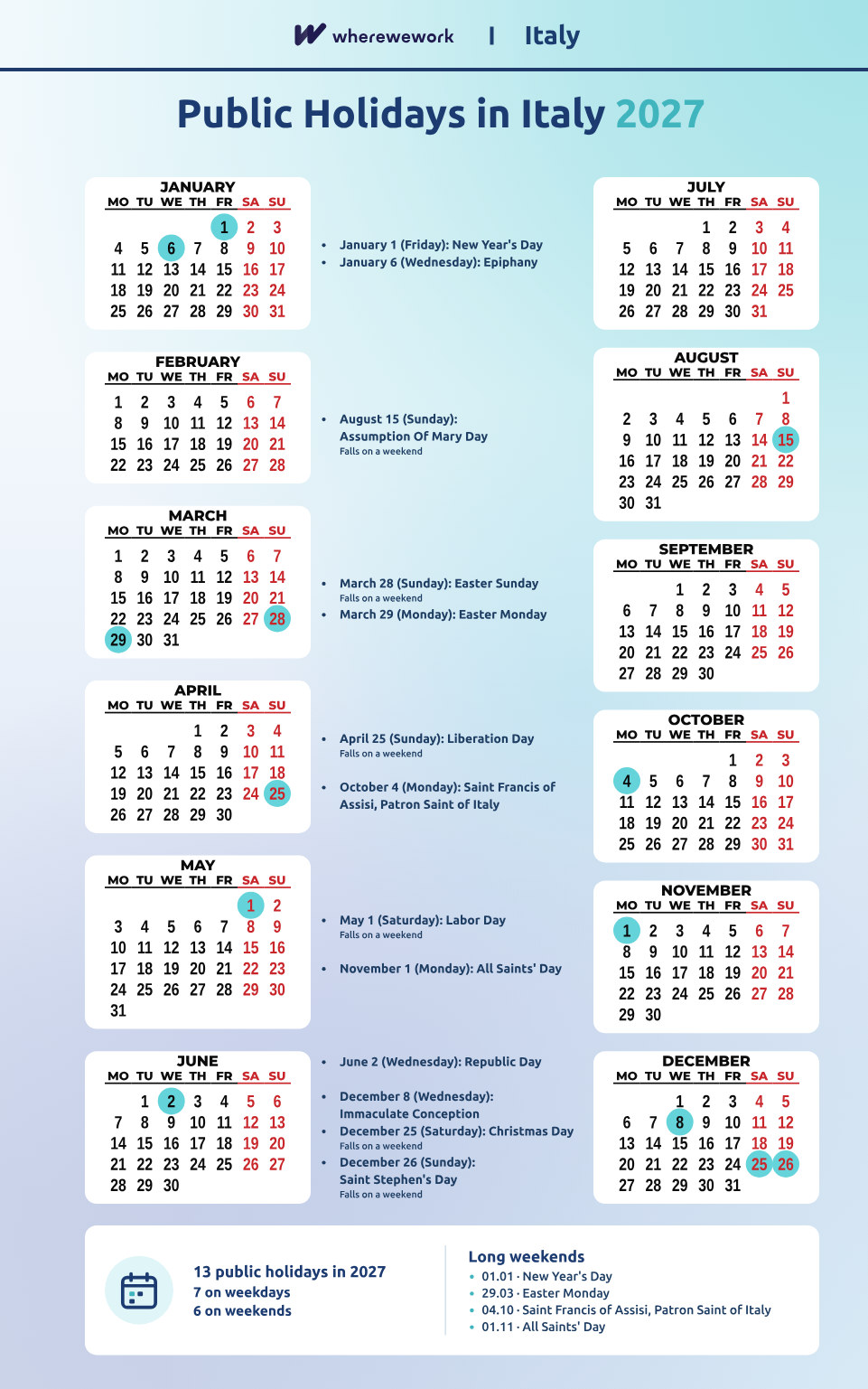
Public holidays in Italy 2027: the full list
The list is fixed by statute, resting on Legge 260/1949 (as amended by Legge 54/1977 and later acts) with 4 October inserted by Legge 151/2025, article 2. The Italian Foreign Ministry's Circolare n. 2 of 4 September 2026 confirms twelve holidays besides Sundays, noting that the current total stands at twelve (the circular's Italian phrasing confirms the count as attualmente pari a dodici).
- 1 January 2027 (Friday): New Year's Day
- 6 January 2027 (Wednesday): Epiphany
- 28 March 2027 (Sunday): Easter Sunday
- 29 March 2027 (Monday): Easter Monday
- 25 April 2027 (Sunday): Liberation Day
- 1 May 2027 (Saturday): Labour Day
- 2 June 2027 (Wednesday): Republic Day
- 15 August 2027 (Sunday): Assumption of Mary
- 4 October 2027 (Monday): San Francesco d'Assisi, patron of Italy (new national holiday)
- 1 November 2027 (Monday): All Saints' Day
- 8 December 2027 (Wednesday): Immaculate Conception
- 25 December 2027 (Saturday): Christmas Day
- 26 December 2027 (Sunday): Saint Stephen's Day
Two points newcomers often miss. The Circolare n. 2 states that, for ministry staff in Italy, holidays are fixed and cannot be shifted to another working day when they fall on a weekend. And 4 November (National Unity Day) is a commemoration under Legge 27 of 1 March 2024 without civil effects, so it remains an ordinary working day.
What's new in 2027: San Francesco on a Monday
Article 1 of Legge 151/2025, published in the Gazzetta Ufficiale n. 236 of 10 October 2025, establishes the national feast of San Francesco d'Assisi to be celebrated on 4 October every year (the law's Italian text uses the verb istituisce, meaning it creates a wholly new national holiday, not a reinstatement). The distinction matters: before this law, 4 October was only a solennità civile (civil solemnity) under Legge 132/1958, carrying no entitlement to a day off. After the 2025 change, 4 October also remains a civil solemnity in honour of Santa Caterina da Siena, Italy's other patron.
Hospitals, police stations and fire stations still operate on 4 October, and that has a price. Article 3 of Legge 151/2025 authorises EUR 10,684,044 a year from 2027 for extra holiday-work pay and allowances. According to the Camera dei Deputati's research service (Servizio Studi), EUR 8,793,880 of that goes to Servizio Sanitario Nazionale (national health service) staff and EUR 1,890,164 to the police forces, the armed forces and the fire brigade. The spending starts only in 2027 because 4 October 2026 was a Sunday.
If you work in health, security, defence or public rescue, expect 4 October on the 2027 rota and check how your contratto collettivo pays it.
Working on a public holiday in Italy: what you are owed
Holiday pay rests on Legge 260/1949, article 5 (as replaced by Legge 90/1954), and in practice on your contratto collettivo nazionale di lavoro (CCNL), the sector-level agreement negotiated between union federations and employer bodies such as Confindustria or Confcommercio:
- Salaried workers: your normal daily pay is due whether or not you work. If you do work, you are also owed pay for the hours worked plus the holiday premium set by your collective agreement.
- Hourly-paid workers: unless your contract says otherwise, a paid holiday is worth one-sixth of your normal weekly hours.
- Sunday holidays: for civil holidays such as Liberation Day, Legge 260/1949 article 5 (as replaced by Legge 90/1954) entitles salaried staff to an extra day's pay when the holiday falls on a Sunday - by default 1/26 of fixed monthly pay [quote:q3, quote:p25]. In 2027 that applies to Sunday 25 April (Liberation Day). For Easter Sunday, Assumption and Saint Stephen's Day, entitlement depends on your CCNL: the retail and services agreement (CCNL Terziario, art. 142) adds a daily quota for any listed holiday on a Sunday.
- Saturday holidays: Labour Day and Christmas both fall on a Saturday in 2027. For workers on a five-day week, the Corte di Cassazione (Court of Cassation) found in ruling 11117/1995 that the extra quota is not due unless your collective agreement specifically provides for it.
- Your right to refuse: an extensive line of Corte di Cassazione rulings (9176/1997, 4435/2004, 16634/2005, 16592/2015, 22482/2016, 18887/2019, 8958/2021) confirms that workers have the right to decline work on a weekday public holiday. That right can be waived only through an individual agreement or a union agreement signed by organisations you have explicitly mandated.
- Absences: holiday pay remains due if you are absent through illness, injury, maternity, or marriage leave, but not if you are on strike.
Before your next payslip arrives, it is worth working out what a holiday premium means for your net salary against your gross pay. Checking how your salary compares with verified benchmarks for your role and sector in Italy gives you a concrete foundation for any conversation with your employer.
Extra days off beyond the official list
Abolished holidays (festività soppresse)
To compensate for the holidays removed in 1977 by Legge 54/1977, Legge 937 of 23 December 1977 gave public employees six extra rest days a year on top of annual leave: two added compulsorily to ordinary leave and four taken on request, compatibly with service needs. Private-sector collective agreements generally compensated the four abolished holidays with individual paid permits totalling 32 hours a year, accruing at 1/12 each month. Use them within the year: unused permits are generally paid out in the private sector, while Ministero della Giustizia (Ministry of Justice) staff simply lose theirs if not taken in the reference year.
Your local patron saint
Many workers also get the patron saint's day of the town where they work. For central public administration staff, the entitlement comes from article 29(2) of the 2016-2018 CCNL for the Funzioni Centrali sector. Private-sector collective agreements typically add the patron saint's day of the municipality where the workplace is located, with some contracts (such as the metalworking CCNL) allowing local organisations to agree a substitute day at the start of each year. In Rome, Santi Pietro e Paolo falls on Tuesday 29 June 2027, recognised by Decreto del Presidente della Repubblica 792/1985 for the municipality of Rome. In Milan, Sant'Ambrogio falls on Tuesday 7 December 2027, right next to the Immaculate Conception national holiday on Wednesday 8 December.
Your annual leave
The Ministero del Lavoro e delle Politiche Sociali sets a minimum of four weeks of paid leave a year, two of which must be taken consecutively within the year they accrue. The remaining two weeks may be used within 18 months after the end of the accrual year, unless your CCNL provides otherwise, and the four-week minimum cannot be replaced by a payment except when employment ends. That is the budget the bridge plans below draw on.
Bridge plans for 2027: turn leave into long weekends
The counting rule: leave days are the working days in your break that are not public holidays.
- New Year (Friday 1 January): a free 3-day weekend, Friday 1 to Sunday 3 January (0 leave days). For 10 days off, covering Friday 25 December 2026 to Sunday 3 January 2027, take 4 leave days: 28, 29, 30 and 31 December.
- Epiphany (Wednesday 6 January): take Thursday 7 and Friday 8 for 5 days off, Wednesday 6 to Sunday 10 January (2 leave days). For 10 days, Friday 1 to Sunday 10 January, take 4 leave days: 4, 5, 7 and 8 January.
- Easter Monday (29 March): a free 3-day weekend, Saturday 27 to Monday 29 March (0 leave days). For 9 days, Saturday 27 March to Sunday 4 April, take 4 leave days: 30 and 31 March, 1 and 2 April.
- Republic Day (Wednesday 2 June): take Thursday 3 and Friday 4 for 5 days off, Wednesday 2 to Sunday 6 June (2 leave days). For 9 days, Saturday 29 May to Sunday 6 June, take 4 leave days: 31 May, 1, 3 and 4 June.
- San Francesco (Monday 4 October): a free 3-day weekend, Saturday 2 to Monday 4 October (0 leave days). For 9 days, Saturday 2 to Sunday 10 October, take 4 leave days: 5, 6, 7 and 8 October.
- All Saints (Monday 1 November): a free 3-day weekend, Saturday 30 October to Monday 1 November (0 leave days). For 9 days, Saturday 30 October to Sunday 7 November, take 4 leave days: 2, 3, 4 and 5 November.
- Immaculate Conception (Wednesday 8 December): take Thursday 9 and Friday 10 for 5 days off, Wednesday 8 to Sunday 12 December (2 leave days). For 9 days, Saturday 4 to Sunday 12 December, take 4 leave days: 6, 7, 9 and 10 December. In Milan, if Sant'Ambrogio on 7 December is your day off, only 3 leave days are needed in that span: 6, 9 and 10 December.
Working in Rome? Take Monday 28 June (1 leave day) and Santi Pietro e Paolo gives you 4 days off, Saturday 26 to Tuesday 29 June. Spring is the lean stretch: with Liberation Day on a Sunday and Labour Day on a Saturday, there is no bridge in late April or early May in 2027 [quote:p15, quote:p30].
Plan smart, rest well
The two October and November Mondays will be popular across most workplaces, so putting your leave requests in early makes practical sense. The quieter days around public holidays are also a good moment to refresh your CV and take a calm look at open positions. If that leads to an interview, asking how the employer handles rotas on public holidays and whether the relevant CCNL premium is paid in full tells you a great deal about the working culture you would be joining. The right to refuse work on a festivo infrasettimanale without a waiver, confirmed through repeated Corte di Cassazione rulings, is one of those protections that is easy to overlook until the first holiday rota lands in your inbox.
Share
What I read is worth it:
Read all the articles about
About the crafts Balance Career planning Economic Employee experience Ethics HR Metrics HR Coach Guide Labour market Workforce planning Statistics Students Negotiation LegislativeArticle written by:
 wherewework.com

Comments
0 comments
No comments! Be the first to comment on this article!

Access your account and add your comment
Subscribe to the Newsletter
Read articles of interest from wherewework.com contributors
