Share
Minimum Wage in Morocco 2026: The Final Phase of the Social Dialogue Hikes
05/14/2026
2 min
In 2026, Morocco completes a landmark multi-year plan to uplift the purchasing power of its private-sector workforce. Under the framework of the National Social Dialogue agreement signed in April 2024, the Moroccan government has implemented the second and final 5% increase for the statutory minimum wage. For 2026, the country continues to use its dual-rate system, distinguishing between urban/industrial work (SMIG) and agricultural labor (SMAG).
1. SMIG: Non-Agricultural Minimum Wage 2026
The SMIG (Salaire Minimum Interprofessionnel Garanti) applies to the industry, commerce, and services sectors, as well as liberal professions.
-
Effective Date: January 1, 2026.
-
Hourly Rate: 17.92 MAD (approx. €1.65 / $1.80).
-
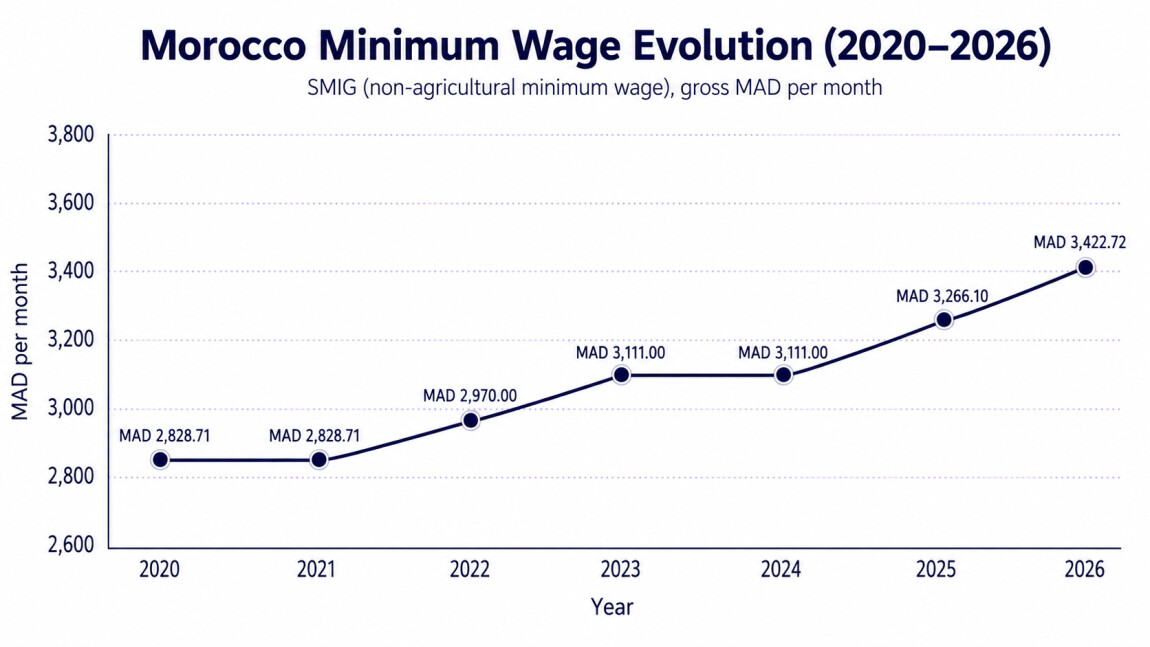
Monthly Gross (191 hours): 3,422.72 MAD.
-
Cumulative Growth: Since 2021, the SMIG has seen a total increase of approximately 20%, representing an additional 594 MAD in the gross monthly paycheck of a full-time worker.
2. SMAG: Agricultural Minimum Wage 2026
The SMAG (Salaire Minimum Agricole Garanti) is the minimum wage specifically for the agricultural and forestry sectors. Historically lower than the SMIG, the government is gradually closing the gap between the two.
-
Effective Date: April 1, 2026.
-
Daily Rate: 97.44 MAD.
-
Monthly Estimate (26 days): 2,533.44 MAD.
-
Context: While the SMIG is calculated hourly, the SMAG remains a daily-rate system, though conversion to monthly totals is standard for formal contracts.
3. The 2024 Tripartite Agreement Context
The 2026 increases are the result of Decree No. 2-25-983, which finalized the promises made during the April 2024 negotiations between the government, major trade unions (UMT, CDT, UGTM), and the employers' federation (CGEM).
-
Phase 1 (2025): A 5% increase was applied in January (SMIG) and April (SMAG).
-
Phase 2 (2026): The final ≈5% increase, bringing the total hike for this cycle to 10%.
4. Public Sector vs. Private Sector
It is important to note the disparity between the private sector minimums and the Public Service Minimum Wage. In July 2025, the government completed a massive increase for civil servants, raising the minimum net monthly salary in the public sector to 4,500 MAD. This creates a significant gap between the urban private sector floor (~3,192 MAD net) and government employment.
5. Take-Home Pay (Net Salary)
For a worker earning the SMIG in 2026, the "gross to net" calculation is relatively straightforward. At 3,422.72 MAD gross:
-
CNSS (Social Security): ~153.33 MAD.
-
AMO (Mandatory Health Insurance): ~77.35 MAD.
-
Income Tax (IR): 0 MAD (Minimum wage earners in Morocco are generally exempt from income tax as they fall below the taxable threshold).
-
Estimated Net Pay: ~3,192.04 MAD.
Conclusions
Morocco’s 2026 wage landscape reflects a state in the midst of "social state" reforms. The move to 17.92 MAD per hour is a significant victory for labor unions, though inflation in food and energy prices continues to challenge the real purchasing power of this new floor. For international businesses operating in Morocco, especially in the automotive and aerospace hubs of Tangier and Casablanca, 2026 marks the new baseline for labor cost projections. Ready to take the next step? Create your CV, browse job opportunities, or get ready for your job interview.
FAQ – Frequently Asked Questions
What is the SMIG in Morocco for 2026? The SMIG is 17.92 MAD per hour, effective January 1, 2026. This totals 3,422.72 MAD gross per month for 191 hours.
What is the difference between SMIG and SMAG? SMIG applies to industrial and commercial sectors (hourly), while SMAG applies specifically to agriculture (daily).
Does the Moroccan minimum wage increase automatically? No. Increases are usually the result of "Social Dialogue" agreements and must be codified by a government decree.
What is the minimum wage for domestic workers? Under Law No. 19-12, domestic workers must earn at least 60% of the SMIG, which is approximately 10.75 MAD per hour in 2026.
Share
What I read is worth it:
Article written by:
 wherewework.com

Comments
0 comments
No comments! Be the first to comment on this article!

Access your account and add your comment

Subscribe to the Newsletter
Read articles of interest from wherewework.com contributors
