Share
Netherlands public holidays 2027: what your CAO actually decides
10/30/2026
10 min

The 2027 public holiday calendar in the Netherlands carries eleven official dates, but four of them land on a weekend and two more depend entirely on what your collectieve arbeidsovereenkomst (CAO, the sectoral collective agreement that governs most Dutch employment) actually says. For anyone who has recently arrived here, or who has never had reason to read their CAO closely, 2027 is a good year to start: both Christmas days fall on a Saturday and Sunday, which means no automatic extra weekday off, and whether Wednesday 5 May is yours to take depends on a five-year cycle that does not tick over again until 2030.
According to the official 2027 list published by Rijksoverheid (the Dutch central government portal), there are 11 public holidays. Of these, four fall on a weekend: Easter Sunday, Whit Sunday, and both Christmas days. Seven land on weekdays, but that figure is misleading on its own, because Good Friday and Liberation Day carry a conditional status that sets them apart from the others. Compared with 2026, the year-end picture is leaner: Christmas Day fell on a Friday in 2026, while in 2027 both Christmas days sit on a Saturday and Sunday. King's Day shifts from a Monday to a Tuesday, and Liberation Day from a Tuesday to a Wednesday.
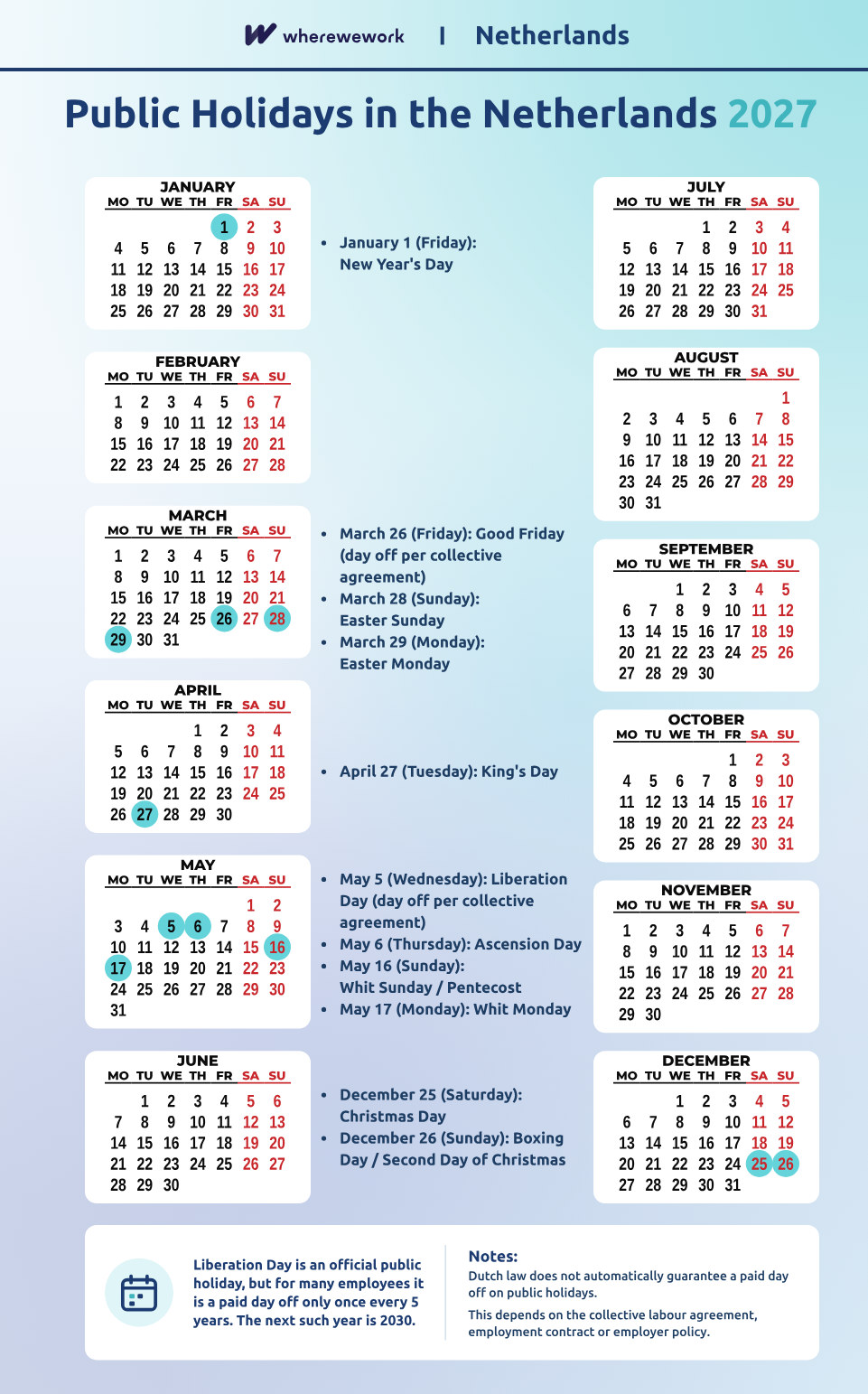
The official Dutch public holidays in 2027
The full list below comes from Rijksoverheid and the government's English-language FAQ at government.nl. Seven holidays fall on weekdays and four on a weekend.
- 1 January 2027 (Friday): New Year's Day
- 26 March 2027 (Friday): Good Friday - a day off only if your CAO or contract says so
- 28 March 2027 (Sunday): Easter Sunday
- 29 March 2027 (Monday): Easter Monday
- 27 April 2027 (Tuesday): King's Day
- 5 May 2027 (Wednesday): Liberation Day - a day off only if your CAO or contract says so
- 6 May 2027 (Thursday): Ascension Day
- 16 May 2027 (Sunday): Whit Sunday
- 17 May 2027 (Monday): Whit Monday
- 25 December 2027 (Saturday): Christmas Day
- 26 December 2027 (Sunday): Boxing Day (Second Day of Christmas)
The Algemene termijnenwet (General Time Limits Act, 25 July 1964) defines these as officially recognised public holidays, but that law only moves statutory legal deadlines that fall on a weekend or holiday to the next working day. Article 1(1) of the Algemene termijnenwet is a deadlines provision, not an entitlement to time off.
No Dutch law gives you a paid day off on a public holiday
This is the detail that catches many people out, particularly those who have moved from countries where public holidays carry a statutory entitlement to rest. In the Netherlands, the position is unambiguous. The Government of the Netherlands states it plainly on its official FAQ:
"There is no law that says employees must be given a day off work on certain public holidays. So no one has a legal right to a day off on a public holiday."
Rijksoverheid repeats the same point in Dutch: there is no law fixing certain holidays as days off for employees, and whether you are free on a holiday depends on what your CAO or employment contract says. In April 2025, Minister of Social Affairs and Employment Y.J. van Hijum confirmed to the Tweede Kamer that a single statutory rule could not deliver the tailored arrangements different sectors need (Kamerstuk 36 600 XV, nr. 110).
In practice, most CAOs do grant holidays. The SZW study Cao-afspraken 2025 (19 May 2025) examined 145 CAOs with holiday arrangements: 92 of them, covering around 3 million workers, grant seven paid holidays, while 45 CAOs covering 2.2 million workers grant eight. The hospitality (Horeca) CAO sits at the lower end, granting just three. When a holiday falls on a day you would not normally work, such as a Saturday in a standard five-day week, Randstad's employer guide notes there is usually no automatic replacement day or additional pay unless your CAO or contract has explicitly arranged one. For a standard Monday-to-Friday worker, Christmas 2027 therefore brings no extra weekday off.
Two dates to check in your CAO: Good Friday and 5 May
Good Friday, 26 March
Good Friday is on the official Rijksoverheid list, but the government's own FAQ is clear: employees working at companies, and civil servants working for the government, will in most cases simply have to work on that day. Schools are almost always closed on Good Friday, so working parents should plan childcare well in advance. Under Article 3(2) of the Algemene termijnenwet, Good Friday is equated with recognised holidays only for the purpose of computing statutory deadlines, not for employment purposes. Any Easter long-weekend plan that starts on Good Friday is only realistic where your CAO or individual contract explicitly grants it as a paid day off.
Liberation Day, Wednesday 5 May
Bevrijdingsdag was designated a national holiday by decree of 24 September 1990, but that designation does not translate into a guaranteed day off. The SZW study Cao-afspraken 2026, published on 18 May 2026 and covering the largest CAOs, found that 81% of CAO workers have a CAO arrangement on paid leave on 5 May. Within that group, more than 2.6 million workers (48%) are off every year, while another 1.8 million (34%) are off only in lustrum years, once every five years.
Lustrum years end in 0 or 5. 2025 was one, but 2027 is not, and the next does not arrive until 2030. If your CAO grants 5 May only in lustrum years, Wednesday 5 May 2027 is a normal working day for you. The Nationaal Comité 4 en 5 mei has long advocated for an annual national day off for everyone on 5 May, and several recent CAO negotiations have moved in that direction. According to the SZW Cao-afspraken 2026 report, four of seven recent principle agreements that address the day, including those covering insurance, housing services, childcare and production and supply companies, now make 5 May an annual holiday. A parliamentary motion adopted in December 2024 asked the government to map options for making 5 May a universal statutory holiday; Minister Van Hijum responded on 25 April 2025 that he would ask social partners to keep promoting the issue through CAO negotiations, but he did not propose legislation. The day therefore remains a matter for your CAO in 2027.
Working on a Dutch public holiday: premiums and rights
Because no law guarantees the day off, no law guarantees a pay premium either. CNV (Christelijk Nationaal Vakverbond, one of the two main Dutch union federations) is direct on this: a premium on top of your normal wage is not a statutory right, and you only receive one if your CAO requires it. CNV points to the cleaning (Schoonmaak), NS (railways) and private security (Particuliere Beveiliging) CAOs as examples that do include a feestdagentoeslag.
Where premiums exist, Randstad's employer guide puts the typical range at 50 to 100 percent above normal pay; a 100% premium means double pay for that shift. Some CAOs use a time-for-time arrangement instead, giving you an equivalent amount of leave to take later. AWVN (Algemene Werkgeversvereniging Nederland, the main employers' association) explains that the exact form of compensation is set by whichever CAO or employment-conditions scheme applies at your workplace.
If no CAO applies and your employer does not give you the holiday off, AWVN confirms there is no statutory obligation to compensate you in any form. Sunday holidays follow the same logic: no statutory rules exist for extra Sunday pay. Under the Arbeidstijdenwet (Working Hours Act) you are entitled to at least 13 free Sundays per year unless you have agreed to fewer, but the Act does not set a pay premium for Sunday work.
If you expect to work on several holidays in 2027, it is worth calculating what a premium actually adds to your net income starting from your gross salary, and checking how your pay compares with others doing the same role. Sectors that operate through most holidays, such as retail, hospitals, restaurants and public transport, often have specific arrangements worth reading before your next salary conversation.
Public sector, school holidays and part-time workers
Public sector staff
National government employees covered by CAO Rijk receive paid leave on every official holiday except Good Friday, including 5 May every year, as set out in Article 4.2 of CAO Rijk. Municipal employees have had 5 May as an annual paid holiday since 1 January 2024, after the principle agreement for the Branche Cao Gemeenten added it to Article 6.6 of that CAO. Education is the one sector in which all workers under the CAOs studied by SZW are off on 5 May every year. At the other end of the spectrum, the transport, storage and hospitality sectors have no CAO arrangements giving workers 5 May off annually.
School holidays and Friday 7 May
King's Day on Tuesday 27 April falls inside the school May holiday, which runs from 24 April to 2 May 2027 across all regions, according to Rijksoverheid's school holiday overview for 2026-2027. A decree of 1 July 2025, issued under Article 3(3) of the Algemene termijnenwet, treats Friday 7 May 2027, the day after Ascension Day, as a public holiday for the purpose of statutory deadlines only. It is not a day off by law. Some employers, government bodies among them, do designate it as a compulsory day off, which may require staff to use a vacation day or ADV hours. If your workplace closes on that Friday, check your leave calendar before booking travel.
Part-timers with a Monday off
Easter Monday (29 March) and Whit Monday (17 May) both fall on a Monday in 2027. If Monday is your regular day off, you receive no benefit from those holidays compared with colleagues who work that day. The College voor de Rechten van de Mens (Netherlands Institute for Human Rights) addressed this in opinion 2022-106 (15 September 2022), concluding that an employer should ensure full-time and part-time staff receive a proportionally equal number of hours off, suggesting an annual-hours system as one way to achieve this. The opinion is not legally binding, and Accountancy Vanmorgen noted in April 2025 that courts have not yet settled whether an employer is obliged to compensate a part-timer for an official holiday falling on their regular day off. Still, opinion 2022-106 is solid ground for raising the point with your employer, particularly given that Burgerlijk Wetboek art. 7:648(1) prohibits unjustified distinctions based on working hours.
Five long-weekend plans for 2027
The plans below treat Good Friday and Liberation Day as normal working days, which is the realistic position for the majority of workers in 2027. Adjust the Easter plan if your CAO grants Good Friday, and adjust the May plan if your CAO gives you 5 May every year.
- New Year's Day (Friday 1 January). A free three-day weekend from Friday 1 to Sunday 3 January, using 0 leave days. To extend it, take 4 leave days (Monday 28, Tuesday 29, Wednesday 30 and Thursday 31 December 2026) for 10 days off from Friday 25 December 2026 to Sunday 3 January 2027. Those leave days fall in December 2026, so book them promptly.
- Easter Monday (29 March). A free three-day weekend from Saturday 27 to Monday 29 March, using 0 leave days. Take 4 leave days (Tuesday 30 March, Wednesday 31 March, Thursday 1 April and Friday 2 April) for 9 days off from Saturday 27 March to Sunday 4 April. If your CAO grants Good Friday, your Easter break begins a day earlier.
- King's Day (Tuesday 27 April). Take 1 leave day (Monday 26 April) for 4 days off from Saturday 24 to Tuesday 27 April. Alternatively, take 4 leave days (Monday 26, Wednesday 28, Thursday 29 and Friday 30 April) for 9 days off from Saturday 24 April to Sunday 2 May, which aligns neatly with the school May holiday.
- Ascension Day (Thursday 6 May). Take 1 leave day (Friday 7 May) for 4 days off from Thursday 6 to Sunday 9 May. Or take 4 leave days (Monday 3, Tuesday 4, Wednesday 5 and Friday 7 May) for 9 days off from Saturday 1 to Sunday 9 May. If your CAO gives you 5 May off, you only need 3 leave days: Monday 3, Tuesday 4 and Friday 7 May.
- Whit Monday (17 May). A free three-day weekend from Saturday 15 to Monday 17 May, using 0 leave days. Take 4 leave days (Tuesday 18, Wednesday 19, Thursday 20 and Friday 21 May) for 9 days off from Saturday 15 to Sunday 23 May.
Christmas 2027 has no bridge-day plan of its own. With both days on a weekend, any break around 25 and 26 December comes entirely out of your leave allowance. The statutory minimum under Burgerlijk Wetboek art. 7:634 is at least four times your agreed weekly working hours per year: for a 40-hour week that is 20 statutory vacation days annually. Whether your CAO adds more on top of that minimum is, again, something to read before year-end.
Read your CAO once before booking anything
The quieter weeks around these holidays are a practical moment to update your CV and take stock of open roles. If you have a job interview lined up for 2027, asking how the employer handles work on public holidays and bridge days is a legitimate question; in the Netherlands the answer sits in the CAO or the employment contract, not in statute. The AWVN framework, the CNV guides and the CAO Rijk provisions all illustrate that arrangements vary considerably by sector, and reading your own CAO once takes far less time than untangling a misunderstood leave balance later. Even a lean calendar can produce several solid breaks, provided the planning is done before the popular dates fill up.
Share
What I read is worth it:
Read all the articles about
About the crafts Balance Career planning Economic HR Metrics HR Coach Guide Labour market Legislative Workforce planning Students NegotiationArticle written by:
 wherewework.com

Comments
0 comments
No comments! Be the first to comment on this article!

Access your account and add your comment

Subscribe to the Newsletter
Read articles of interest from wherewework.com contributors
