Share
Public Holidays in Portugal 2027: Official Dates and Long Weekends
10/30/2026
11 min

Late autumn is when next year's diary starts filling up, and for workers in Portugal one date carries real weight before any leave request goes in: 15 December 2026, the last day your employer can lawfully tell you that one or more of 2027's bridge days has already been reserved as a company closure. Miss that window, and the bridge day stays yours to plan. The Código do Trabalho (CT, Lei n.º 7/2009 of 12 February, as amended) is the framework that governs all of this, and understanding its provisions is the practical starting point for getting the most out of 2027's calendar.
The headline figure first. Portugal's 13 mandatory feriados obrigatórios are unchanged for 2027 under CT artigo 234.º, restored to their current list by Lei n.º 8/2016 (published in the Diário da República on 1 April 2016, in force from 2 April 2016). Five of those 13 fall on a Saturday or Sunday in 2027: Easter Sunday (28 March), Freedom Day (25 April), Workers' Day (1 May), Assumption Day (15 August) and Christmas Day (25 December). The Código do Trabalho provides no general automatic replacement day when a holiday coincides with a worker's rest day, leaving 8 public holidays on weekdays in 2027, compared with 9 in 2026. A slightly leaner year by the numbers.
The real opportunity sits in three midweek holidays: Corpus Christi (Thursday 27 May), the Day of Portugal, Camões and the Portuguese Communities (Thursday 10 June) and Republic Day (Tuesday 5 October). Each of these can be extended into a four-day break with just one day of annual leave, and those same bridge days are precisely the kind your employer may designate as a compulsory closure under CT artigo 242.º, counting the day against your leave entitlement.
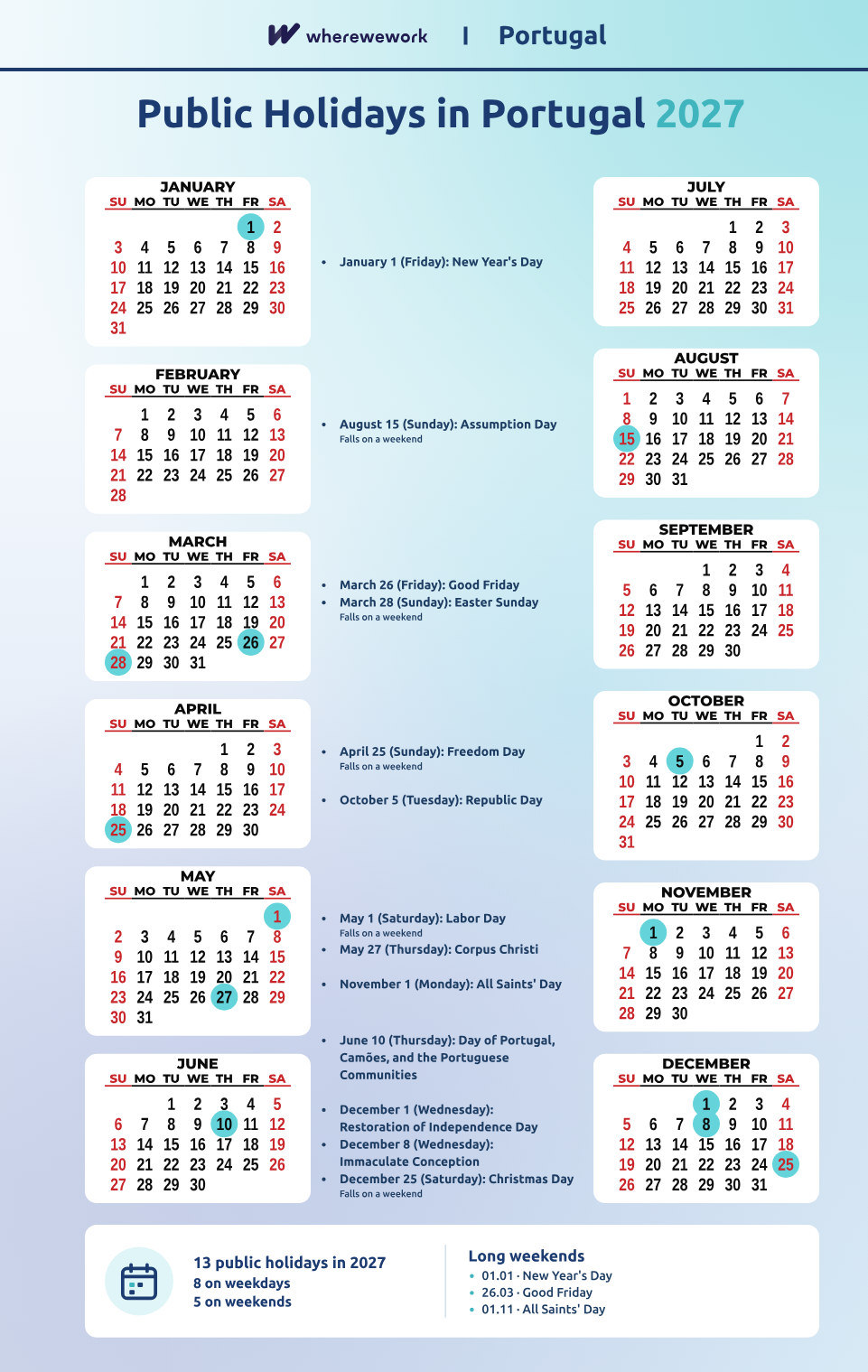
Every public holiday in Portugal in 2027
Artigo 234.º, n.º 1 of the Código do Trabalho (Lei n.º 7/2009), in the version established by Lei n.º 8/2016 which restored four holidays with effect from 2 April 2016, fixes these dates nationwide:
- 1 January (Friday): New Year's Day (Ano Novo)
- 26 March (Friday): Good Friday (Sexta-Feira Santa)
- 28 March (Sunday): Easter Sunday (Domingo de Páscoa)
- 25 April (Sunday): Freedom Day (Dia da Liberdade)
- 1 May (Saturday): Workers' Day (Dia do Trabalhador)
- 27 May (Thursday): Corpus Christi (Corpo de Deus)
- 10 June (Thursday): Day of Portugal, Camões and the Portuguese Communities
- 15 August (Sunday): Assumption Day (Assunção de Nossa Senhora)
- 5 October (Tuesday): Republic Day (Implantação da República)
- 1 November (Monday): All Saints' Day (Todos os Santos)
- 1 December (Wednesday): Restoration of Independence (Restauração da Independência)
- 8 December (Wednesday): Immaculate Conception (Imaculada Conceição)
- 25 December (Saturday): Christmas Day (Natal)
For those working Monday to Friday, a public holiday that falls on a Saturday or Sunday is not recovered on another day unless an employment contract, a collective agreement (instrumento de regulamentação coletiva de trabalho) or a specific legal regime says otherwise. Moving a holiday to the following Monday requires specific legislation under CT artigo 234.º, n.º 3, and no such measure has been announced for 2027. Contracts and collective agreements cannot create holidays beyond those listed in artigos 234.º and 235.º (CT artigo 236.º).
Carnival (Tuesday 9 February 2027) and your municipal holiday are optional under CT artigo 235.º: they apply only where a collective agreement or your employment contract provides for them. Because Carnival 2027 is not a mandatory national holiday, it is worth checking your collective agreement or asking your employer directly.
Madeira, the Azores and your municipality
- Madeira: Three additional regional holidays apply. Autonomy Day on 2 April (a Friday in 2027, one week after Good Friday) was instituted by Regional Legislative Decree n.º 17/2024/M, published on 16 December 2024. Region Day falls on 1 July (a Thursday in 2027, opening the possibility of a bridge on Friday 2 July). The day after Christmas, 26 December, is also a regional holiday in Madeira under Regional Legislative Decree n.º 18/2002/M (falling on a Sunday in 2027).
- Azores: The Day of the Autonomous Region of the Açores, instituted in 1980 and celebrated on the Monday of the Holy Spirit (segunda-feira do Espírito Santo), falls on Monday 17 May 2027, with Pentecost on Sunday 16 May 2027.
- Municipalities: Almost every mainland municipality has its own feriado municipal. The best-known June dates: Saint Anthony (13 June, Lisbon and others) falls on a Sunday in 2027, with no bridge opportunity; Saint John (24 June, Porto, Braga and others) falls on a Thursday, allowing a bridge on Friday 25 June; and Saint Peter (29 June, Sintra, Évora and others) falls on a Tuesday, allowing a bridge on Monday 28 June. Check the rules for your own município, as the list varies.
Working on a public holiday: pay, rest and fines
Under CT artigo 269.º, n.º 1 (as last amended by Lei n.º 13/2023, published in the Diário da República on 3 April 2023, in force from 1 May 2023), you are entitled to your normal pay for a public holiday and your employer may not offset it by requiring you to work overtime. If you do work your normal rostered hours on a holiday in a business not required to close, CT artigo 269.º, n.º 2 gives you one of two things: compensatory rest equal to half the hours you worked, or a 50% supplement on the pay for those hours. Crucially, the choice between rest and the supplement belongs to the employer, not the employee.
Holiday overtime (work outside your normal schedule on a public holiday) is paid at a different scale under CT artigo 268.º: a 50% supplement per hour for the first 100 hours of overtime in a year, rising to 100% per hour beyond that threshold.
Breaching artigo 269.º is classified as a serious (grave) administrative offence. The unit of account (UC) that determines the size of labour fines has been frozen at EUR 102.00 for 2026 under artigo 242.º of the 2026 State Budget law (Lei n.º 73-A/2025, of 31 December), as confirmed by DGERT, the Direção-Geral do Emprego e das Relações de Trabalho. At that rate, a single serious offence under CT artigo 554.º, n.º 3 carries a fine of between EUR 612 (6 x EUR 102, minimum for negligence in the smallest businesses) and EUR 9,690 (95 x EUR 102, maximum for intentional breach by the largest companies), depending on company turnover and whether the conduct was negligent or deliberate. Where several workers are affected, CT artigo 558.º counts one offence per worker, with the combined fine capped at double the applicable maximum. The UC value for offences committed in 2027 will depend on the 2027 State Budget, not yet enacted as of 29 October 2026.
Enforcement rests with ACT, the Autoridade para as Condições do Trabalho (the national labour inspectorate). Workers in sectors that typically remain open on holidays, such as retail, healthcare, hospitality and transport, may find salary benchmarks particularly useful before agreeing to a holiday shift. Seeing how your gross pay compares with what others in the same role earn across Portugal gives you a clearer picture of what a 50% supplement is actually worth in your specific situation.
A note on the European context: a 2019 academic paper from Universidade Católica Portuguesa's Porto law faculty reported that the European Committee of Social Rights found Portugal not in conformity with article 2, paragraph 2 of the Revised European Social Charter in its 2014 conclusions, on the grounds that a 50% pay supplement alone may not constitute adequate compensation for working on a national holiday. That finding has not produced a legislative change so far, but it is a factor that some collective negotiations have referenced.
Leave rules and other days that shape 2027
Parliament rejected the Government's labour-law package on 19 June 2026, with only PSD, CDS-PP and Iniciativa Liberal voting in favour, while Chega, PS, Livre, PCP, Bloco de Esquerda, PAN and JPP voted against. The rules that follow are therefore the Código do Trabalho as it currently stands, with no pending reform in force.
- At least 22 working days of annual leave. For this purpose, working days run Monday to Friday, excluding public holidays: a feriado obrigatório that falls inside your leave period does not consume a leave day (CT artigo 238.º).
- Splitting requires agreement. Annual leave may be divided into several periods only if you and your employer agree, and at least one block of 10 consecutive working days must be taken in one go. The employer must draw up and post the leave map (mapa de férias) by 15 April (CT artigo 241.º).
- Employer-decreed bridge closures. Under CT artigo 242.º, n.º 2, an employer may close the business wholly or partly for workers' leave on five consecutive working days during the school Christmas holidays, and on a bridge day that sits between a Tuesday or Thursday holiday and the weekly rest day, provided staff are notified by 15 December of the preceding year (CT artigo 242.º, n.º 3). For 2027, the three days that meet this description are Friday 28 May (between Corpus Christi on Thursday 27 May and the weekend), Friday 11 June (between the Day of Portugal on Thursday 10 June and the weekend) and Monday 4 October (between Republic Day on Tuesday 5 October and the preceding weekend). Work done to compensate for an employer-imposed bridge closure under artigo 242.º, n.º 2(b) does not count as overtime (CT artigo 226.º, n.º 3(g)).
Public sector. Staff covered by Lei 35/2014 (Lei Geral do Trabalho em Funções Públicas) operate under a separate framework. Prime Minister Luís Montenegro granted a tolerância de ponto to central state administration staff for Carnival, 17 February 2026, and for the afternoon of Holy Thursday, 2 April 2026. A Bola has reported that granting Carnival off has been recurring practice for ten years, with 2021 the only exception due to pandemic lockdown. Whether similar orders will be issued for Carnival 2027 (9 February) or other occasions in 2027 has not been announced as of 29 October 2026: public-sector employees should wait for the relevant despacho.
Parents. Despacho n.º 8368/2024 of the Minister of Education sets the school breaks for the 2026-2027 academic year in public pre-school, primary and secondary schools: Christmas holidays from 16 to 31 December 2026, Carnival break from 8 to 10 February 2027 and Easter break from 22 March to 2 April 2027. The school Easter break aligns closely with the Good Friday and Easter Sunday holidays, making the fortnight around 22 March to 2 April a natural candidate for family leave planning.
Family events. The Código do Trabalho provides for several justified absences: 15 consecutive days on the occasion of your marriage (CT artigo 249.º, n.º 2(a)); up to 20 consecutive days on the death of a spouse or child; up to five consecutive days for a parent or first-degree in-law; and up to two consecutive days for other direct-line relatives (CT artigo 251.º, n.º 1). Initial parental leave runs for 120 or 150 consecutive days, and fathers are required to take 28 days of exclusive parental leave within the 42 days following the birth, seven of them consecutively immediately after it (CT artigos 40.º and 43.º).
Workers of other faiths. Artigo 14.º of the Lei da Liberdade Religiosa (Lei n.º 16/2001) allows employees, at their own request, to stop work on their faith's weekly rest day, its festival days and prescribed hours, subject to working flexible hours, belonging to a registered religious community that notified the competent government minister the previous year, and fully making up the time.
Bridge plans for 2027: turning leave days into longer breaks
- New Year (Friday 1 January). A free three-day weekend with no leave needed. Taking Monday 28 to Thursday 31 December 2026 produces 10 consecutive days off (25 December to 3 January) for 4 leave days.
- Easter (Good Friday, 26 March). A free three-day break, 26 to 28 March. Taking Monday 22 to Thursday 25 March adds up to 9 days off (20 to 28 March) for 4 leave days, in step with the school Easter break.
- Corpus Christi (Thursday 27 May). Take Friday 28 May for 4 days off (27 to 30 May) at the cost of 1 leave day. Add Monday 24 to Wednesday 26 May for a 9-day run (22 to 30 May) using 4 leave days. One caution: if your employer announces a closure on 28 May by 15 December 2026 under CT artigo 242.º, that day is already earmarked.
- Day of Portugal (Thursday 10 June). Take Friday 11 June for 4 days off (10 to 13 June) with 1 leave day. Extend backwards to Monday 7 to Wednesday 9 June for a 9-day run (5 to 13 June) using 4 leave days. Same caution applies if your employer designates 11 June as a bridge closure.
- Republic Day (Tuesday 5 October). Take Monday 4 October for 4 days off (2 to 5 October) with 1 leave day. Add Wednesday 6 to Friday 8 October for 9 days off (2 to 10 October) using 4 leave days. A closure on 4 October may be decreed by your employer under artigo 242.º if staff are told by 15 December 2026.
- All Saints' Day (Monday 1 November). A free three-day weekend, 30 October to 1 November, with no leave needed. Taking Tuesday 2 to Friday 5 November extends this to 9 consecutive days off (30 October to 7 November) for 4 leave days.
- Restoration of Independence (Wednesday 1 December). Take Thursday 2 and Friday 3 December for 5 days off (1 to 5 December) at the cost of 2 leave days. Adding Monday 29 and Tuesday 30 November stretches this to 9 days off (27 November to 5 December) for 4 leave days.
- Immaculate Conception (Wednesday 8 December). Take Thursday 9 and Friday 10 December for 5 days off (8 to 12 December) using 2 leave days. Adding Monday 6 and Tuesday 7 December gives 9 days off (4 to 12 December) for 4 leave days. This sequence overlaps naturally with the employer's power to close for five days during the school Christmas holidays under CT artigo 242.º, n.º 2(a).
For plans 3, 4 and 5 above, the key check is whether your employer will notify a bridge closure by 15 December 2026. If it does, that leave day is no longer yours to assign. The minimum 10-consecutive-working-day block requirement under CT artigo 241.º, n.º 8 also shapes how many separate bridges one worker can realistically plan, since shorter scattered breaks do not satisfy that threshold on their own.
Plan ahead, rest better
The most useful step right now is to check your collective agreement (contrato coletivo de trabalho or acordo coletivo) for any provisions on Carnival, your municipal holiday and holiday-work pay that go beyond the Código do Trabalho minimums. Sector agreements negotiated through bodies such as CGTP-IN (Confederação Geral dos Trabalhadores Portugueses - Intersindical Nacional) or UGT (União Geral de Trabalhadores) sometimes set more generous holiday-work supplements or additional days off than the statutory floor. Confirm whether your employer plans to exercise its artigo 242.º rights before 15 December 2026, so that 28 May, 11 June or 4 October do not come as a surprise. And if you are covered by Lei 35/2014 as a public-sector worker, watch for any tolerância de ponto despacho that Prime Minister Montenegro's government may issue for Carnival or the end-of-year period in 2027.
The quieter weeks around the midweek holidays are also a sensible moment to review where your salary sits relative to others in your role, and to update your profile for any opportunities you have been considering.
Share
What I read is worth it:
Read all the articles about
About the crafts Balance Career planning Economic Entrepreneurs Employee experience Guide HR Coach HR Metrics Labour market Human behavior Workforce planning Students Motivation and vocation LegislativeArticle written by:
 wherewework.com

Comments
0 comments
No comments! Be the first to comment on this article!

Access your account and add your comment
Subscribe to the Newsletter
Read articles of interest from wherewework.com contributors
