Share
Public Holidays in Serbia 2027: Official Dates and Long Weekends
10/30/2026
9 min

Serbia's 2027 public holiday calendar offers something worth planning around: 8 holidays fall on working days and 3 land on a weekend, one weekday holiday fewer than in 2026, when 9 fell on working days. The standout is the May cluster, where Orthodox Easter and Labour Day collide to produce a free five-day break with no annual leave required at all.
The Saturday rule explains the difference from last year. Under the Zakon o državnim i drugim praznicima u Republici Srbiji (Law on State and Other Holidays, Sl. glasnik RS nos. 43/2001, 101/2007 and 92/2011), only a state-holiday date falling on a Sunday triggers a carry-over to the first following working day. A Saturday brings nothing. In 2027, the second day of New Year (Saturday 2 January) and the first day of Labour Day (Saturday 1 May) are simply lost. Religious holidays, including Orthodox Christmas on 7 January, never shift regardless of the day they fall on.
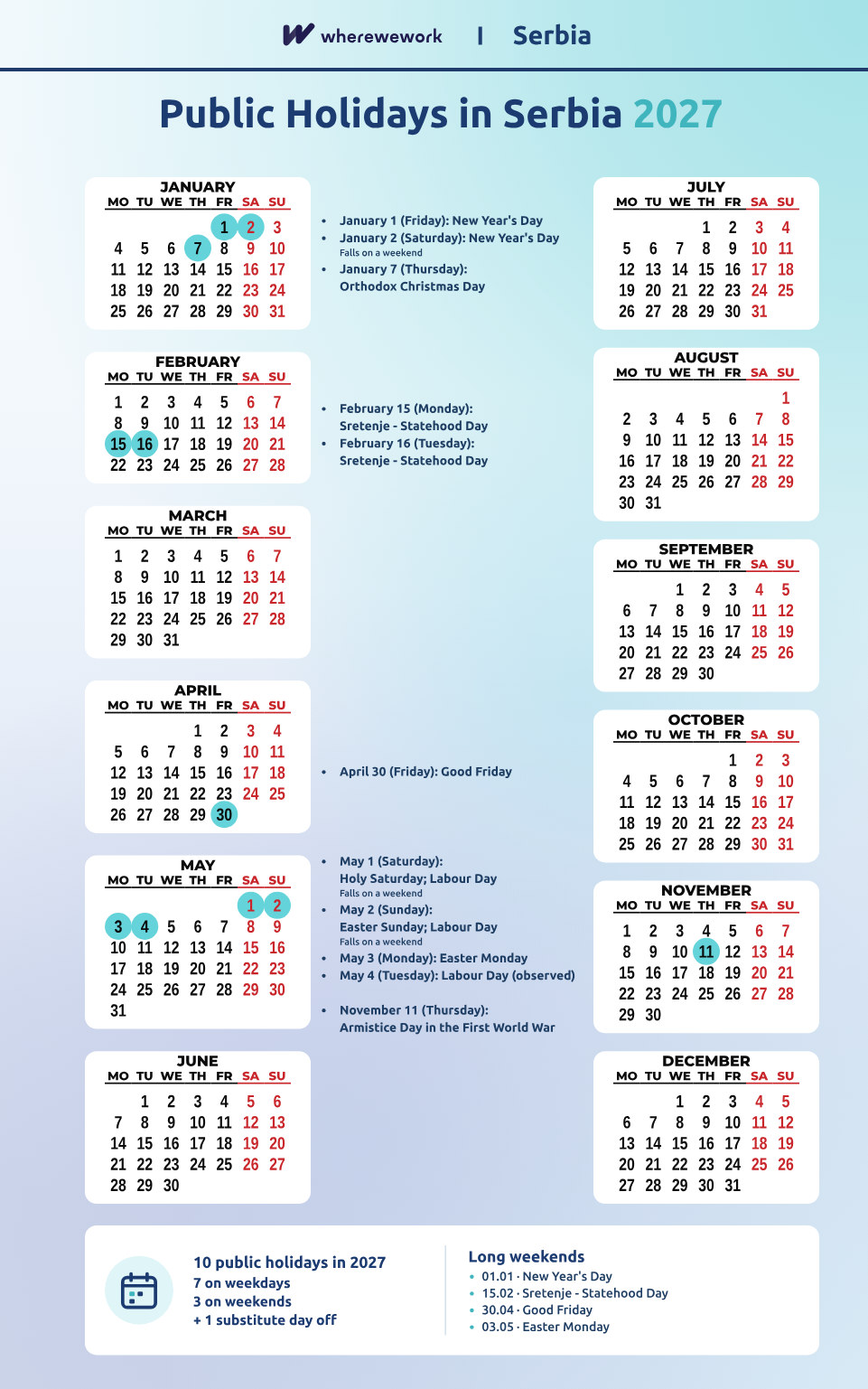
The full list of 2027 public holidays in Serbia
The dates below follow the holidays law (Sl. glasnik RS nos. 43/2001, 101/2007 and 92/2011) and Paragraf's verified 2027 calendar of non-working days. Per Ministry of Labour opinion no. 011-00-1211/2015-02 of 21 January 2016, the Article 2 religious holidays - Orthodox Christmas and the Easter block from Good Friday through the second day of Easter - are non-working days for all employees, regardless of faith.
- 1 January (Friday): New Year, first day
- 2 January (Saturday): New Year, second day - weekend date, no substitute working day
- 7 January (Thursday): Orthodox Christmas (first day of Christmas, Božić)
- 15 February (Monday): Sretenje - Dan državnosti Srbije (Statehood Day)
- 16 February (Tuesday): Sretenje - Dan državnosti Srbije, second day
- 30 April (Friday): Orthodox Good Friday (Veliki petak)
- 1 May (Saturday): Labour Day, first day - weekend date, no substitute working day
- 2 May (Sunday): Orthodox Easter Sunday (Vaskrs) and Labour Day, second day
- 3 May (Monday): Orthodox Easter Monday (Vaskršnji ponedeljak)
- 4 May (Tuesday): Labour Day carry-over day for Sunday 2 May
- 11 November (Thursday): Dan primirja u Prvom svetskom ratu (Armistice Day in the First World War)
That gives 8 days off on working days, including the Tuesday 4 May carry-over, plus 3 holiday dates on the weekend. The National Bank of Serbia's official 2026 holiday list records 9 working-day holidays for 2026, so 2027 is marginally less generous for anyone counting potential long weekends.
Why Tuesday and not Monday for the carry-over? Monday 3 May is already Easter Monday, a non-working day under the Vaskršnji praznici block. The carry-over under Article 3a of the holidays law jumps past it to the first genuine working day, which is Tuesday 4 May. The Ministry of Labour applied exactly this reading in its opinion for 2021, when the calendar had the same layout, and Paragraf's 2027 table lists Tuesday 4 May accordingly. The Ministry's own notice for 2027 had not been published at the time of writing.
Days off for specific faiths, and holidays observed while working
Article 4 of the holidays law entitles employees to stay off work on the religious holidays of their own faith. In 2027 those dates are:
- 9 March (Tuesday): first day of Ramazan Bayram, for members of the Islamic community
- 26 to 29 March (Friday to Monday): Catholic and other Western-calendar Christian Easter holidays
- 16 May (Sunday): first day of Kurban Bayram, for members of the Islamic community
- 11 October (Monday): first day of Yom Kippur, for members of the Jewish community
- 25 December (Saturday): Catholic Christmas, first day
- Your krsna slava (date set by your family): first day of the family patron-saint day, for Orthodox Christians
The Bayram dates align with the Education Ministry's regulation on the 2026/2027 school calendar (Sl. glasnik RS - Prosvetni glasnik no. 3/2026). Per Ministry of Labour opinion no. 011-00-1211/2015-02 of 21 January 2016, Catholic employees are entitled to wage compensation for these days off and to the increased wage if they work on them.
A separate category covers holidays that are marked while everyone works: Saint Sava (Wednesday 27 January), the Day of Remembrance of the Victims of the Holocaust, Genocide and Other Victims of Fascism in WWII (Thursday 22 April), Victory Day (9 May, a Sunday in 2027 and always a working holiday in any year), and Vidovdan (Monday 28 June). Because Victory Day is celebrated as a working day, no carry-over applies even when it falls on a Sunday, and Paragraf's 2027 table confirms none. Religious holidays, as noted, also never shift under Article 3a - that rule covers state holidays only.
Working on a public holiday: what Serbian law pays
Article 3 of the holidays law permits businesses that must run continuously - hospitals, shops, restaurants, transport - to keep operating on state and religious holidays. If you are rostered for a shift, Article 108 of the Zakon o radu (Labour Law, Sl. glasnik RS br. 24/2005 as subsequently amended, most recently by Sl. glasnik RS 109/2025) entitles you to an increased wage of at least 110% of the basic wage for work on a holiday that is a non-working day. Your employer's general act or employment contract can set a higher rate, but 110% is the statutory floor.
In practice, as Biznis.rs explains, that 110% is applied on top of your contracted hourly rate: you receive your regular 100% plus 110% on top of it, which is the colloquial dupla dnevnica (double day's pay) that shift workers talk about. The base for calculating the premium is your basic wage only. Performance pay, bonuses, the meal allowance (topli obrok), the annual-leave bonus (regres) and seniority pay (minuli rad) are all excluded from the calculation.
Premiums also stack. Article 108 of the Labour Law sets at least 26% for night work (where that is not already built into the basic wage) and at least 26% for overtime; when several grounds coincide, the total increase cannot fall below the sum of the individual percentages. Duško Vuković of the Savez samostalnih sindikata Srbije (Confederation of Autonomous Trade Unions of Serbia - SSSS) told N1 that a hospitality worker starting 1 January on a night shift should receive an increase of at least 136% on the basic wage, combining the 110% holiday rate and the 26% night-work rate. Vuković also flagged that workers sometimes cover holiday shifts without receiving the 110% at all.
Knowing the limits matters too:
- If a holiday falls on one of your scheduled working days and you have the day off, Article 114 of the Labour Law entitles you to wage compensation equal to your average wage over the previous 12 months.
- If the holiday falls on your scheduled weekly rest day, a 2014 Ministry of Labour opinion (no. 011-00-172/2014-02, 11 March 2014) confirms you are not entitled to compensation for it, and no substitute day follows.
- A Saturday holiday date brings no substitute weekday, as with 2 January and 1 May in 2027.
- People engaged on service contracts, author contracts, or temporary and occasional work contracts are not employees under Article 5 of the Labour Law, so the premium does not apply to them.
- Your employer must notify you of your schedule - holiday shifts included - at least five days in advance, or at least 48 hours ahead when unforeseen business needs arise, per Article 56 of the Labour Law.
If the premium is not paid, you can raise it directly with the employer or report the matter to the Inspektorat za rad (Labour Inspectorate). With sufficient evidence, the Inspectorate can order the employer to pay the increased wage for those days, as Vuković explained to N1. An employer that is a legal entity and fails to pay wage compensation as required under Articles 114-117 of the Labour Law faces a fine of RSD 600,000 to 1,500,000 under Article 274; an entrepreneur faces RSD 200,000 to 400,000.
Wages in Serbia are stated gross under Article 105 of the Labour Law, so before you accept a holiday shift, calculate what the premium adds to your net pay starting from the gross figure. Checking what others in the same role earn - in retail, healthcare, hospitality or transport, the sectors most likely to keep you working through the May cluster - gives you a grounded basis for any conversation with your employer.
Two extras: the school break and Christmas Eve
Parents with school-age children get a convenient alignment in 2027. The school spring break under the Education Ministry's 2026/2027 calendar regulation (Prosvetni glasnik no. 3/2026) runs Friday 30 April to Tuesday 4 May, exactly matching the Easter and Labour Day non-working block. Your days off and your children's line up without any coordination needed.
Christmas Eve (Badnji dan) is a different matter. In December 2025 the Government of Serbia issued a recommendation that employers make 6 January a non-working day for Orthodox employees. A recommendation carries no legal force. The Unija poslodavaca Srbije (Serbian Association of Employers - UPS) has made clear that employers are under no obligation to follow it. Lawyer Branislav Vještica put it plainly when commenting on the same type of recommendation: under the Constitution, only the National Assembly can pass laws, and government conclusions cannot carry statutory weight. If your employer gives you Wednesday 6 January 2027 off, treat it as a goodwill gesture rather than an entitlement. No recommendation for 2026/2027 had been issued at the time of writing.
Five bridge plans for 2027
Leave days listed below are the working days within each span that are not already public holidays. Under Article 70 of the Labour Law, public holidays that are non-working days by law are not counted as annual leave days, so these plans extend your time off without consuming the holiday dates themselves.
- New Year: Friday 1 January alone gives a free three-day weekend (1-3 January) for 0 leave days. For a longer run, take Monday 28, Tuesday 29, Wednesday 30 and Thursday 31 December 2026: 4 leave days secure 9 consecutive days off, Saturday 26 December to Sunday 3 January.
- Orthodox Christmas: take Friday 8 January for 1 leave day and 4 days off (Thursday 7 to Sunday 10 January). For a 10-day break, add Monday 4, Tuesday 5 and Wednesday 6 January plus Friday 8 January: 4 leave days, Friday 1 to Sunday 10 January.
- Sretenje: Monday 15 and Tuesday 16 February already give a free four-day weekend (Saturday 13 to Tuesday 16 February) for 0 leave days. Adding Wednesday 17, Thursday 18 and Friday 19 February costs 3 leave days and produces 9 days off, Saturday 13 to Sunday 21 February.
- Easter and Labour Day: the free five-day block (Friday 30 April to Tuesday 4 May) costs 0 leave days. Taking Monday 26 to Thursday 29 April as well - 4 leave days - extends it to 11 days off, Saturday 24 April to Tuesday 4 May. Alternatively, taking Wednesday 5, Thursday 6 and Friday 7 May - 3 leave days - gives 10 days off, Friday 30 April to Sunday 9 May.
- Armistice Day: Friday 12 November costs 1 leave day and gives 4 days off (Thursday 11 to Sunday 14 November). For a 9-day run, take Monday 8, Tuesday 9, Wednesday 10 and Friday 12 November: 4 leave days, Saturday 6 to Sunday 14 November.
What the 2027 calendar means for your planning
The practical takeaway is to anchor your 2027 leave plan around the May block first, since it delivers five consecutive days off at zero leave cost - a ratio that does not appear elsewhere in the year. The Sretenje fortnight in mid-February offers a secondary pivot: Monday 15 and Tuesday 16 February are already free, so a modest three days of annual leave yields a nine-day stretch in February at a reasonable cost.
For workers in shift-heavy sectors - healthcare at institutions such as hospital networks across Serbia, hospitality, and retail chains including Delhaize Serbia supermarkets - the May cluster raises a practical question worth asking your employer now: how will shifts over the 30 April to 4 May block be scheduled, and does the rota give you adequate advance notice under Article 56 of the Labour Law? Under Article 69 of the Labour Law every employee is entitled to at least 20 working days of annual leave per calendar year, and under Article 73 the first part of that leave must run for at least two unbroken working weeks within the calendar year. Fitting those obligations around public holidays is easier with early planning on both sides.
The quieter stretches around each holiday cluster are also a useful moment to review your salary position. If you work in a sector that operates through public holidays, checking what comparable roles pay in Serbia before any pay conversation gives you something solid to stand on rather than a general impression.
Share
What I read is worth it:
Read all the articles about
About the crafts Balance Career planning Economic Employee experience Ethics Entrepreneurs HR Metrics HR Coach Guide Human behavior Labour market Legislative Workforce planning NegotiationArticle written by:
 wherewework.com

Comments
0 comments
No comments! Be the first to comment on this article!

Access your account and add your comment

Subscribe to the Newsletter
Read articles of interest from wherewework.com contributors
