Share
Public Holidays in Russia 2027: Official Dates and Long Weekends
10/30/2026
10 min

Russia's 2027 working calendar is settled and ready to plan around. Government Decree No. 1187, signed by Prime Minister Mikhail Mishustin on 17 September 2026, published on 18 September and in force since 26 September 2026, fixes three day-off transfers under Labour Code of the Russian Federation (Federal Law No. 197-FZ, 2001), Article 112. The first consequence lands almost immediately: the New Year break begins on Thursday 31 December 2026, so the planning window is already open.
The headline numbers for 2027: 15 working-day slots fall on non-working days (covering 3 substitute days for holidays that land on a weekend and 3 days moved by the decree), while 5 public holidays fall on a Saturday or Sunday. That is one more weekday off than 2026 produced, but there is an important offset: Saturday 20 February 2027 becomes a working day.
The net result is that the total workload does not change. According to the ConsultantPlus 2027 production calendar, a five-day-week employee works 247 days in 2027, identical to 2026, and the annual norm on a 40-hour week stays at 1,972 hours. What shifts is the distribution of rest across the year, and that is what this guide helps you navigate.
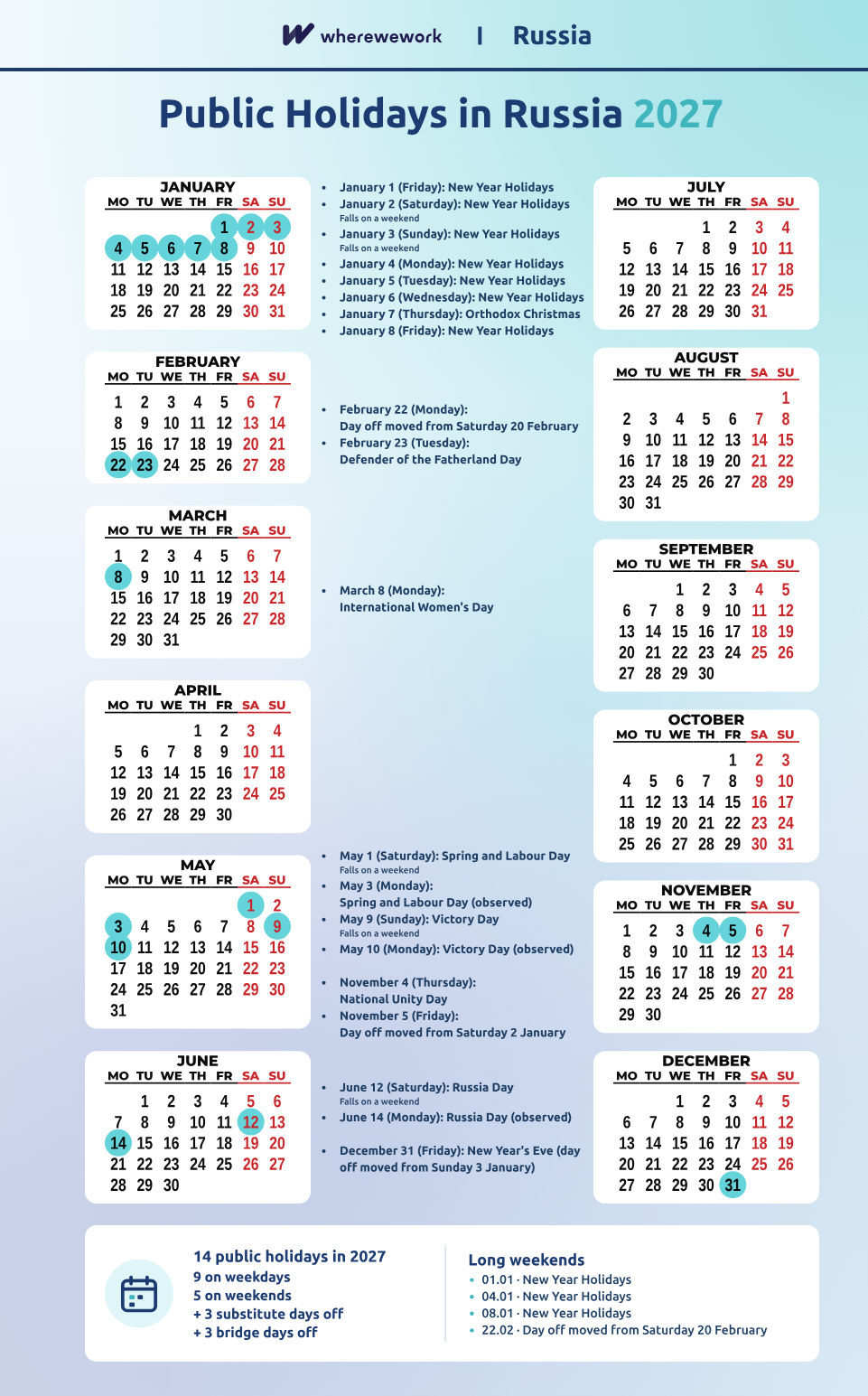
Full list of public holidays and days off in Russia in 2027
Russia's non-working public holidays are set out in Article 112 of the Labour Code (Federal Law No. 197-FZ). On top of that fixed list, Decree No. 1187 applies three specific transfers to make the calendar work more efficiently in 2027. Here is every non-working day confirmed by the Government:
- Friday 1 January: New Year holidays (Novogodniye kanikuly)
- Saturday 2 January: New Year holidays - weekend day; its substituted day off moves to Friday 5 November
- Sunday 3 January: New Year holidays - weekend day; its substituted day off moves to Friday 31 December
- Monday 4 January: New Year holidays
- Tuesday 5 January: New Year holidays
- Wednesday 6 January: New Year holidays
- Thursday 7 January: Orthodox Christmas (Rozhdestvo Khristovo)
- Friday 8 January: New Year holidays
- Saturday 20 February: working day, shortened by one hour (its day off moves to Monday 22 February)
- Monday 22 February: day off moved from Saturday 20 February under Decree No. 1187
- Tuesday 23 February: Defender of the Fatherland Day (Den' zashchitnika Otechestva)
- Monday 8 March: International Women's Day
- Saturday 1 May: Spring and Labour Day (Prazdnik Vesny i Truda)
- Monday 3 May: day off for Spring and Labour Day, moved automatically under Labour Code Article 112
- Sunday 9 May: Victory Day (Den' Pobedy)
- Monday 10 May: day off for Victory Day, moved under Article 112
- Saturday 12 June: Russia Day (Den' Rossii)
- Monday 14 June: day off for Russia Day, moved under Article 112
- Thursday 4 November: National Unity Day (Den' narodnogo edinstva)
- Friday 5 November: day off moved from Saturday 2 January under Decree No. 1187
- Friday 31 December: day off moved from Sunday 3 January under Decree No. 1187
One note for international staff and expats: 25 December carries no special status under Russian labour law. Christmas appears in Article 112's exhaustive list only as 7 January, the Orthodox date.
Reading the calendar as blocks of rest, the Government's arrangements deliver an 11-day New Year break running from Thursday 31 December 2026 to Sunday 10 January 2027. Beyond that, every other major holiday produces at least a three-day weekend: Defender of the Fatherland Day (Sunday 21 to Tuesday 23 February), International Women's Day (Saturday 6 to Monday 8 March), Spring and Labour Day (Saturday 1 to Monday 3 May), Victory Day (Saturday 8 to Monday 10 May) and Russia Day (Saturday 12 to Monday 14 June). National Unity Day extends to a four-day break from Thursday 4 to Sunday 7 November. The May holidays together account for 6 days off in total.
Compared with 2026, where Decree No. 1466 of 24 September 2025 gave a 12-day New Year break (31 December 2025 to 11 January 2026), the 2027 opening break is one day shorter. The gain comes later in the year: National Unity Day grows from a single standalone day in 2026 into a genuine four-day break in 2027, thanks to the 2 January day off being transferred to 5 November. The price for that November extension is February: on a standard five-day schedule, the working week of Monday 15 to Saturday 20 February 2027 runs to six consecutive days before the break begins.
Pre-holiday hours shortened by one hour under Labour Code Article 95: 20 February, 30 April, 11 June and 3 November. Thursday 30 December 2027 is a full working day without reduction because 31 December 2027 is the transferred day off, not the day immediately before a holiday.
RIA Novosti counts seven short working weeks in 2027 from the decree: three-day working weeks in February and November, and four-day working weeks in March, May (two of them), June and December.
Working on a public holiday: what you are owed
Under Article 113 of the Labour Code (Federal Law No. 197-FZ), holiday work is as a general rule prohibited. Your employer needs your written consent and a written order to bring you in, except in genuine emergencies such as industrial accidents or natural disasters, where the employer may act without consent. Disabled employees and women with children under three must be notified in writing that they have the right to decline.
Article 153 of the Labour Code sets the compensation floor: at least double pay. Piece workers receive at least double piece rates. Workers paid by the day or hour receive at least double those rates. If you are on a fixed monthly salary, you receive at least one extra daily or hourly rate on top of your normal salary when the holiday hours fall within your monthly norm, and at least double that rate if you exceed the norm. A collective agreement or your individual employment contract may set a higher rate, and the enhanced payment applies only to the hours actually worked during the holiday.
An alternative to the cash premium is time off in lieu. Since 1 March 2025, following the amendment introduced by Federal Law No. 339-FZ of 30 September 2024, taking a rest day means the holiday hours are paid at the single rate and the rest day itself is unpaid. You can use that rest day within one year of the holiday worked, or attach it to your annual leave during that period. If you leave the job with the rest day still unused, the employer pays out the difference up to the full double rate.
Months with non-working holidays never reduce a fixed monthly salary under Article 112, part 4: the presence of public holidays in a calendar month is not grounds for cutting salaried pay.
Employers who disregard these obligations face scrutiny from Rostrud (the Federal Service for Labour and Employment), which has inspection and enforcement powers under the Labour Code. Violations of labour law carry fines under Article 5.27 of the Code of Administrative Offences: 30,000 to 50,000 RUB for a company and 1,000 to 5,000 RUB for an official on a first offence. A repeat violation costs the company 50,000 to 70,000 RUB and the responsible official 10,000 to 20,000 RUB or disqualification for one to three years.
If you are offered a holiday shift, take a moment to calculate what the premium means for your net pay, starting from your gross monthly salary. Sectors that operate continuously through public holidays, including retail chains such as X5 Group's Pyaterochka or Perekrestok stores, hospitals, restaurants and transport, routinely roster staff over long weekends, so knowing your entitlement before you discuss your rota or your next salary review is worth the effort.
Other days off worth knowing
- Family events (Article 128): on a written application, your employer is obliged to grant up to five calendar days of unpaid leave for the birth of a child, registration of a marriage or the death of a close relative. Working pensioners of retirement age may claim up to 14 calendar days a year, and employees with a registered disability up to 60.
- Health checks (Article 185.1): employees get one working day off with average pay every three years for a state health screening (dispanserizatsiya); one day per year from the age of forty; two days per year if you are within five years of pension age or already receiving a pension.
- School breaks for parents: Minister of Education Sergei Kravtsov (Minprosveshcheniya, the Ministry of Education) has stated that autumn, winter and spring school holidays should each last at least nine days to allow children a proper recovery period. The recommended winter break for 2026/27 runs from 31 December 2026 to 10 January 2027, aligning exactly with the 11-day New Year workers' break. Parents of first-graders face a particular tension in February: the recommended supplementary break for first-graders runs 15 to 21 February 2027, overlapping precisely with the six-day working week of 15 to 20 February. These are Minprosveshcheniya recommendations, not binding rules; individual schools and regions may set their own dates.
- Regional holidays: under Labour Code Article 6, regional authorities may establish additional non-working public holidays. Bashkortostan, for example, recognises Republic Day (11 October), Uraza Bayram and Kurban Bayram as regional non-working days under its regional law of 27 February 1992 No. VS-10/21; Republic Day on 11 October 2027 falls on a Monday, giving that republic a three-day weekend from Saturday 9 to Monday 11 October. Tatarstan adds its own Republic Day (30 August) and Constitution Day (6 November) to the federal list; in 2026, Tatarstan's regional calendar gave workers 244 working days against the federal 247. The 2027 dates for Uraza Bayram and Kurban Bayram in both republics will be confirmed by their respective regional authorities closer to the time and have not yet been published.
Seven ways to stretch your 2027 leave
Annual leave is counted in calendar days, but under Labour Code Article 120 any non-working public holidays that fall inside a leave period are excluded from the day count, effectively extending your leave by those days. The days off created by Decree No. 1187 and by the automatic weekend-transfer rule (22 February, 3 May, 10 May, 14 June, 5 November and 31 December) are treated like ordinary weekends for leave purposes: they count as calendar days if they fall inside your booked leave period, so the efficient approach is to book leave only on the working days that sit between holiday blocks. Basic annual leave is 28 calendar days under Article 115, with at least one continuous portion of at least 14 calendar days required under Article 125.
- New Year 2026/27: the 11-day break from Thursday 31 December 2026 to Sunday 10 January 2027 costs zero leave days. Adding Monday 28, Tuesday 29 and Wednesday 30 December 2026 stretches the break to 16 days, from Saturday 26 December 2026 to Sunday 10 January 2027, for 3 leave days.
- February: the official break runs Sunday 21 to Tuesday 23 February (remember: Saturday 20 February is a working day). Taking Wednesday 24, Thursday 25 and Friday 26 February as leave gives 8 consecutive days off, Sunday 21 to Sunday 28 February, for 3 leave days.
- March: Saturday 6 to Monday 8 March is free. Adding Tuesday 9 to Friday 12 March gives 9 days off, Saturday 6 to Sunday 14 March, for 4 leave days.
- May: taking Tuesday 4, Wednesday 5, Thursday 6 and Friday 7 May gives 10 consecutive days off, Saturday 1 to Monday 10 May, for 4 leave days. Alternatively, Tuesday 11 to Friday 14 May gives 9 days off, Saturday 8 to Sunday 16 May, also for 4 leave days.
- June: after the Russia Day weekend, adding Tuesday 15 to Friday 18 June gives 9 days off, Saturday 12 to Sunday 20 June, for 4 leave days.
- November: the National Unity four-day break, Thursday 4 to Sunday 7 November, is free. Adding Monday 1, Tuesday 2 and Wednesday 3 November gives 9 days off, Saturday 30 October to Sunday 7 November, for 3 leave days.
- New Year 2027/28: Friday 31 December 2027 is a transferred day off, and the Labour Code's 1 to 8 January holidays create an expected 10-day break from Friday 31 December 2027 to Sunday 9 January 2028 for zero leave days. Adding Monday 27 to Thursday 30 December could extend this to 16 days, Saturday 25 December 2027 to Sunday 9 January 2028, for 4 leave days. The Government's 2028 transfer decree must be published no later than 1 December 2027 under Article 112, part 5, and will confirm the January 2028 arrangements.
On timing leave pay rather than length, HR practitioner and PPT.RU columnist Natalia Gusarova points to the months with the highest number of working days as the best value for leave pay: March, April, July, August, September and December. Conversely, January (15 working days in 2027), February and May (19 each) are the least favourable months for the daily leave rate. Gusarova also flags an unusual feature of 2027: not a single month reaches 23 working days, which typically appears in at least one or two months of a standard year. If the goal is maximum days off rather than pay value, the same logic that makes January and May poor for leave pay makes them the most powerful months to bridge with annual leave.
The quieter stretches around long breaks are a natural moment to review your salary against verified benchmarks and to look at open positions. When an interview comes up, asking directly how the employer handles public holiday rosters and whether additional days off are offered above the statutory minimum gives you concrete information to weigh. Book your 2027 breaks early and protect them: the workload is the same as last year, but the calendar rewards those who plan ahead.
Share
What I read is worth it:
Read all the articles about
About the crafts Balance Career planning Economic Employee experience HR Coach HR Metrics Guide Labour market Legislative Workforce planning NegotiationArticle written by:
 wherewework.com

Comments
0 comments
No comments! Be the first to comment on this article!

Access your account and add your comment

Subscribe to the Newsletter
Read articles of interest from wherewework.com contributors
