Share
Public Holidays in Singapore 2027: Official Dates and Long Weekends
10/30/2026
9 min

Singapore's 2027 public holiday dates are already confirmed. The Ministry of Manpower (MOM) published the official list on 18 June 2026: the country keeps its 11 gazetted holidays, but five-day-week workers will find the calendar noticeably less generous than 2026 was, with only 8 of those 11 days landing on a weekday against 10 in the year just passing.
The difference comes down to three Saturday holidays: Chinese New Year day one on 6 February, Labour Day on 1 May, and Christmas Day on 25 December. Only the second day of Chinese New Year, which falls on Sunday 7 February, triggers an automatic replacement under statute, making Monday 8 February a paid public holiday. The other two Saturdays add nothing to the national calendar, and what you actually receive for them depends on a decision your employer makes, not on any automatic rollover rule.
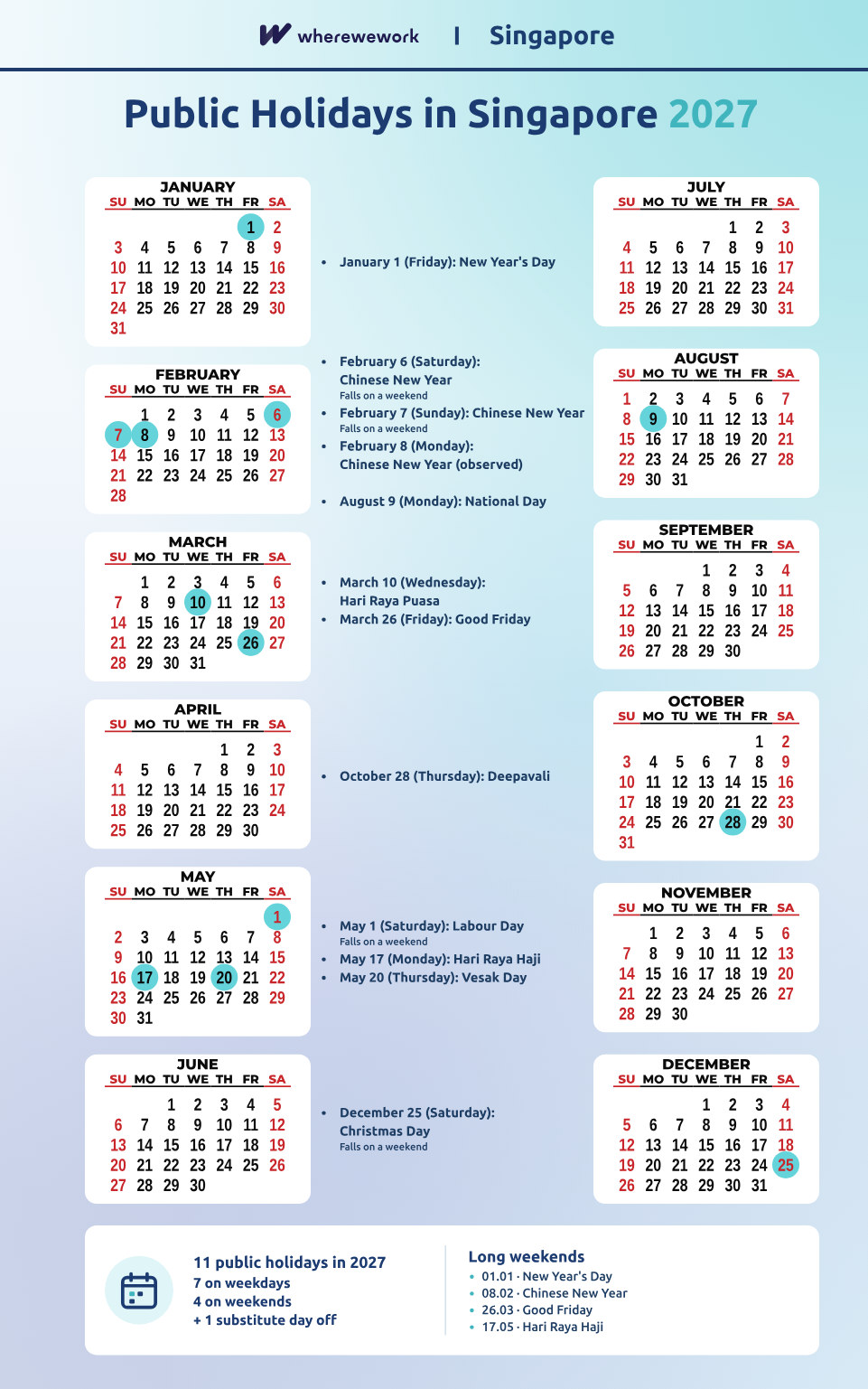
The full list of Singapore public holidays in 2027
The Holidays Act 1998 (Cap. 126) fixes which days are public holidays by name in its Schedule. MOM then confirms the calendar dates each year. These are the dates on MOM's official 2027 list:
- 1 January (Friday): New Year's Day
- 6 February (Saturday): Chinese New Year, day one
- 7 February (Sunday): Chinese New Year, day two
- 8 February (Monday): public holiday in place of Sunday 7 February
- 10 March (Wednesday): Hari Raya Puasa
- 26 March (Friday): Good Friday
- 1 May (Saturday): Labour Day
- 17 May (Monday): Hari Raya Haji
- 20 May (Thursday): Vesak Day
- 9 August (Monday): National Day
- 28 October (Thursday): Deepavali
- 25 December (Saturday): Christmas Day
That gives 8 days off on weekdays and 4 holidays on a weekend. One date to watch: Hari Raya Puasa and Hari Raya Haji follow the Islamic calendar and can shift after publication. In October 2021, following a date revision by Muis (Majlis Ugama Islam Singapura, the Islamic Religious Council of Singapore), MOM gazetted new 2022 dates for both festivals, moving Hari Raya Puasa to 3 May 2022 and Hari Raya Haji to 10 July 2022. MOM's 2027 dates are official as published, but worth rechecking closer to the time.
Why a Saturday holiday does not move to Monday
Section 4(2) of the Holidays Act 1998 (Cap. 126) creates a replacement day for Sundays only. The provision states that if any day specified in the Schedule falls on a Sunday, the day next following not being itself a public holiday is declared a public holiday in Singapore. That is precisely why Monday 8 February appears on the list, while Saturday 6 February, Saturday 1 May and Saturday 25 December do not generate any additional holiday at all.
Your protection for those three Saturdays comes from the Employment Act 1968 (Cap. 91) instead. For employees on a five-day week, MOM treats Saturday as the non-working day and Sunday as the rest day. Under section 88(1)(c) of the Employment Act, when a holiday falls on a day you are not required to work under your contract of service, your employer may either pay you for that holiday at your gross rate of pay or give you a substitute day off.
When MP Liang Eng Hwa raised the question in Parliament in 2022, asking whether the working day after a Saturday public holiday could be made a holiday in the same way as Sunday holidays, MOM's written answer pointed to the existing entitlement under the Employment Act and confirmed no change to the rule. MOM stated:
"Under the Employment Act, if a public holiday falls on a day that employees are not required to work, employees are entitled to either one extra day of pay, or one day off in lieu of that public holiday. Employees are thus able to enjoy the benefits of a public holiday, regardless of the specific day of the week that the public holiday falls on."
The practical step: check with HR which option your organisation will apply for the 2027 Saturday holidays, and confirm any deadline for taking a substitute day off if that is the path chosen. If your rest day is not Sunday, as is common in retail and shift rosters, section 88(1)(b) of the Employment Act applies: a holiday falling on your rest day makes the next working day a paid public holiday. Seafarers, domestic workers, civil servants and statutory board employees sit outside the Employment Act, so their employment contracts determine what applies.
Working on a public holiday: what you are owed
Hospitals, transport operators, restaurants and shops do not close for Deepavali or Vesak Day. If you are required to work on a public holiday, section 88(4) of the Employment Act 1968 entitles you to an extra day's salary at the basic rate of pay on top of your gross rate of pay for that day, plus overtime pay for any hours beyond your normal schedule. For monthly-rated staff, MOM notes that the monthly salary already covers the holiday, so the employer needs to pay one additional day's pay on top.
Working a Saturday holiday on a five-day week follows a slightly different calculation: overtime pay applies to the hours worked, plus either one extra day's salary at the gross rate of pay or another day off.
Managers, executives, workmen earning more than S$4,500 a month and non-workmen earning more than S$2,600 a month may be offered time off in lieu instead, based on mutually agreed hours. If nothing is agreed, MOM's guidance sets out three default options: an extra day at the basic rate; 4 hours off on a working day for 4 hours or less of holiday work; or a full day off on a working day for more than 4 hours of holiday work. Note that the Tripartite Workgroup on the Employment Act Review, which includes MOM and tripartite partners, is currently reviewing the Part 4 thresholds that determine who falls into these categories, and will announce any outcome in due course. The figures above reflect the current position.
Two entitlement traps are worth knowing. First, under section 88(3) of the Employment Act, an employee who is absent on the working day immediately before or after a public holiday without the employer's prior consent or a reasonable excuse loses the holiday pay for that day. Second, a public holiday falling on approved unpaid leave carries no holiday pay entitlement. Employers who fail to pay holiday salary under Part 10 of the Employment Act face a fine of up to S$5,000 under section 90(1), rising to S$10,000 or up to 12 months' imprisonment, or both, for repeat offences.
If you work in a sector that operates through public holidays, including retail, healthcare, food and beverage or transport, it is worth knowing how your total pay compares with others in the same role before you accept or negotiate a holiday shift.
School days and your leave budget
For parents, the Ministry of Education (MOE) has designated three school-only off-in-lieu days to correspond with the Saturday public holidays: Tuesday 9 February, Monday 3 May and Monday 27 December. On those three days, schools, general offices, student care centres and KCare centres will be closed. These are not public holidays. Unless your employer grants you a substitute weekday for the Saturday holiday, your office remains open and you will need to arrange childcare cover separately. Raise this with HR early if it affects you.
Under section 88A of the Employment Act 1968, after at least 3 months of continuous service you are entitled to 7 days of paid annual leave for the first 12 months, with one additional day for every subsequent year of service, up to a maximum of 14 days. New starters cannot apply for annual leave until the 3-month mark has passed, which may limit options for employees who joined late in 2026. MOM data from 2024 shows that over 90% of full-time resident employees aged 25 to 64 already had more than seven days of annual leave, and 68.2% had 15 days or more. Even so, the statutory floor is 7 days, and it is that floor which determines what you can plan around if you are newer to a role.
Long weekends in 2027: seven bridge plans
New Year's Day (Friday 1 January), Good Friday (Friday 26 March), Hari Raya Haji (Monday 17 May) and National Day (Monday 9 August) each sit naturally at a weekend boundary and cost nothing in leave days. The remaining holidays require some planning, particularly where you want to join them into a longer break.
- New Year's Day. Friday 1 January to Sunday 3 January is a free 3-day weekend (0 leave days). For 10 days off stretching from Friday 25 December 2026 to Sunday 3 January 2027, use 4 leave days: Monday 28, Tuesday 29, Wednesday 30 and Thursday 31 December 2026. Check which leave year those days count against.
- Chinese New Year. Saturday 6 February to Monday 8 February is a free 3-day weekend (0 leave days). Adding 4 leave days (Tuesday 9, Wednesday 10, Thursday 11 and Friday 12 February) gives 9 days off from Saturday 6 February to Sunday 14 February.
- Hari Raya Puasa. Take Thursday 11 and Friday 12 March (2 leave days) for 5 days off from Wednesday 10 March to Sunday 14 March. Alternatively, use 4 leave days (Monday 8, Tuesday 9, Thursday 11 and Friday 12 March) for 9 days off from Saturday 6 March to Sunday 14 March.
- Good Friday. Friday 26 March to Sunday 28 March is a free 3-day weekend (0 leave days). With 4 leave days (Monday 22, Tuesday 23, Wednesday 24 and Thursday 25 March), you get 9 days off from Saturday 20 March to Sunday 28 March.
- Hari Raya Haji and Vesak Day. The strongest value window of 2027. Saturday 15 May to Monday 17 May is a free 3-day weekend (0 leave days). Take 3 leave days (Tuesday 18, Wednesday 19 and Friday 21 May) for 9 days off from Saturday 15 May to Sunday 23 May. A shorter option: use 1 leave day (Friday 21 May) for a 4-day break from Thursday 20 May to Sunday 23 May.
- National Day. Saturday 7 August to Monday 9 August is a free 3-day weekend (0 leave days). With 4 leave days (Tuesday 10, Wednesday 11, Thursday 12 and Friday 13 August), you get 9 days off from Saturday 7 August to Sunday 15 August.
- Deepavali. Take Friday 29 October (1 leave day) for a 4-day break from Thursday 28 October to Sunday 31 October. Or use 4 leave days (Monday 25, Tuesday 26, Wednesday 27 and Friday 29 October) for 9 days off from Saturday 23 October to Sunday 31 October.
If your employer grants substitute weekdays for the three Saturday holidays, slot those in place of leave days where they align. The quieter periods around public holiday clusters are also a useful moment to review your CV and consider open roles in the market. When you reach the interview stage at any employer, it is worth asking directly how the organisation handles work on public holidays and whether substitute days are given in place of pay.
The wider signal for 2027 planning
The 2027 calendar asks five-day-week workers to engage with the rules more actively than 2026 did. In 2026, three Sunday holidays automatically generated Monday replacements; in 2027, only one does. For the three Saturday holidays, the decision between an extra day's pay and a substitute day off rests with your employer under section 88(1)(c) of the Employment Act 1968, and MOM has confirmed that no legislative change to this arrangement is planned. Confirming the approach with HR before the year turns, locking in any substitute days that are offered, and booking the bridge weeks that matter most to you are the practical steps that follow from that statutory reality. MOM's guidance frames public holiday entitlements alongside annual leave and sick leave as the combined set of provisions that support work-life balance: taken together, they are most useful when planned rather than claimed at short notice.
Share
What I read is worth it:
Read all the articles about
About the crafts Balance Career planning Economic Employee experience Ethics HR Coach HR Metrics Guide Labour market Workforce planning Students Negotiation Mission LegislativeArticle written by:
 wherewework.com

Comments
0 comments
No comments! Be the first to comment on this article!

Access your account and add your comment
Subscribe to the Newsletter
Read articles of interest from wherewework.com contributors
