Share
Public Holidays in Turkey 2027: Official Dates and Long Weekends
10/30/2026
10 min

The 2027 public holiday calendar for workers in Turkey is worth studying now, not in January. The Presidency of Religious Affairs (Diyanet İşleri Başkanlığı) has already published its official 2027 list, prepared under Law No. 2429 on National Holidays and General Holidays (Ulusal Bayram ve Genel Tatiller Hakkında Kanun, published in the Resmî Gazete on 19 March 1981, issue 17284) and its 2016 amending Law 6752. That list gives 13 full public holiday dates; 11 of them fall on working days. Only 2 land on a weekend: Labour and Solidarity Day on Saturday 1 May, and the opening day of Kurban Bayramı (Eid al-Adha, Feast of Sacrifice) on Sunday 16 May.
That puts 2027 a step ahead of 2026, when 10 days off landed on working days. On top of the full days come three half-day eves (arefe) starting at 13.00: Monday 8 March, Saturday 15 May and Thursday 28 October. Because Diyanet computes the lunar bayram dates years in advance and has published lists through 2035, these dates are confirmed, not preliminary estimates.
Three Turkey-specific legal rules ultimately decide how much rest you actually receive: the half-day holiday structure, the no-substitution rule when holidays fall on weekends, and the consent and pay obligations on employers under Labour Law No. 4857 (İş Kanunu).
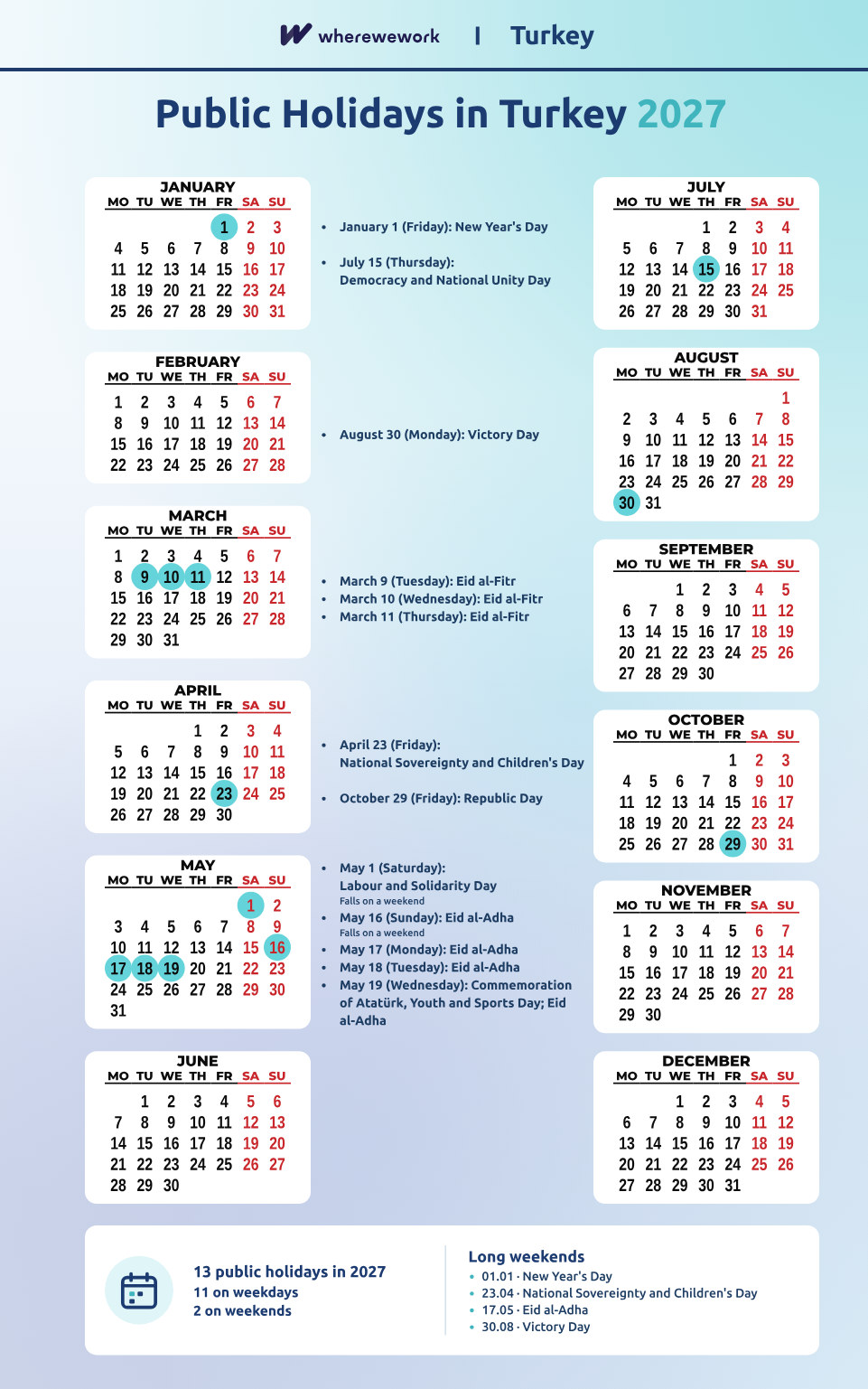
The full official list of public holidays in Turkey for 2027
All dates follow Diyanet's official 2027 holiday list (titled 2027 YILI RESMİ TATİL GÜNLERİ), prepared under Law 2429 of 17 March 1981 and the amending Law 6752 of 25 October 2016.
- 1 January 2027 (Friday): New Year's Day (Yılbaşı)
- 8 March 2027 (Monday, from 13.00): Ramazan Bayramı eve (arefe), half day
- 9, 10 and 11 March 2027 (Tuesday, Wednesday, Thursday): Ramazan Bayramı (Eid al-Fitr, Ramadan Feast)
- 23 April 2027 (Friday): National Sovereignty and Children's Day (Ulusal Egemenlik ve Çocuk Bayramı)
- 1 May 2027 (Saturday): Labour and Solidarity Day (Emek ve Dayanışma Günü)
- 15 May 2027 (Saturday, from 13.00): Kurban Bayramı eve (arefe), half day
- 16, 17, 18 and 19 May 2027 (Sunday to Wednesday): Kurban Bayramı (Eid al-Adha, Feast of Sacrifice)
- 19 May 2027 (Wednesday): Commemoration of Atatürk, Youth and Sports Day (Atatürk'ü Anma ve Gençlik ve Spor Bayramı) - coincides with the last day of Kurban Bayramı
- 15 July 2027 (Thursday): Democracy and National Unity Day (Demokrasi ve Milli Birlik Günü)
- 30 August 2027 (Monday): Victory Day (Zafer Bayramı)
- 28 October 2027 (Thursday, from 13.00): Republic Day eve, half day
- 29 October 2027 (Friday): Republic Day (Cumhuriyet Bayramı)
Part of 2027's advantage over 2026 comes from the lunar calendar's shift. In 2026, Diyanet's calendar placed Ramazan Bayramı on Friday 20 to Sunday 22 March, meaning two of its three days fell on a weekend, and Kurban Bayramı ran from Wednesday 27 to Saturday 30 May. In 2027, the entire Ramazan Bayramı period sits midweek, with no days absorbed by the weekend.
A few dates are widely observed but are not statutory days off. Nevruz (21 March) is celebrated across Turkey but carries no general holiday status under Law 2429. The 10 and 24 November are commemoration days. And 31 December is an ordinary working day; only 1 January carries holiday protection.
Counting the half-day eves, Turkey's statutory public holidays add up to 15.5 days a year.
Three rules that change the real count
Half days are genuinely half days. Under Article 1 of Law 2429, Republic Day begins at 13.00 on 28 October (dossier: 'Bayram 28 Ekim günü saat 13.00'ten itibaren başlar') and the two bayram eves follow the same pattern. A leave request placed on one of these eves covers only the morning hours. The Kazım Ceylan Hukuk Bürosu (Kazım Ceylan law office) notes that if you do work after 13.00 on an arefe, you are owed half a day's holiday pay on top of your regular wage under Article 47 of Labour Law No. 4857, and that private-sector practice varies - some employers give the full arefe day off.
Holidays do not move. Turkish public holidays remain anchored to their fixed calendar dates, and no substitute day off is given when a holiday falls on a weekend. Law firms including Harbiye Hukuk and Kazım Ceylan Hukuk Bürosu both confirm this position, noting that Law 2429 contains no substitution provision. In 2026, Victory Day fell on a Sunday and the following Monday remained an ordinary working day. In 2027, the same rule affects Saturday 1 May and the Saturday-Sunday start of Kurban Bayramı. Additionally, because 19 May 2027 coincides with the final day of Kurban Bayramı, the two holidays overlap without generating a separate extra day off.
The Friday-into-Saturday clause is not an active perk. Law 2429 still carries a 1981 provision stating that when a holiday ends on a Friday evening, the following Saturday is also a holiday. Turkey's Court of Cassation (Yargıtay, 9th Civil Chamber, decision of 23 October 2003, E. 2003/17723, K. 2003/17653) held that the clause was written during an era of Saturday working until 13.00, and that the Saturday after a Friday holiday cannot be treated as a general holiday - it is an ordinary Saturday (dossier: 'cumartesi gününün genel tatil günü olarak kabulü mümkün değildir'). Diyanet's own official 2027 list includes no Saturday after 1 January, 23 April or 29 October as a holiday. Workers on a six-day week should plan to be at their desks on those Saturdays.
Working on a public holiday: what Labour Law No. 4857 says
In the private sector, whether a workplace operates on national and general holidays is determined by the collective agreement or the employment contract, under Article 44 of Labour Law No. 4857 (İş Kanunu). Where no contractual clause exists, the law is explicit: worker consent is required before any holiday shift can be scheduled (dossier: 'Sözleşmelerde hüküm bulunmaması halinde söz konusu günlerde çalışılması için işçinin onayı gereklidir'). The Ministry of Labour and Social Security (Çalışma ve Sosyal Güvenlik Bakanlığı, ÇSGB) adds in its Labour Law FAQ that this consent must be obtained in writing.
The pay rule sits in Article 47 of Labour Law No. 4857. An employee who takes the holiday off receives that day's full wage without working for it. An employee who works a holiday earns one additional day's wage on top of their regular pay (dossier: 'tatil yapmayarak çalışırlarsa ayrıca çalışılan her gün için bir günlük ücreti ödenir'), which the Ministry of Labour and Social Security sums up as two days' total pay per holiday worked. For hourly-paid workers, Article 49 of the same law sets the holiday day rate at seven and a half times the hourly wage. Holiday pay is counted by the day rather than by the hours worked on that day, as confirmed by the Court of Cassation's 9th Civil Chamber (E. 2017/27071, K. 2020/20070, of 24 December 2020).
Republic Day carries one additional obligation for employers. Article 2 of Law 2429 requires private workplaces to close on 29 October (dossier: '29 Ekim günü özel işyerlerinin kapanması zorunludur'). This is not a contractual arrangement - it is a statutory closure requirement.
If a holiday shift is being offered to you, it is worth calculating what the premium means for your net salary, starting from your gross figure. Seeing how your regular salary sits relative to others doing the same role provides a useful baseline before you negotiate. Workers in sectors that keep running through public holidays - retail, healthcare, hospitality, transport - tend to have the most holiday shifts on offer.
Public sector, school breaks and leave rules
Public employees: the Presidency sometimes grants administrative leave (idari izin) around the bayrams, bridging the gap between a holiday block and the nearest working Monday or Friday. In 2024, when Kurban Bayramı had the identical Sunday-to-Wednesday layout as in 2027, President Erdoğan announced that the two working days following the bayram would become administrative leave, creating a nine-day break for public staff (dossier: 'perşembe ve cuma günlerini de bayram tatiline ekleyerek 9 günlük bir tatil imkânı sağlamış oluyoruz'). For Kurban Bayramı 2026, a Presidency circular gave public employees Monday 25 May as a full day and Tuesday 26 May until 13.00 as administrative leave, notified to ministries, governorships, municipalities and the Council of Higher Education, with institution heads required to maintain a minimum number of staff on duty. As of 29 October 2026, no equivalent decision exists for 2027, so planning around a similar extension would be premature. Administrative leave applies only to public-sector employees and has no automatic counterpart in the private sector.
Parents: the Ministry of National Education (Millî Eğitim Bakanlığı, MEB) 2026-2027 school year calendar sets the second-term mid-year break from Monday 8 March to Friday 12 March 2027, covering the Ramazan Bayramı eve on Monday 8 March and all three bayram days of 9 to 11 March. For families coordinating childcare and work schedules, the Ramazan week offers the closest alignment of school and public holidays in the entire year.
Annual leave rules: under Article 56 of Labour Law No. 4857, annual leave cannot be split unilaterally by the employer; by agreement between both parties it may be taken in parts, but one portion must be at least ten days in length. Public holidays falling within an annual leave period are not deducted from your leave entitlement - they are added on top. Statutory paid annual leave under Article 53 is at least fourteen days for one to five years of service (five years included), at least twenty days for over five and fewer than fifteen years, and at least twenty-six days for fifteen years or more. Employees aged 18 or under and those aged 50 or over are entitled to at least twenty days regardless of their service length.
One rule worth tracking: if your employer closes the workplace on a bridge day around a holiday, Article 64 of Labour Law No. 4857 permits make-up work for those hours within four months (the President may extend this to eight months). Such make-up shifts may not exceed three hours per day, may not be scheduled on rest days or holidays, and are not classified as overtime. A bridge day granted by an employer may therefore come back as additional time worked in a later month.
Seven bridge plans for 2027
All plans below assume a Monday-to-Friday working week. Workers on a six-day schedule should adjust the leave day counts, bearing in mind that Article 63 of Labour Law No. 4857 permits a 45-hour week spread across six working days, and that Saturday 1 May 2027 remains a statutory general holiday for anyone whose regular week includes Saturday.
- New Year: Friday 1 January gives a free 3-day weekend, 1 to 3 January (0 leave days). To extend it, take Monday 28 to Thursday 31 December 2026 (4 leave days) for 9 days off, Saturday 26 December to Sunday 3 January.
- Ramazan Bayramı: take Monday 8 March (1 leave day - and the afternoon is already a holiday) for 6 days off, Saturday 6 to Thursday 11 March. Add Friday 12 March (2 leave days in total) for 9 days off, Saturday 6 to Sunday 14 March - and note that the MEB mid-term school break runs Monday 8 to Friday 12 March, which aligns school and work leave for that whole block.
- 23 April: a free 3-day weekend, Friday 23 to Sunday 25 April (0 leave days). Take Monday 19 to Thursday 22 April (4 leave days) for 9 days off, Saturday 17 to Sunday 25 April.
- Kurban Bayramı: the strongest opportunity of the year. Saturday 15 to Wednesday 19 May is a free 5-day block (0 leave days): the arefe starts at 13.00 on Saturday, and the four bayram days run Sunday to Wednesday. Take Thursday 20 and Friday 21 May (2 leave days) for 9 days off, Saturday 15 to Sunday 23 May. The ten-day block rule under Article 56 of Labour Law No. 4857 is comfortably satisfied.
- 15 July: take Friday 16 July (1 leave day) for 4 days off, Thursday 15 to Sunday 18 July. Take Monday 12, Tuesday 13, Wednesday 14 and Friday 16 July (4 leave days) for 9 days off, Saturday 10 to Sunday 18 July.
- Victory Day: a free 3-day weekend, Saturday 28 to Monday 30 August (0 leave days). Take Tuesday 31 August to Friday 3 September (4 leave days) for 9 days off, Saturday 28 August to Sunday 5 September.
- Republic Day: a free 3-day weekend, Friday 29 to Sunday 31 October (0 leave days) - in practice starting at Thursday 13.00 when the Republic Day eve holiday begins. Take Monday 25 to Thursday 28 October (4 leave days, with Thursday morning being the only working time to cover) for 9 days off, Saturday 23 to Sunday 31 October.
Plan ahead and get the full benefit
The Ramazan and Kurban Bayramı weeks will attract the most leave requests in 2027, so submitting your application early gives you the best chance of securing your preferred dates. Keep the ten-day block rule in mind if you plan to split your leave: a single bridge day here and there may not combine into a second standalone block unless one of them anchors a ten-day minimum. The quieter stretches around the national holidays - late April, mid-July, late August - can be productive moments to review your CV, explore open positions, and ask prospective employers directly how their holiday-shift policies and consent procedures work under Article 44 of Labour Law No. 4857.
Share
What I read is worth it:
Read all the articles about
About the crafts Balance Career planning Economic Employee experience HR Coach HR Metrics Guide Job opportunities Labour market Negotiation Students Workforce planning LegislativeArticle written by:
 wherewework.com

Comments
0 comments
No comments! Be the first to comment on this article!

Access your account and add your comment
Subscribe to the Newsletter
Read articles of interest from wherewework.com contributors
