Share
AI interview notes create legal risk for US recruiters
09/22/2026
8 min
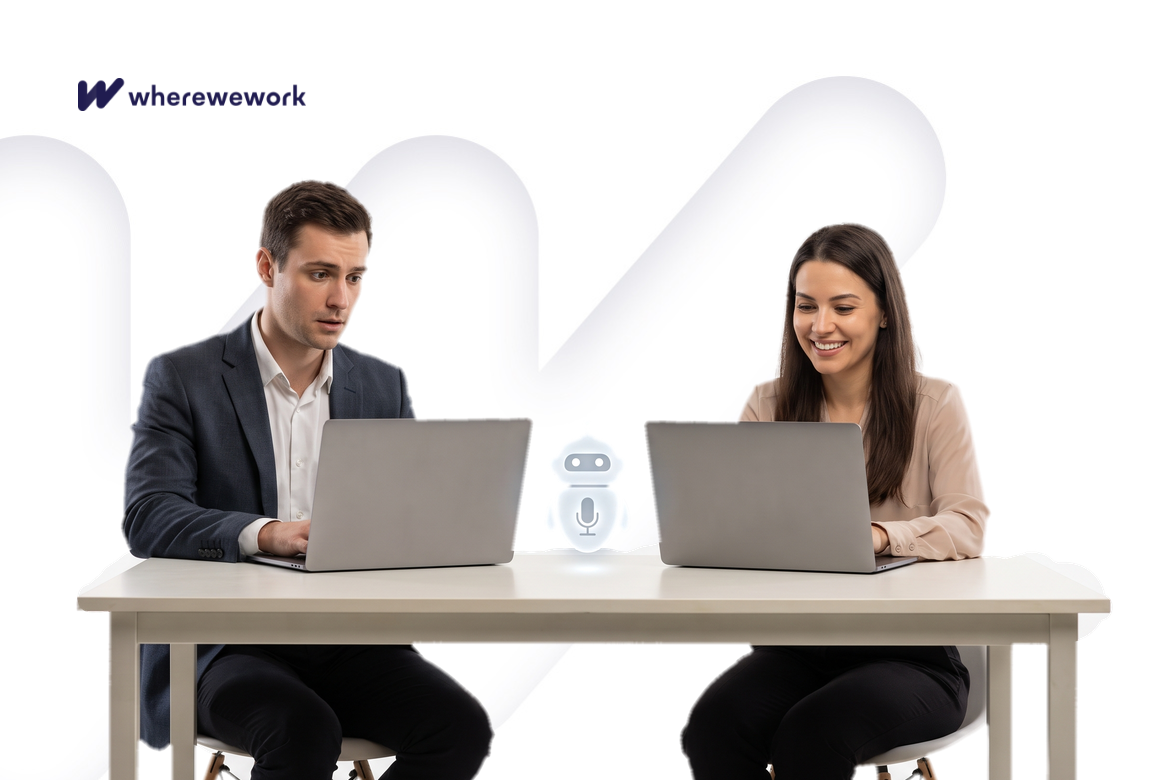
You log into the video call, adjust your camera, and the recruiter smiles and kicks off the meeting. What nobody mentions is the AI notetaker that joined a few seconds later. It is already recording. It is already transcribing. And before the hiring manager has opened your resume a second time, it will have produced a written summary that may shape the entire decision about you.
This is no longer an edge case. According to a Paylocity survey published in 2026, just over 90% of HR managers said they actively use AI somewhere in their recruitment process, and the rest said they plan to add it within the next 18 months. If you are interviewing for a job right now, the probability that some form of AI is listening is high. The probability that anyone told you about it is much lower.
Here is what is actually happening on the other side of the screen, what it means for your legal position in the United States, and how to adapt your preparation before your next interview.
Your interview is probably being recorded and summarized
Zoom, Microsoft Teams, and Google Meet all offer transcription services and AI summaries built into their platforms. Most recruiting platforms now bundle tools that can produce interview notes, fill out scorecards, and even draft follow-up questions automatically. The recruiter does not have to enable anything exotic. In many configurations, it is already on by default.
Outplacement firm Challenger, Gray and Christmas published an analysis warning about the paper trail these tools leave behind. The concern is not abstract. A nervous moment, a verbal stumble, or a badly worded answer you would normally recover from in the flow of a 45-minute conversation now exists as a permanent, searchable line of text in an applicant tracking system.
"A whole host of issues can be introduced by using recording and transcription services in external-facing meetings. A job seeker's mistake could be recorded permanently. An interviewer's insensitive, or even illegal, question could also be captured."
That is John Challenger, CEO of Challenger, Gray and Christmas. The cut works both ways, and that is genuinely worth holding onto. An interviewer who asks about your age, national origin, or disability status in violation of Title VII of the Civil Rights Act of 1964 or the Americans with Disabilities Act (ADA) has now created a transcript that documents that question. But as a candidate, the power asymmetry still sits with the employer: the company holds the transcript, decides who sees it, and decides how long it lives in their system.
The hiring manager may never actually watch you
This is the part that should change how you prepare. In a traditional interview process, the recruiter met you, formed an impression, and passed that impression up the chain. Now, an AI-generated summary can travel in your place.
"A hiring manager may read an AI-generated summary without watching the interview. That summary can become the initial evaluation of the candidate, even when the software is described as a notetaker. And sometimes those notetakers make mistakes."
Those mistakes carry real consequences. Automatic transcription tools misread accents, mislabel speakers, and compress a nuanced answer into a generic bullet point. If English is not your first language, if you speak quickly when you are nervous, if you have a stutter, or if you are neurodivergent and take a beat before answering, the summary that lands on the hiring manager's desk may be a distorted version of the conversation you actually had. For candidates who already face structural barriers in hiring, an inaccurate AI summary adds another layer of risk that the ADA's reasonable-accommodation framework was not built to address directly.
The Paylocity data adds a troubling wrinkle. 4 in 5 leaders surveyed said they were actively managing at least one issue with their AI tools. In the same survey, the vast majority said they trusted AI to assess applicants regardless of background. Both things are true at once: the tools are known to have problems, and the people using them believe the output is fair. For anyone whose profile does not resemble the training data, that combination carries real risk.
What the law says if you are interviewing in the United States
Recording consent law in the United States is not uniform, and that matters for every job seeker on a video call. Under the federal Electronic Communications Privacy Act (18 U.S.C. § 2511), one-party consent is the federal baseline, meaning a recruiter can legally record a call they are part of without telling you. But a significant number of states impose a stricter standard. California's Penal Code § 632, for example, requires all-party consent before recording a confidential communication. Illinois, Connecticut, Florida, Maryland, Michigan, Montana, Nevada, New Hampshire, Oregon, Pennsylvania, and Washington have similar all-party or two-party consent requirements. If your interview crosses state lines, the more protective state law often applies in practice, and employers running national hiring programs typically face the most restrictive standard in the mix.
Legal counsel across the industry has flagged AI notetakers on two distinct fronts: compliance with those recording consent statutes, and compliance with workplace monitoring rules that increasingly extend to candidates, not just current employees. On the AI-evaluation side, New York City's Local Law 144 already requires employers using automated employment decision tools to conduct annual bias audits and notify candidates. Illinois' Artificial Intelligence Video Interview Act requires companies to disclose when AI is being used to evaluate video interviews and to obtain consent. These are live legal obligations, not future proposals. Federal agencies including the Equal Employment Opportunity Commission (EEOC) have also issued guidance flagging that AI hiring tools can violate Title VII if they produce discriminatory outcomes regardless of intent.
The practical upshot: you almost always have the right to ask whether the call is being recorded, and in many states, the right to decline. Companies vary in how gracefully they handle that request. Asking is legitimate, and it is not a red flag.
What to ask before the interview starts
You do not need to open with a legal argument. A short, direct question at the start of the call, or in the confirmation email the day before, is enough. Consider asking:
- Will this interview be recorded or transcribed by any AI tool? I would like to know before we begin.
- If it is recorded, who will have access to the transcript, and how long is it retained?
- Will the hiring manager watch the recording, or read a summary?
- Can I request a copy of the transcript or summary that gets shared internally?
That last question is the most strategically useful. Unlike the European GDPR framework, the United States does not have a single federal law giving candidates the right to see personal data held about them. But California residents can invoke the California Consumer Privacy Act (CCPA) to request personal information a business holds, which can include interview transcripts and AI-generated summaries. If you are outside California, some employers will still honor a direct written request as a matter of policy, especially if their legal team is already managing exposure under state consent laws. It is worth asking. The worst outcome is a polite no.
How to interview when the transcript is your real audience
Plan on the assumption that your summary will be read by someone who was not in the room, and shape your answers so they hold up under compression. A rambling story that sounds warm and personable in real time may collapse into a confused bullet when an AI reduces it to three lines. A crisp, structured answer with a clear beginning, middle, and end holds up significantly better.
Practical adjustments that make a measurable difference:
- Signpost your answers. Say there are two or three reasons, and then actually deliver them in sequence. AI summarizers latch onto structure, and numbered reasoning is more likely to survive intact.
- Repeat the key phrase. If you want the summary to reflect that you led a team of eight people or managed a $2 million budget, say those specifics more than once. Repetition raises the probability that the phrase makes it into the output.
- Reset verbally after a stumble. If you fumble an answer, do not just power through. Say something like: let me take that from the top. Transcripts capture false starts, and a clear reset gives the summarizer a cleaner signal to prioritize.
- Speak at a measured pace. Automatic transcription is noticeably more accurate on measured speech, and it is more forgiving of regional accents and non-native English patterns.
- Close with your own summary. A 20-second recap of what you have covered gives the AI a clean, coherent paragraph to lift into its notes, which is often what the hiring manager actually reads.
None of this replaces genuine preparation on the substance of the role. It is an additional layer that acknowledges your second audience, after the recruiter on the call, is a language model processing your words into a document.
If the transcript feels unfair, you have a documented path forward
If you are rejected and something about the process felt wrong, you have options that did not exist before AI notetakers created paper trails. If an interviewer asked a question that violates Title VII of the Civil Rights Act of 1964 (covering race, color, religion, sex, and national origin), the ADA, or the Age Discrimination in Employment Act (ADEA), and the transcript captures it, that record can support a formal complaint. The EEOC handles federal-level discrimination complaints in hiring, and most states have parallel agencies: the California Civil Rights Department (CRD), the New York State Division of Human Rights, and the Texas Workforce Commission, among others. Filing deadlines vary by state, but EEOC charges generally must be filed within 180 days of the discriminatory act, extended to 300 days in states with a fair employment agency.
These bodies will not rerun the interview for you. But an AI-summary process that produces a clearly biased or inaccurate record is a documented pattern. And documented patterns are what regulators act on. The EEOC's 2023 technical assistance guidance on AI in hiring specifically flagged that employers remain liable for discriminatory outcomes even when those outcomes are generated by a third-party AI vendor.
"Recording changes how candidates behave and how hiring teams interpret interviews. Organizations need to consider its effect on candor, fairness, and trust."
John Challenger's observation applies directly to your own preparation. Knowing you might be recorded changes what you say and how you say it. That is not something to resist; it is something to plan around.
The bottom line for your next interview
AI notetakers are a fixture of the 2026 hiring process. If you are actively looking for work, you will encounter them in nearly every video interview loop you enter. Two things are worth internalizing: first, you have the right to ask what is recording you, and in many US states you have meaningful legal recourse if recording happened without consent; second, the way you answer needs to survive being compressed by a machine before it reaches the person making the decision.
Ask the question at the start of the call. Structure your answers so they hold up on the page. If you are a California resident, consider a CCPA request if the outcome feels wrong and the process felt off. The technology tilts the room, but knowing it is tilted is most of the correction. Start your preparation from that reality, and you are already ahead of most candidates walking into the same call.
Share
What I read is worth it:
Article written by:
 wherewework.com
Comments
0 comments
No comments! Be the first to comment on this article!

Access your account and add your comment
Workforce planning


Subscribe to the Newsletter
Read articles of interest from wherewework.com contributors
