Share
FLSA's frozen floor: 17 years at $7.25 and what it costs you
07/22/2026
7 min
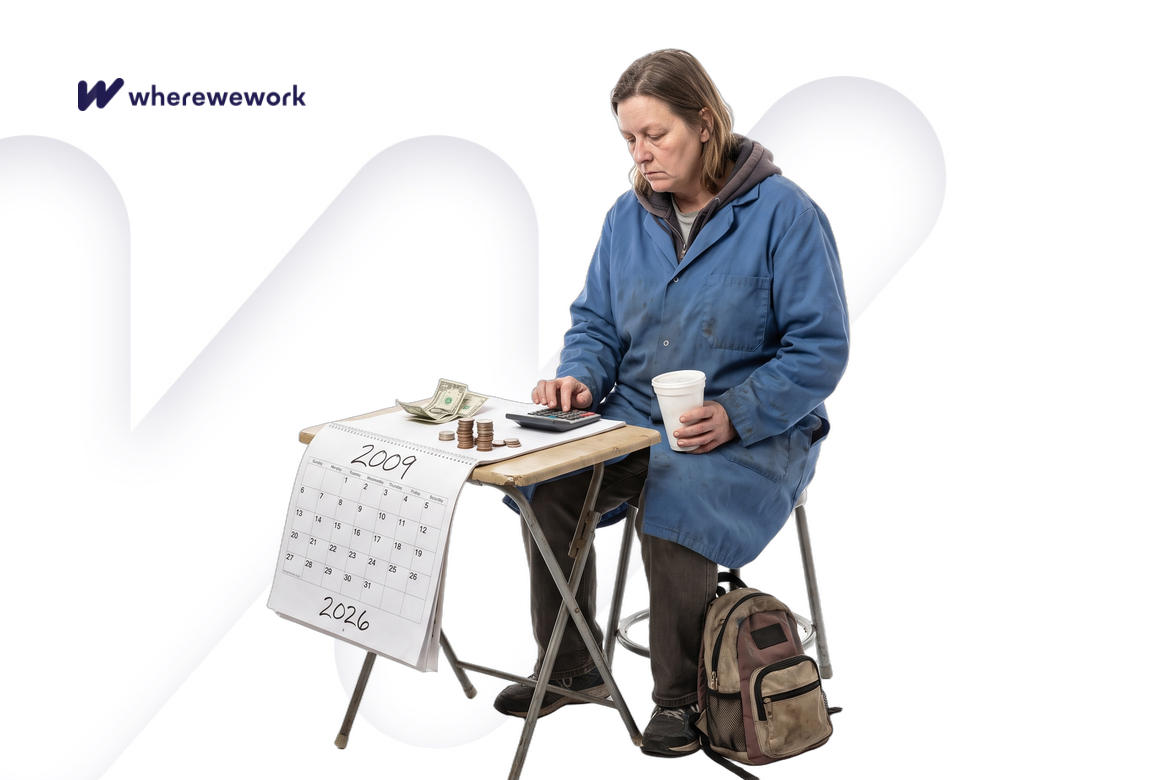
Clock 40 hours a week at the federal minimum wage and your annual pay before tax comes to $15,080. The Department of Health and Human Services (HHS) sets the 2026 poverty line for a two-person household at $15,650. That gap is not an abstraction: a full-time job at $7.25 an hour now pays less than what the federal government itself defines as poverty.
This July marks 17 consecutive years since Congress last raised the federal floor. The Fair Labor Standards Act (FLSA), first enacted in 1938, established the federal minimum wage framework, but nothing in the statute forces automatic inflation adjustments. Every year Congress stays silent, the real value of $7.25 erodes. If you live in one of the 20 states that have never moved their own floor above the federal rate, your effective wage floor has been shrinking in real terms every year while your grocery bill and rent have not.
This piece is for workers at or near minimum wage, for job-seekers in low-wage sectors, and for anyone trying to figure out whether a move to a higher-wage state is worth the disruption. The data makes that calculation easier than most employers want you to think.
The wage floor has not moved since 2009. Everything else has.
The federal minimum wage has been stuck at $7.25 since July 24, 2009. According to a July 2026 analysis from the Center for Economic and Policy Research (CEPR), the purchasing power of that $7.25 is now at its lowest point in 70 years, below the federal minimum wage's 1968 peak. The Bureau of Labor Statistics (BLS) Inflation Calculator puts that 1968 peak at roughly $15.62 in 2026 dollars, more than double the current rate.
"We are currently in the longest period of inaction on the federal minimum wage since its inception in 1938. In fact, today the federal wage floor is officially a poverty wage."
That is Sylvia Allegretto, senior economist at CEPR, from the same July 2026 analysis. The word she chooses matters: officially. A full-time year-round job at $7.25 does not clear the government's own poverty threshold. That is not a political opinion. It is arithmetic.
The scale is not marginal. According to the Economic Policy Institute's (EPI) Low Wage Workforce Tracker, 14 million US workers earn less than $15 an hour. When you include overtime, tips, and commissions in the count, 20 million earn less than $16 an hour. These are not edge-case earners. They represent a substantial share of the workforce in sectors that keep daily life running: home health, childcare, food service, retail.
Where you live decides what you earn for the same job
Thirty states plus Washington, D.C. now set minimum wages above $7.25. The Cato Institute calculated the average US minimum wage at $12.13 as of January 2026, and a National Employment Law Project report notes that around two dozen states will raise their floors at some point in 2026.
The remaining 20 states have not raised their floors above the federal rate. That full list: Alabama, Georgia, Idaho, Indiana, Iowa, Kansas, Kentucky, Louisiana, Mississippi, New Hampshire, North Carolina, North Dakota, Oklahoma, Pennsylvania, South Carolina, Tennessee, Texas, Utah, Wisconsin, and Wyoming. Five of those states (Alabama, Louisiana, Mississippi, South Carolina, and Tennessee) have no state minimum wage at all. Georgia and Wyoming set their own floors at $5.15, so the federal $7.25 applies as the effective floor under FLSA.
What this looks like in real roles, using 2025 BLS median wages:
- Home health and personal care aides: $10.83/hour median in Louisiana, $11.65 in Texas.
- Childcare workers: $10.60/hour median in Mississippi, $10.92 in Alabama.
- Fast food cooks: $13.85/hour median in Pennsylvania versus $17.20 in New York.
The concentration is regional and pronounced. More than one-quarter of Mississippi's workforce earns below $15 an hour. Roughly one-fifth of workers in Arkansas, Oklahoma, and Alabama fall in the same bracket. If you are a candidate in one of those states, you are not an outlier for earning under $15. In your local labor market, you are the statistical norm.
The "raising wages kills jobs" argument is being tested with real payroll data
If you have ever been told a wage increase would cost you your job, the evidence from recent state-level experiments is worth knowing before you accept that framing.
In 2024, California Governor Gavin Newsom signed a $20 minimum wage for fast-food workers. Two independent studies have since looked at the outcomes. A UC Berkeley working paper found the law raised eligible workers' average weekly wages by about 11%, with no measurable employment impact; prices at those restaurants rose about 1.5%. A November 2025 Cato Institute report, drawing on BLS data, found California's fast-food sector lost 18,000 roles relative to the broader job market after the law took effect.
Two studies, two different framings. Both agree on one thing: workers' pay went up meaningfully, and the sector kept functioning.
"A lot of people are watching what's happening in California. And it could be a model for the rest of the country."
That is Michael Reich, chair of the Center on Wage and Employment Dynamics at UC Berkeley and lead author of the working paper.
The Pennsylvania-New York comparison adds another data point. A Keystone Research Center report found that after New York raised its minimum wage while Pennsylvania remained at $7.25, leisure and hospitality employment growth in New York far outpaced Pennsylvania's. The higher-wage state added more low-wage jobs, not fewer. For workers near the Pennsylvania-New York border, that difference is not academic.
A 2021 Pew Research Center survey found 62% of Americans support a $15 federal minimum wage. In New York City, Mayor Zohran Mamdani has proposed raising the city's minimum from $16.50 to $30 by 2030. Whether or not those proposals advance, they signal where the political center of gravity on wage floors is moving.
What this means when you are applying, negotiating, or thinking of moving
If you work in one of the 20 states that has not raised its floor, the market around you is quieter, but it is not static. US wage growth overall has declined from a July 2022 peak of 6.7% to 3.6% as of mid-2026, per Federal Reserve Bank of Atlanta data. That is still positive growth. Here is how to use it in a pay conversation.
1. Know your state's floor before you talk pay. If your state has not raised its minimum, $7.25 is the legal floor under FLSA, but almost no employer competing for staff pays exactly that. Check the BLS median wage for your specific role and state before an interview. When an employer offers $9 for a role where the state median is $12, you have a data-backed reason to push back, not just a feeling.
2. Compare across the state line honestly. A fast food cook earning the Pennsylvania median of $13.85 could earn $17.20 in New York for the same work, a 24% difference. That gap is real, but so are moving costs, housing prices, local taxes, and family or support networks. If you are weighing a move for pay, calculate the annual difference after rent, not just the hourly one.
3. Track what your state legislature is doing in 2026. Around two dozen states are raising minimum wages at some point this year. If yours is among them, your negotiation floor moves with it, legally. If yours is not, pressure from neighboring states still affects local employers: businesses near state borders often raise pay quietly to stop losing staff to the higher-wage side.
4. Ask about the full package, not just the hourly rate. In home health, childcare, and fast food, the sectors where the wage freeze bites hardest, schedule stability, guaranteed hours, and paid sick leave often matter as much as the base rate. A $12 job with 32 guaranteed hours can outperform a $13 job with unpredictable shifts when you run the monthly math.
The bigger picture, without the slogans
A 1987 Congressional Budget Office study by Ralph E. Smith and Bruce Vavrichek found that 20% of hourly workers paid at or below the then-$3.35 minimum wage earned incomes below the US poverty line. Nearly four decades later, that threshold has not just failed to improve: full-time work at the federal minimum no longer clears the poverty line even for a two-person household. The arithmetic has moved in the wrong direction.
Center for American Progress research puts a number on the broader cost. Childhood poverty, they estimate, reduces US productivity and economic output by roughly 1.3% of GDP per year. When wage floors stay frozen and full-time workers stay poor, that shows up on national balance sheets, not just household ones.
Adam Smith, writing in 1776 and cited in a recent op-ed by Holly Sklar of Business for a Fair Minimum Wage, argued that those who feed, clothe, and lodge the whole body of the people should receive enough from their labor to be themselves tolerably well fed, clothed, and lodged.
The argument for a wage floor that keeps working people out of poverty is not new. What is new is the length of time the current floor has stayed still. The EPI's Low Wage Workforce Tracker and the CEPR analysis published in July 2026 give that argument updated, granular numbers. They are worth bookmarking before your next offer conversation.
What to do this week
If you are actively looking or expect to negotiate soon, three concrete steps are worth taking in the next few days:
- Look up the BLS median hourly wage for your exact job title in your state at bls.gov. That number is your evidence in any pay conversation, and it costs nothing to find.
- Check whether your state has a minimum wage change scheduled for 2026. If yes, factor that new floor into any offer you accept before the change takes effect, because once you sign, you are negotiating from the new baseline, not a retroactive one.
- If you are within commuting or moving distance of a higher-wage state, run the full annual math: hourly delta multiplied by expected hours, minus the realistic difference in rent and commuting costs.
$7.25 is what the FLSA allows an employer to pay. It is almost never what the market actually pays, even in states that have never raised the floor above the federal rate. Knowing the gap between the legal minimum and the local market median is the difference between accepting an opening offer and negotiating a real one.
Share
What I read is worth it:
Read all the articles about
Workforce planning About the crafts Career planning HR Metrics Internships and volunteering Legislative Statistics Labour marketArticle written by:
 wherewework.com
Comments
0 comments
No comments! Be the first to comment on this article!

Access your account and add your comment
Workforce planning


Subscribe to the Newsletter
Read articles of interest from wherewework.com contributors
