Share
Public Holidays in Canada 2027: Official Dates and Long Weekends
10/30/2026
9 min

Christmas Day 2027 lands on a Saturday and Boxing Day on a Sunday. For any Monday-to-Friday worker in Canada, what you actually get back for that lost weekend depends entirely on which legal framework governs your employment, and the answers range from two fully paid substitute weekdays to nothing at all.
Canada has never had a single statutory holiday calendar. The federal public service operates under one set of designated paid holidays, the Canada Labour Code sets a different list for privately-employed workers in federally regulated sectors, and each province adds its own regime for the roughly 94% of the workforce who fall under provincial jurisdiction. The 2027 Christmas weekend makes this fragmentation unusually visible: read on for the full date list, a jurisdiction-by-jurisdiction comparison, holiday work pay rules, and nine leave-bridge plans to get the most out of the year.
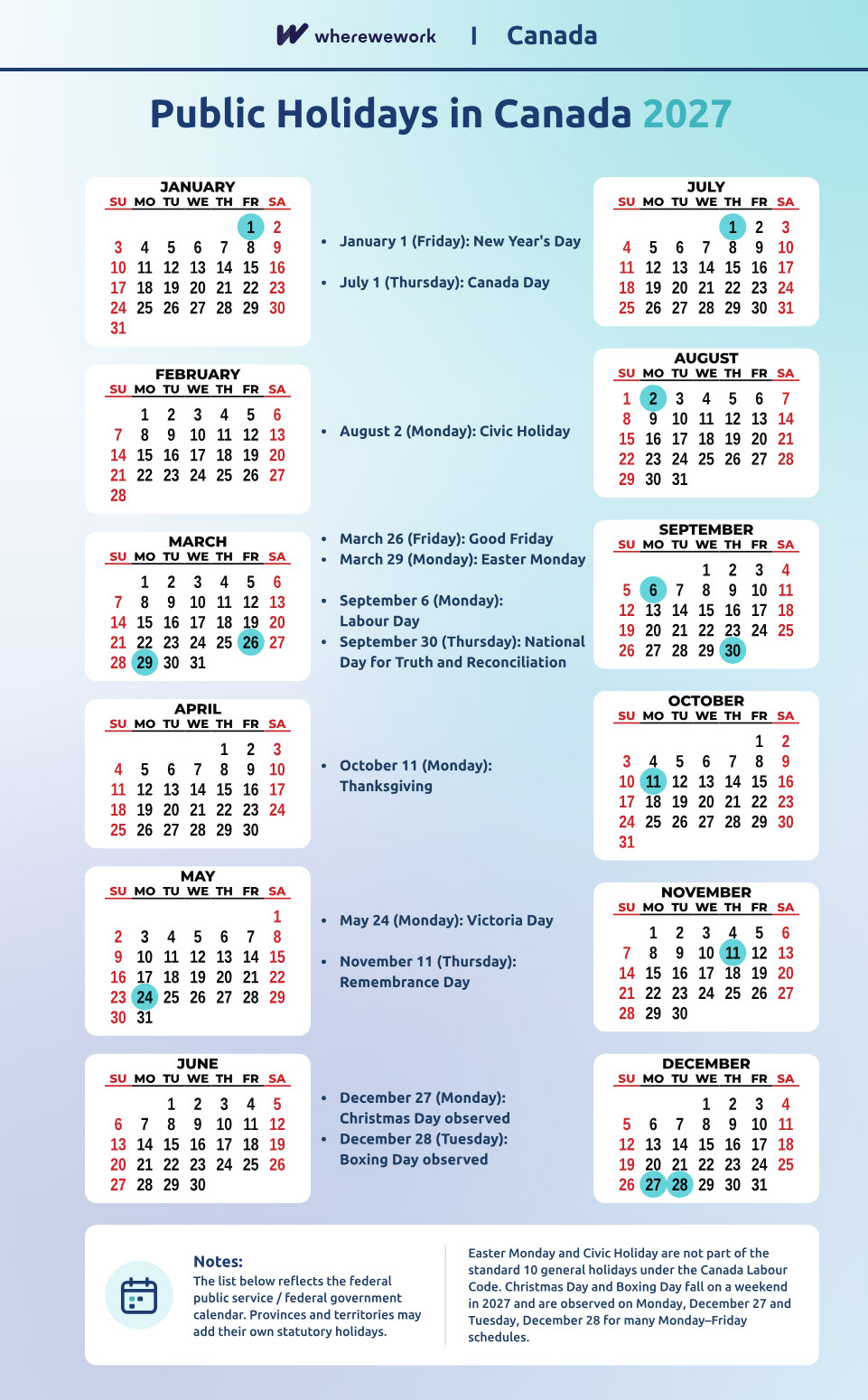
The full 2027 calendar, federal list first
The dates below follow the designated paid holidays for the federal public service, as published by Public Services and Procurement Canada. The Canada Revenue Agency (CRA -- Agence du revenu du Canada) also publishes a public holidays page that is useful primarily for tax due-date purposes; it is not a definitive labour-law source. Several provinces and territories add their own days beyond the federal list, so the notes next to each date matter.
- 1 January (Friday): New Year's Day
- 26 March (Friday): Good Friday
- 29 March (Monday): Easter Monday -- federal public service only among the frameworks below; optional in Alberta; in Quebec the employer picks Good Friday or Easter Monday
- 24 May (Monday): Victoria Day (called Journee nationale des Patriotes in Quebec)
- 1 July (Thursday): Canada Day
- 2 August (Monday): Civic Holiday -- federal public service default and BC Day in British Columbia; optional Heritage Day in Alberta
- 6 September (Monday): Labour Day
- 30 September (Thursday): National Day for Truth and Reconciliation
- 11 October (Monday): Thanksgiving
- 11 November (Thursday): Remembrance Day
- 25 December (Saturday): Christmas Day (federal public servants observe it on Monday 27 December)
- 26 December (Sunday): Boxing Day (federal public servants observe it on Tuesday 28 December)
Three dates sit outside this federal list but apply to large groups of workers: Family Day on 15 February (Monday) in Ontario, British Columbia and Alberta, and Quebec's Fete nationale on 24 June (Thursday). Easter Monday and the Civic Holiday do not appear in section 166 of the Canada Labour Code, so a bank, airline or telecom is not legally required to give you either as a paid day under that statute.
Which rulebook covers you, and what Christmas 2027 gives back
The federal public service guarantees 12 designated paid holidays. The Canada Labour Code gives 10 general holidays to workers at federally regulated employers such as banks, airlines and telecoms. British Columbia names 11 statutory holidays under its Employment Standards Act; Ontario has 9 under the Ontario Employment Standards Act 2000 (ESA 2000); Alberta has 9 general holidays under its Employment Standards Code; and Quebec has 8 under the Act respecting labour standards, according to Educaloi and the Commission des normes, de l'equite, de la sante et de la securite du travail (CNESST -- Quebec's labour standards body).
The practical difference crystallises when a holiday falls on your day off, which is precisely what happens with both Christmas Day and Boxing Day in 2027. Here is how each framework handles it:
- Federal public servants. Under clause 30.05 of the Treasury Board's Program and Administrative Services (PA) collective agreement with the Public Service Alliance of Canada (PSAC), two holidays that coincide with an employee's consecutive days of rest move to the first two scheduled working days after the weekend: Monday 27 and Tuesday 28 December 2027.
- Federally regulated private sector. Subsection 193(2) of the Canada Labour Code provides that when Christmas Day or Boxing Day falls on a Saturday or Sunday that is a non-working day, the employee is entitled to and shall be granted a holiday with pay on the working day immediately preceding or following the general holiday. Section 194 disapplies this rule if a collective agreement already guarantees at least nine paid holidays per year.
- Ontario. Both days are public holidays under Ontario ESA 2000. If they fall on a day you would not normally work, you are entitled to either a substitute day off with public holiday pay, or public holiday pay alone if you agree electronically or in writing. The substitute day must be taken within three months, or up to 12 months with written agreement.
- Quebec. Only Christmas counts here; Boxing Day is not a statutory holiday under the Act respecting labour standards. Under section 64 of that Act (as explained by CNESST), your employer either pays the holiday indemnity or grants a compensatory day off. Quebec is a distinct civil-law jurisdiction with its own French-language workplace obligations under the Charter of the French Language (Bill 96), so workers there should verify their entitlements through CNESST rather than relying on other-province guidance.
- British Columbia. Only Christmas counts. Under section 45 of BC's Employment Standards Act, an eligible employee receives an average day's pay whether or not the statutory holiday falls on their regularly scheduled day off, but the Employment Standards Branch is clear that the employer has no obligation to give another day off.
- Alberta. Christmas is a general holiday and Boxing Day is optional. Under Alberta Employment Standards, if you do not work on a day that is not a regular day of work for you, you receive neither holiday pay nor a paid day in lieu. For Monday-to-Friday staff, that means a Saturday Christmas yields nothing automatically.
Working on a holiday: pay premiums and fines
The Canada Labour Code does not prohibit holiday work, but it sets a floor price. A federally regulated employee who works a general holiday gets at least one and a half times the regular rate for the hours worked plus holiday pay. Under subsection 196(1) of the Code, holiday pay equals at least one twentieth of the wages (excluding overtime) earned in the four weeks before the holiday week. In continuous operations -- services covering rail, air, shipping, road transport and broadcasting -- an employer may instead grant a paid day off at another time, and managers or professionals receive their regular rate plus a substitute paid holiday.
Federal public servants under the PA agreement earn time and a half for the first 7.5 hours and double time after that, on top of holiday pay; with approval they may instead take a paid lieu day at a later date plus the same premium rates. In Ontario, premium pay is 1.5 times the regular rate, and you choose between regular wages plus a substitute day off or holiday pay plus premium pay (agreed in writing). BC pays time and a half for up to 12 hours, double beyond 12 hours, plus an average day's pay. Alberta gives employers the option of providing a future lieu day instead of the premium calculation. In Quebec, workers receive their usual wages for hours worked plus either the indemnity of 1/20 of wages earned in the four full pay weeks before the holiday week, or a compensatory day off taken within three weeks before or after the holiday.
Federal employers who ignore the general holiday rules commit a Type B violation under the Administrative Monetary Penalties (Canada Labour Code) Regulations. The baseline penalty is C$500 for an individual, C$750 for a micro business, C$1,500 for a small business and C$6,000 for a large business, and a history of non-compliance adds twice the baseline on top. Employment and Social Development Canada (ESDC -- Emploi et Developpement social Canada) administers these penalties through the Labour Program, which generally issues a monetary penalty only after voluntary compliance measures have been exhausted.
Before agreeing to a holiday shift, start from your gross salary and work out what the premium actually adds after tax. It also helps to see how your pay compares with what others in similar roles earn across Canada. Workers in sectors that operate through the holidays -- retail, hospitals, restaurants, transport -- should check verified salary data for those jobs before negotiating.
Nine bridge plans for 2027
These plans follow the federal public service calendar. If your framework skips a date (Easter Monday, the Civic Holiday, Remembrance Day or the Christmas substitute days), count that date as a leave day instead when calculating your totals.
- New Year 2027. Friday 1 January gives a free 3-day weekend, Friday 1 to Sunday 3 January (0 leave days). Take Tuesday 29, Wednesday 30 and Thursday 31 December 2026 and you get 10 days off, Friday 25 December 2026 to Sunday 3 January 2027, for 3 leave days.
- Easter. Good Friday plus Easter Monday makes a free 4-day weekend, Friday 26 to Monday 29 March (0 leave days). Add Monday 22 to Thursday 25 March for 10 days off, Saturday 20 to Monday 29 March, for 4 leave days; or add Tuesday 30 March to Friday 2 April for 10 days, Friday 26 March to Sunday 4 April, also for 4 leave days.
- Victoria Day and Patriots' Day. Free 3-day weekend, Saturday 22 to Monday 24 May. Take Tuesday 25 to Friday 28 May for 9 days off, Saturday 22 to Sunday 30 May, for 4 leave days.
- Canada Day. Take Friday 2 July for 4 days off, Thursday 1 to Sunday 4 July (1 leave day). Add Monday 28, Tuesday 29 and Wednesday 30 June for 9 days, Saturday 26 June to Sunday 4 July, for 4 leave days. In Quebec, taking Friday 25 June after the Fete nationale gives 4 days, Thursday 24 to Sunday 27 June, for 1 leave day; chaining both holidays with leave on Friday 25, Monday 28, Tuesday 29 and Wednesday 30 June plus Friday 2 July gives 11 days off, Thursday 24 June to Sunday 4 July, for 5 leave days.
- Civic Holiday. Free 3-day weekend, Saturday 31 July to Monday 2 August. Take Tuesday 3 to Friday 6 August for 9 days, Saturday 31 July to Sunday 8 August, for 4 leave days.
- Labour Day. Free 3-day weekend, Saturday 4 to Monday 6 September. Take Tuesday 7 to Friday 10 September for 9 days, Saturday 4 to Sunday 12 September, for 4 leave days.
- Truth and Reconciliation Day. Take Friday 1 October for 4 days off, Thursday 30 September to Sunday 3 October (1 leave day).
- Thanksgiving and Remembrance Day. Thanksgiving gives a free 3-day weekend, Saturday 9 to Monday 11 October; take Tuesday 12 to Friday 15 October for 9 days, Saturday 9 to Sunday 17 October, for 4 leave days. For Remembrance Day, take Friday 12 November for 4 days, Thursday 11 to Sunday 14 November (1 leave day).
- Christmas 2027. Federal public servants get a free 4-day break, Saturday 25 to Tuesday 28 December (0 leave days under the PA agreement). Taking Wednesday 29, Thursday 30 and Friday 31 December stretches it to 10 days, Saturday 25 December to Sunday 2 January 2028, for 3 leave days. Workers on other frameworks should verify whether their Christmas substitute day or holiday pay is already confirmed before building this bridge.
Check your rulebook before you book leave
Start by confirming who regulates your employer: federal (Canada Labour Code for banks, airlines, telecoms, interprovincial transport and most federal Crown corporations) or provincial (Ontario ESA 2000, BC Employment Standards Act, Alberta Employment Standards Code, or Quebec's Act respecting labour standards for the majority of Canadian workers). Then check whether a collective agreement improves on the statutory minimum -- PSAC members under the PA agreement, for example, get 12 designated paid holidays compared to the Code's 10. Once you know what you are actually owed, you can build your leave strategy around it rather than assuming a universal holiday calendar that does not exist.
The quieter period around the holidays is also a practical moment to update your CV, browse open roles, and prepare for upcoming interviews. If a job interview comes up, it is worth asking how the employer handles work on public holidays and whether it offers additional days beyond the statutory minimum. That information tells you a lot about workplace culture before you sign anything.
Christmas 2027 falls on the same Saturday for every worker in Canada. The rest that follows it does not. Knowing which framework applies to your job now is what separates a properly planned two-week break from a Monday back at your desk wondering what just happened.
Share
What I read is worth it:
Read all the articles about
About the crafts Balance Career planning Economic Editorial Entrepreneurs Employee experience Guide HR Coach HR Metrics Labour market Workforce planning Students NegotiationArticle written by:
 wherewework.com

Comments
0 comments
No comments! Be the first to comment on this article!

Access your account and add your comment
About the crafts


Subscribe to the Newsletter
Read articles of interest from wherewework.com contributors
