Share
Minimum Wage in China 2026: Regional Floors and the Tier-1 Standouts
05/14/2026
2 min

In 2026, China’s approach to the minimum wage continues to reflect its vast economic diversity. Rather than a one-size-fits-all national figure, the Ministry of Human Resources and Social Security (MOHRSS) oversees a system where individual provinces and major municipalities set their own rates. As of January 2026, the landscape shows a significant upward trend, with over 31 regions now maintaining a monthly minimum above the RMB 2,000 threshold.
1. The 2026 Leaders: Top Monthly Rates
As of January 1, 2026, the highest monthly minimum wages are concentrated in the Tier-1 economic hubs:
-
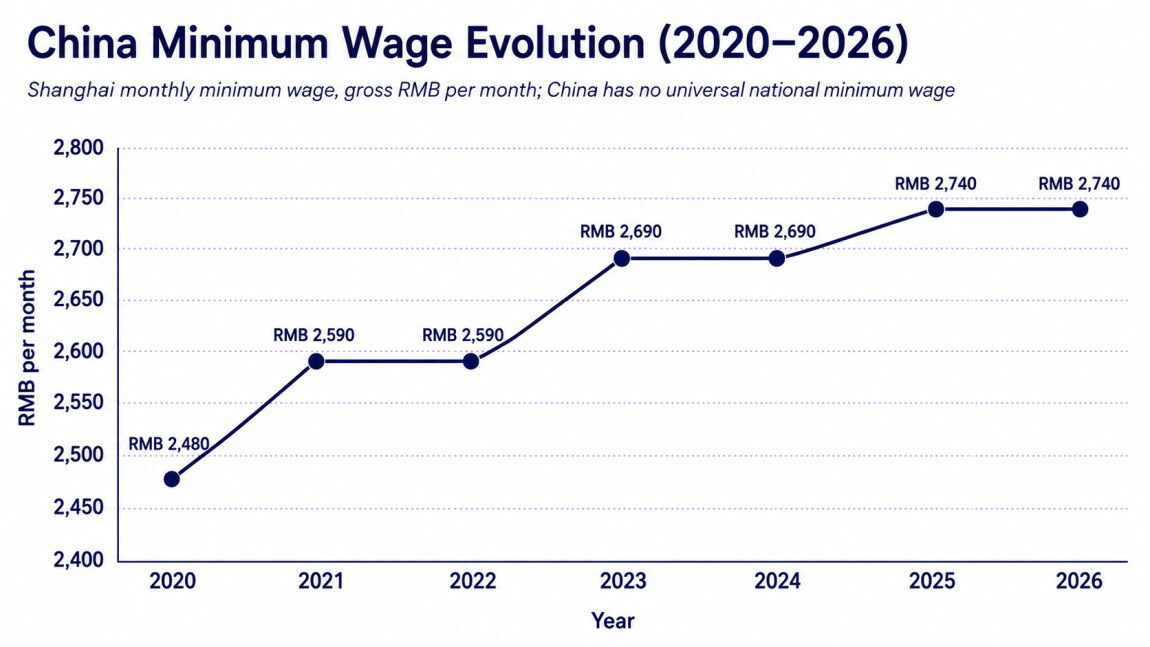
Shanghai: RMB 2,740 (The highest in China).
-
Jiangsu & Zhejiang: RMB 2,660.
-
Beijing: RMB 2,540.
-
Shenzhen: RMB 2,520.
-
Tianjin: RMB 2,510.
-
Guangdong (General): RMB 2,500.
2. Hourly Minimum Wages: The Flexibility Factor
China also mandates hourly minimum wages, which are crucial for part-time and flexible employment. Interestingly, the rankings differ slightly from the monthly standards:
-
Beijing: RMB 27.7 per hour (Highest in the country).
-
Tianjin: RMB 26.6 per hour.
-
Shanghai, Jiangsu & Zhejiang: RMB 25.0 per hour.
-
Guangdong: RMB 23.7 per hour.
Note: The difference between Beijing’s high hourly rate and Shanghai’s high monthly rate often stems from local differences in how work weeks and social security contributions are structured.
3. Recent Evolution (2024–2026)
The last two years have seen a steady wave of updates. While many provinces updated their rates during 2025, several key regions implemented new standards specifically for the start of 2026:
-
January 1, 2026: New standards went into effect in Zhejiang, Jiangsu, and Shaanxi.
-
The "RMB 2,000" Milestone: The shift toward higher floors is evident in the fact that 31 regions have now crossed the RMB 2,000 mark, a level that was rare just a few years ago.
4. Comparison with Average Monthly Salaries
To put these minimums in perspective, it is essential to look at the broader Chinese salary landscape:
-
Urban Non-Private Units: The average annual salary was 124,110 yuan (approx. 10,342 yuan/month) as of the 2024 data.
-
Urban Private Units: The average is significantly lower, at 69,476 yuan annually, or around 5,790 yuan per month, according to 2024 official data.
-
Ratio: In a city like Shanghai, the minimum wage (RMB 2,740) represents roughly 26% of the average salary in the non-private sector, but nearly half (48%) of the average salary in the private sector.
5. Compliance and Exceptions
The minimum wage in China generally includes basic pay but often excludes overtime, night shift allowances, and certain social security or housing fund contributions, depending on local provincial regulations. Employers who fail to meet these floors face strict penalties from local labor bureaus.
Conclusions
For 2026, the message from China is clear: the focus is on a high-quality "floor" in its most productive cities. While a rural worker in a lower-tier province might still see a much smaller minimum, the aggressive updates in Shanghai and the surrounding provinces show a commitment to supporting the cost of living in China’s economic engines. Ready to take the next step? Create your CV, browse job opportunities, or get ready for your job interview.
FAQ – Frequently Asked Questions
Which city has the highest monthly minimum wage in China for 2026? Shanghai holds the top spot with a monthly minimum of RMB 2,740.
Is there a national minimum wage in China? No. Rates are set by provincial and municipal governments based on local economic conditions.
Why does Beijing have a higher hourly rate than Shanghai? Beijing leads in hourly rates (RMB 27.7) due to specific local structures in part-time labor laws, even though its monthly full-time rate is lower than Shanghai’s.
Does the minimum wage include social security? In most regions, the minimum wage is the "take-home" floor, meaning it often excludes mandatory social security and housing fund contributions, which the employer must pay separately.
Share
What I read is worth it:
Article written by:
 wherewework.com

Comments
0 comments
No comments! Be the first to comment on this article!

Access your account and add your comment
Subscribe to the Newsletter
Read articles of interest from wherewework.com contributors
