Share
China Public Holidays 2026: Official Schedule and Golden Weeks
05/07/2026
2 min

Planning your travel or business operations in China requires a deep understanding of the official government holiday calendar, which includes a unique system of "make-up" workdays. In 2026, China observes seven main public holiday periods, including the famous Golden Weeks. Whether you are checking the Chinese New Year 2026 date or planning around the National Day Golden Week, this guide explains the 33-day holiday block system.
Official List of Public Holidays in China for 2026
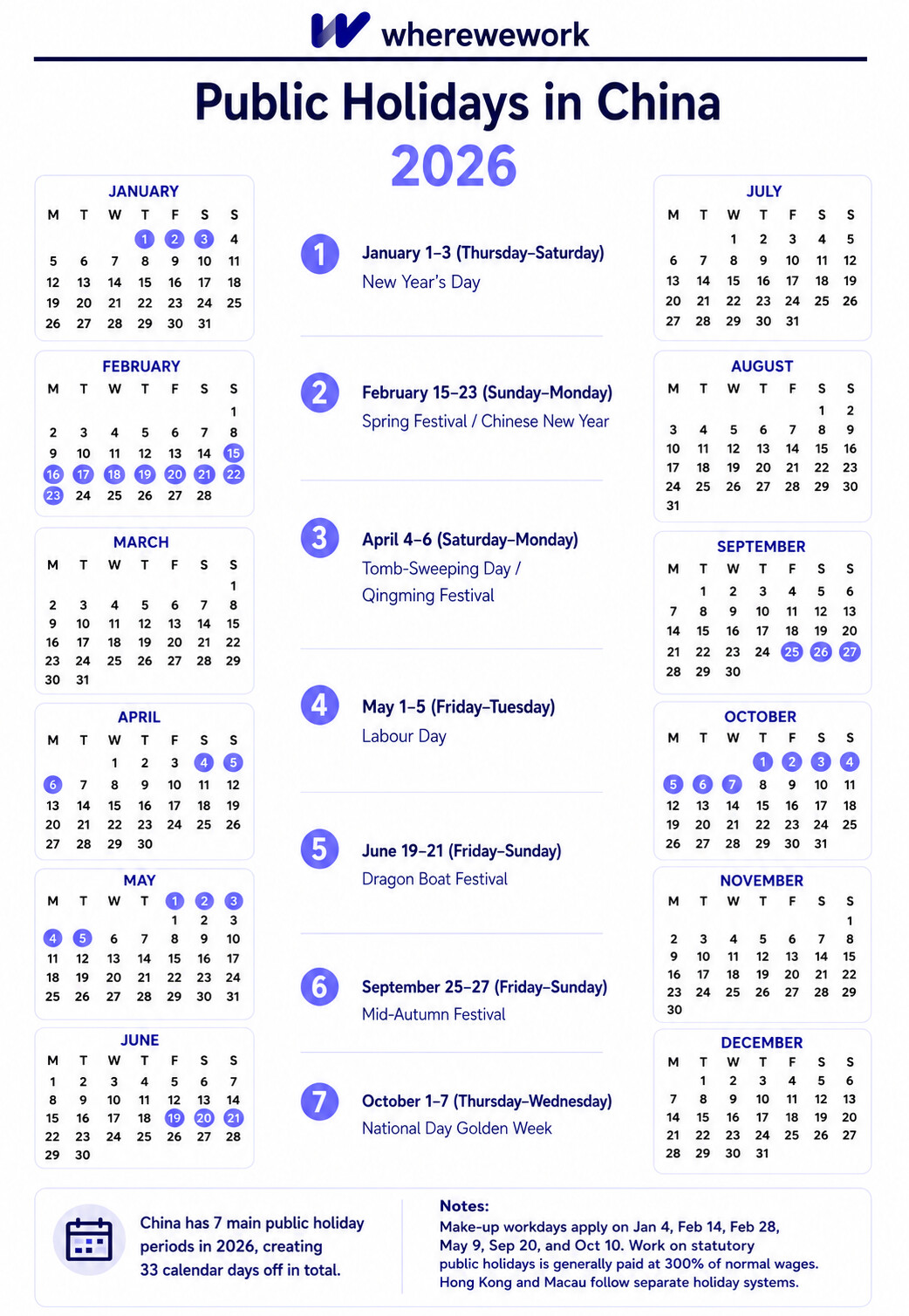
The following are the official holiday periods observed in mainland China for 2026:
-
January 1–3 (Thursday–Saturday): New Year's Day — 3 calendar days off
-
February 15–23 (Sunday–Monday): Spring Festival / Chinese New Year — 9 calendar days off
-
April 4–6 (Saturday–Monday): Tomb-Sweeping Day / Qingming Festival — 3 calendar days off
-
May 1–5 (Friday–Tuesday): Labour Day — 5 calendar days off
-
June 19–21 (Friday–Sunday): Dragon Boat Festival — 3 calendar days off
-
September 25–27 (Friday–Sunday): Mid-Autumn Festival — 3 calendar days off
-
October 1–7 (Thursday–Wednesday): National Day Golden Week — 7 calendar days off
The "Make-up" Workday System
China's holiday system is unique because the government "arranges" long breaks by moving weekend rest days to be adjacent to the holiday.
-
Adjusted Weekends: To compensate for long holiday blocks, certain Saturdays or Sundays near the holiday period become official "make-up" workdays.
-
Planning Tip: Always check the official State Council announcement for which specific weekends will be designated as working days to avoid scheduling conflicts.
The 2026 Golden Weeks
Chinese New Year (Spring Festival) In 2026, the Spring Festival holiday block is particularly long, spanning 9 days from February 15 to February 23. This is the most significant holiday in China, characterized by massive internal migration as people return to their hometowns.
National Day Golden Week Running from October 1 to October 7, this 7-day break commemorates the founding of the People's Republic of China. It is a peak period for both domestic and international tourism.
Employee Rights and Compensation in China
-
Statutory Pay: Work performed on official statutory public holidays is generally paid at 300% of normal wages.
-
Overtime during Blocks: Work on the "adjusted" weekend days or the non-statutory parts of a long holiday block is typically paid at 200% or compensated with time off.
-
Regional Differences: While mainland China follows this schedule, Hong Kong and Macau follow their own separate public holiday systems.
Practical Tips for Planning Your 2026 Calendar
-
The "Chunyun" Period: The 40-day period around Chinese New Year sees extreme pressure on the transport network. Booking train and flight tickets the moment they are released is essential.
-
Business Shutdowns: Many factories and small businesses in China close for much longer than the official 9-day Spring Festival block—sometimes up to three or four weeks.
-
Tourist Crowds: Major attractions like the Great Wall or the Forbidden City reach maximum capacity during Golden Weeks. If you are a business traveler, it is generally advised to avoid meetings in China during these weeks.
-
Plan Your Career Moves: Long weekends and Golden Weeks are also a great opportunity to prepare for your next job interview and get ahead in your career in China.
Frequently Asked Questions (FAQ)
When is the Chinese New Year in 2026? The official holiday block runs from February 15 to February 23.
Do I have to work on weekends in China? Only on specific "make-up" days designated by the government to allow for longer holiday periods during the week.
Is Mid-Autumn Festival a holiday in 2026? Yes, it is observed from September 25 to September 27.
Share
What I read is worth it:
Article written by:
 wherewework.com

Comments
0 comments
No comments! Be the first to comment on this article!

Access your account and add your comment

Subscribe to the Newsletter
Read articles of interest from wherewework.com contributors
