Share
Telework accidents in France: burden of proof shifts to employers
11/03/2026
5 min
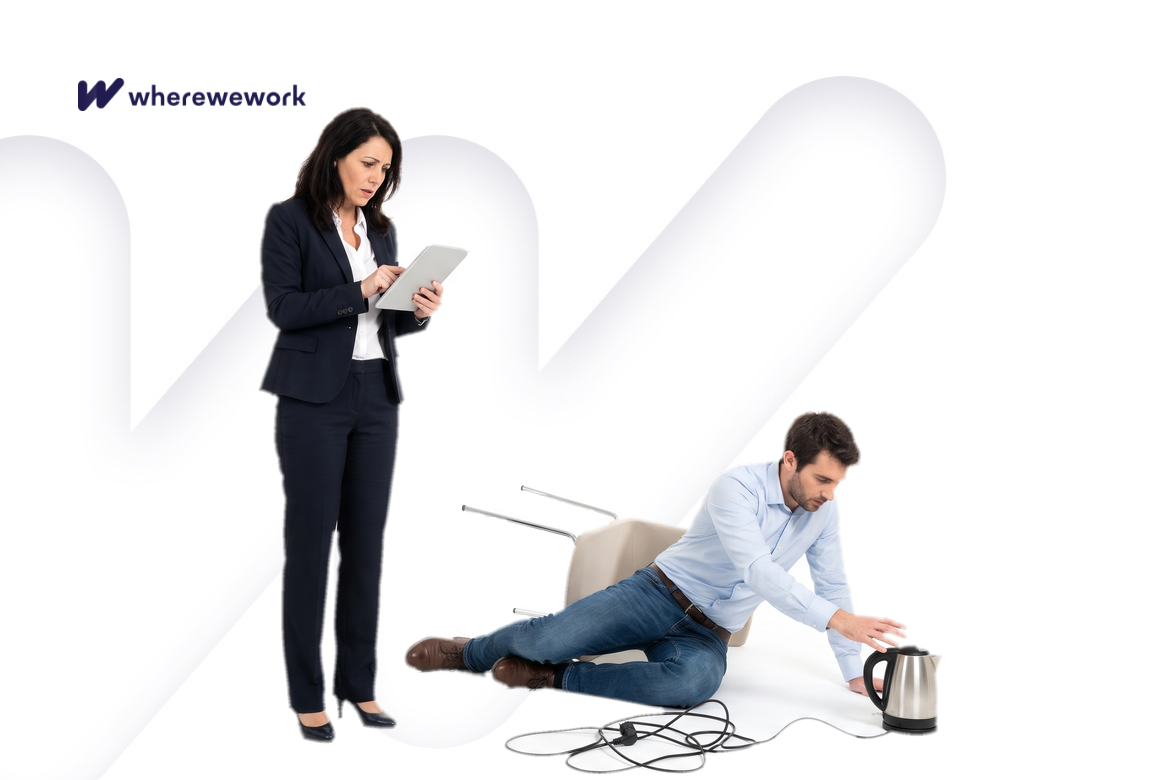
You burn your hand on the kettle at 11am on a telework day, or trip over a cable on the way from your desk to the kitchen. In France, the law starts from a simple assumption: that is a workplace accident, unless your employer can prove otherwise.
The rule sits in the Code du travail (French Labour Code) and covers anyone teleworking under French employment law, telework being the formal legal framework for remote work. For employees, it means protection that does not stop at the office door. For HR teams, it means the burden of proof sits on their side of the table, and the stakes rose on 1 November 2026, when a new compensation regime for permanent incapacity linked to workplace accidents and occupational diseases took effect.
What the law actually says
The starting point is the Code de la sécurité sociale (French Social Security Code). Its article L. 411-1 treats as a workplace accident any accident that happens because of or in the course of work, « quelle qu'en soit la cause » (whatever its cause).
Article L. 1222-9 of the Labour Code then carries that logic into the home:
« L'accident survenu sur le lieu où est exercé le télétravail pendant l'exercice de l'activité professionnelle du télétravailleur est présumé être un accident de travail » (Code du travail, art. L. 1222-9)
In plain English: an accident that happens where you telework, while you are carrying out your job, is presumed to be a workplace accident. Two conditions matter, place and time. When both are met, the presumption applies automatically. Nobody has to show that the work itself caused the injury.
What counts as a telework accident in practice
The examples set out in a recent analysis by Éditions Tissot are deliberately ordinary. All of the following, when they happen during the telework day, are presumed to be work-related:
- a burn from boiling water;
- a cut from a broken plate;
- a fall at home during working hours;
- verbal aggression suffered during a video call.
The kitchen is where most people are surprised. Unless the employer can show that work was genuinely interrupted, for example because the employee was disconnected from the company IT network and phone, the places where you eat lunch or take a break at home can be treated like the break areas of an office. Legally, a coffee at your own kitchen table looks much closer to a coffee in the staff room than many assume.
For employees: what this means for you
If you get hurt at home on a telework day, during your working hours, treat it exactly as you would an accident at the office. Tell your employer promptly, write down the time and what you were doing, and have any injury medically documented.
You do not need to prove that work caused the accident: the presumption does that for you. Your employer is required to declare an accident that happens during working time at your telework location. They can contest how it is qualified, but only by producing concrete evidence that it had nothing to do with your job, not simply by deciding that a fall at home “doesn’t count”.
The grey zone is the edge of the day. The statutory wording ties the presumption to the time you are actually working, so an accident at 8pm, long after you have closed the laptop, is a different situation. If your employer has a telework charter, or if your arrangement is covered by a collective agreement, check what it says about working hours and breaks. It is the simplest protection you have.
Why does the label matter so much? Because recognition as a workplace accident decides which compensation rules apply to you, from daily allowances to the new permanent incapacity regime explained below.
For HR teams: the burden of proof is yours
For employers, the presumption reverses the usual instinct. The question is not whether the employee can show the accident was work-related, but whether you can show it was not. Per the Tissot analysis, employers must declare accidents that occur during working time at the telework location, and may only contest the qualification with material proof that the accident is unrelated to work.
That proof rarely appears after the fact. It is built in advance, through the way telework is organised. Three areas are worth reviewing now:
- Working hours and breaks. A telework charter or agreement with clear time slots makes it far easier to establish whether an accident happened inside or outside working time.
- Evidence of a genuine interruption. Disconnection from the IT network and phone is the kind of element that can show work had stopped. Think about how breaks are recorded, without sliding into intrusive monitoring of people at home.
- An incident protocol for teleworkers. Who the employee contacts, what information is collected (time, activity, circumstances) and who files the declaration. A clear process protects the employee’s rights and your ability to contest a claim on solid ground.
A word on tone. Contesting every accident at home is likely to cost more in trust than it saves in contributions or disputes. Most kitchen burns at 11am on a Tuesday will be exactly what they appear to be. The goal is accurate qualification, not a reflex challenge.
Why 1 November 2026 raises the stakes
The timing is not neutral. A new compensation regime for permanent incapacity resulting from accidents du travail et maladies professionnelles (AT/MP, workplace accidents and occupational diseases) took effect on 1 November 2026. Any telework accident recognised as work-related that leaves lasting consequences now falls under that new framework.
Two other figures frame the financial picture. The daily social security allowances paid after a workplace accident (indemnités journalières, or IJSS) are capped at 1.8 times the SMIC, France’s statutory minimum wage. And the 2027 finance bill (projet de loi de finances, PLF 2027) could toughen the taxation of these daily allowances. Put together, the qualification of a single telework accident is a decision with real weight for both sides.
Telework has moved part of the workplace into the home, and French law has followed it there. If you are an employee, know your agreed hours and report an accident at home as you would one at the office. If you work in HR, your strongest position in a contested claim is not a dispute after the fact, but a telework charter that makes working time readable before anything goes wrong.
Share
What I read is worth it:
Read all the articles about
Ethics Balance Career planning Employee experience HR Metrics HR Coach Off topic Workforce planning Labour market Human behaviourArticle written by:
 wherewework.com

Comments
0 comments
No comments! Be the first to comment on this article!

Access your account and add your comment
Ethics


Subscribe to the Newsletter
Read articles of interest from wherewework.com contributors
