Share
South Africa public holidays 2026: dates and best bridge days
09/23/2026
8 min

South Africa's 2026 public holiday calendar is more generous than most years, and there are still four working-day holidays ahead for anyone who has not yet mapped out the final quarter. The standard statutory tally under the Public Holidays Act 36 of 1994 is 12 fixed holidays, but President Cyril Ramaphosa's proclamation on 15 September 2026 added a 13th: Wednesday 4 November, the date of the Local Government Elections, declared a public holiday nationwide under Section 2A of the Public Holidays Act of 1994. That single proclamation repositioned an ordinary mid-week day into the centrepiece of one of the best bridge-day windows left on the calendar.
Counting working-day holidays carefully, 2026 delivers 11 weekday public holidays including one Monday substitute for National Women's Day, which fell on a Sunday, plus the three holidays that land on weekends. The election-day bonus brings the practical total to 12 weekday holidays across the year, which is one more than 2025 offered. The good news for the fourth quarter is that most of what remains clusters around Wednesday anchors, exactly the structure where a modest annual-leave spend unlocks the longest stretches away from the office.
By today, 23 September, seven working-day holidays have already passed. Below you will find the full 2026 list for reference, then four bridge plans that are still actionable, and finally the Basic Conditions of Employment Act 75 of 1997 (BCEA) Section 18 pay framework for anyone who will be working through any of them.
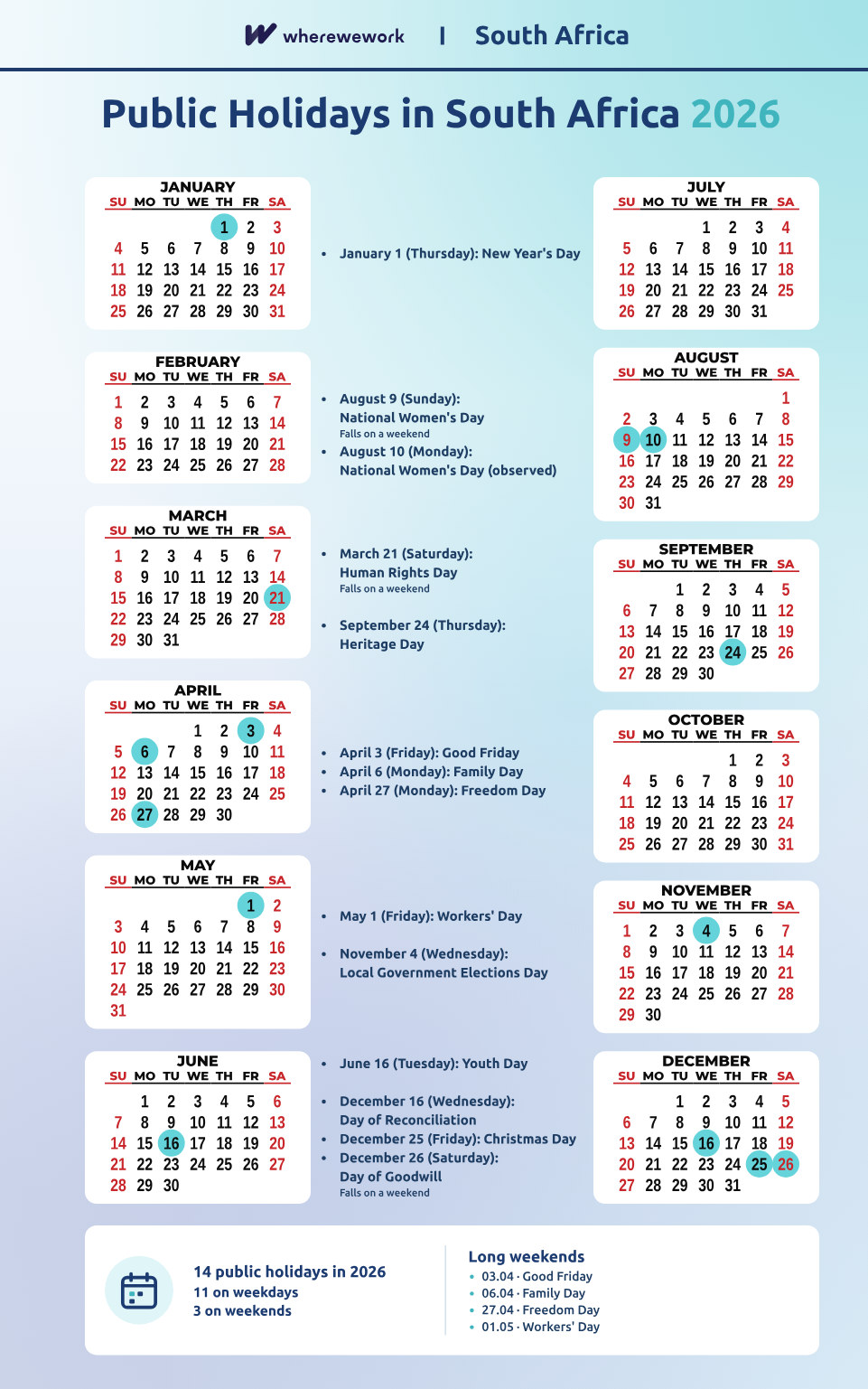
The complete 2026 public holidays calendar
Per the official gov.za calendar and the Presidency's 15 September proclamation, South Africa's 13 public holidays for 2026 are as follows:
- 1 January (Thu), New Year's Day
- 21 March (Sat), Human Rights Day - falls on a weekend
- 3 April (Fri), Good Friday
- 6 April (Mon), Family Day
- 27 April (Mon), Freedom Day
- 1 May (Fri), Workers' Day
- 16 June (Tue), Youth Day
- 9 August (Sun), National Women's Day - falls on a weekend
- 10 August (Mon), National Women's Day (observed)
- 24 September (Thu), Heritage Day
- 4 November (Wed), Local Government Elections Day
- 16 December (Wed), Day of Reconciliation
- 25 December (Fri), Christmas Day
- 26 December (Sat), Day of Goodwill - falls on a weekend
The Public Holidays Act 36 of 1994 contains a built-in Sunday-shift rule: when a public holiday lands on a Sunday, the following Monday automatically becomes a public holiday in its place. That rule is why 10 August appears on this list as the observed National Women's Day. For Saturday falls, the Act does not trigger a shift to the next working day, so Human Rights Day on Saturday 21 March and Day of Goodwill on Saturday 26 December both simply land on non-working days for most employees. If you ordinarily work Mondays, you do not gain a substitute day in either case.
The Local Government Elections holiday: a genuine 13th day
On 15 September 2026, the Presidency confirmed that President Cyril Ramaphosa had used his powers under Section 2A of the Public Holidays Act of 1994 to declare Wednesday 4 November a public holiday throughout the Republic. SAnews, the South African Government News Agency, published the same confirmation the same day. The declaration also urges employers to make provision for employees to exercise their constitutional right to vote on that day.
In practical terms, 4 November carries exactly the same legal weight as any other day on the statutory list. The BCEA Section 18 pay rules apply in full, and an employee who does not want to work is protected by the by-agreement requirement discussed below. This is not a partial or symbolic recognition; it is a full, freestanding 13th statutory holiday for 2026, with all the leave and pay protections that flow from that status.
Bridge-day plans for the rest of 2026
Four public holidays remain on working days after today, 23 September: Heritage Day, Local Government Elections Day, Day of Reconciliation and Christmas Day. Here is how to get the most out of each one with the smallest possible draw on your annual leave balance.
1. Heritage Day, Thursday 24 September
Take Friday 25 September as annual leave and you have a 4-day weekend running from Thursday 24 September to Sunday 27 September, at the cost of just 1 leave day. This is the sharpest and most immediate bridge on offer, and given that today is already 23 September, the window to plan it is right now.
2. Local Government Elections Day, Wednesday 4 November
Two approaches here, depending on how much annual leave you are willing to commit.
- Compact option: take Thursday 5 November and Friday 6 November as leave. That gives you a 5-day break from Wednesday 4 November through to Sunday 8 November, spending 2 leave days.
- Full-week option: take Monday 2 November, Tuesday 3 November, Thursday 5 November and Friday 6 November off. Four leave days convert into a 9-day escape running from Saturday 31 October to Sunday 8 November. This is the best leave-to-days-off ratio of any remaining opportunity in the year.
3. Day of Reconciliation, Wednesday 16 December
The same mid-week Wednesday structure as the election day holiday, and the same two configurations apply.
- Compact option: book Thursday 17 December and Friday 18 December off for a 5-day break from Wednesday 16 to Sunday 20 December, at the cost of 2 leave days.
- Full-week option: take Monday 14, Tuesday 15, Thursday 17 and Friday 18 December off to unlock 9 consecutive days from Saturday 12 to Sunday 20 December, on 4 leave days. This approach lets you wind down properly before Christmas week itself begins.
4. Christmas Day, Friday 25 December
Because Christmas Day is a Friday and Day of Goodwill falls on Saturday 26 December, the weekend already gives you a free 3-day window from 25 to 27 December without spending a single leave day.
For a longer stretch: take Monday 21, Tuesday 22, Wednesday 23 and Thursday 24 December as leave. Four leave days produce a 9-day festive period from Saturday 19 to Sunday 27 December, with Christmas Day anchoring the end of that run.
Section 20 of the BCEA entitles you to at least 21 consecutive days of annual leave on full pay per 12-month leave cycle, which works out to roughly 15 working days for a five-day week. Chain the two November and December bridges together with Heritage Day and you can be out of the office for 23 calendar days across the final quarter of the year on just 11 leave days. That is worth mapping out before your team's December leave planner fills.
If you have to work on a public holiday: what you are owed
Section 18 of the Basic Conditions of Employment Act 75 of 1997 is unusually specific, and worth committing to memory before any public-holiday roster lands. The starting point is consent: an employer may not require you to work on a public holiday except by agreement. If your contract does not obligate you to public-holiday work and you have not otherwise agreed, you have the right to decline.
If you do work, the pay calculation depends on whether the public holiday falls on a day you would ordinarily have worked.
- Ordinary working day: under Section 18(2) of the BCEA, your employer must pay you at least double your ordinary daily wage, or if it produces a larger figure, your ordinary daily wage plus the amount you actually earned for the hours worked.
- Not an ordinary working day: under Section 18(3) of the BCEA, you receive your ordinary daily wage plus the amount earned for the work performed on the day.
- Not working, but it is your usual day: Section 18(2)(a) still entitles you to the wage you would ordinarily have received for that day.
- Shifts crossing midnight: Section 18(5) of the BCEA treats a shift that straddles a public holiday and another day as fully worked on the public holiday, unless the greater portion of the shift actually falls on the other day.
Section 18(4) requires payment on your usual pay day, not at some delayed point afterwards. Separately, Section 2(2) of the Public Holidays Act 36 of 1994 allows you and your employer to agree to swap a public holiday for another working day, which is the statutory basis for a day-in-lieu arrangement. That option is legitimate and practical in essential-services and retail environments, but it must be reached by agreement rather than imposed unilaterally.
Family responsibility leave, and what public holidays do not cover
Two points come up repeatedly in leave planning and are worth separating clearly. First, Section 27 of the BCEA gives an employee who has completed more than four months of service with the same employer, and who works more than four days a week, three days of paid family responsibility leave per annual leave cycle. This leave covers situations such as a child's illness or the death of a spouse, life partner, parent, adoptive parent, child, adopted child, grandchild, grandparent or sibling. It does not cover a wedding, and it is not a general-purpose leave buffer.
Second, the BCEA does not create a separate statutory entitlement to marriage leave. Time off for a wedding comes directly out of your annual leave balance, so if you are getting married in late 2026, that draw needs to sit alongside whatever you are reserving for the bridge-day windows above.
On parental leave, Section 25 of the BCEA entitles a biological mother to four consecutive months of maternity leave. Non-birthing, adoptive and commissioning parents historically held an entitlement to 10 days of parental leave, though a Constitutional Court judgment has since made that leave sharable between parents. If your family plans overlap with the November or December holiday window, raising the conversation with your HR team early gives everyone the best chance to plan around it.
Parents: what the 2026 school calendar looks like
For working parents, the Department of Basic Education's 2026 school calendar maps directly onto the public holiday planning above. Public school terms run from 14 January to 27 March (Term 1), 8 April to 26 June (Term 2), 21 July to 23 September (Term 3), and 6 October to 9 December (Term 4). The department has also declared Monday 15 June 2026 a special school holiday adjoining Youth Day, extending the break around that Tuesday off.
Term 4 closes on 9 December, a full week before the Day of Reconciliation on 16 December. For parents whose daily rhythm is anchored to school pick-up, the 12 to 20 December bridge plan aligns neatly with the end of the school year. Closing the office and the school gate at the same time is a meaningful practical benefit that the 4-leave-day bridge quietly enables.
Enforcement: what happens if your employer gets Section 18 wrong
Non-compliance with the BCEA's public-holiday pay requirements falls within the enforcement mandate of the Department of Employment and Labour. Inspectors from the Department can issue compliance orders, levy fines, and direct employers to compensate employees who have been underpaid. Disputes about incorrect public-holiday pay can also be referred to the Commission for Conciliation, Mediation and Arbitration (CCMA) under the BCEA's arbitration procedures.
The financial exposure for employers is not nominal. For a first underpayment finding, a CCMA arbitration award can impose a fine equal to the greater of twice the underpayment or twice the employee's monthly wage. For repeat non-compliance, that multiplier rises to three times. If you believe a public-holiday shift was paid at a flat daily rate rather than the Section 18(2) or Section 18(3) rate, the potential recovery is large enough that raising it formally is a reasonable step, not an overreaction.
Plan the leave, know the pay
The 13-holiday calendar that 2026 turned out to be rewards preparation. Heritage Day is tomorrow. The election-day and Reconciliation Day bridges each convert two leave days into a mid-week reset, or four leave days into nine days away from the office. And for anyone who will be working through any of these days, the Section 18 framework under the Basic Conditions of Employment Act 75 of 1997 is precise about what you are owed: know those numbers before payslip day, not after it lands.
Share
What I read is worth it:
Read all the articles about
About the crafts Balance Career planning Economic Employee experience Editorial Human behavior International Internships and volunteering Labour market HR Metrics HR Coach Workforce planning Negotiation Legislative No categories Off topicArticle written by:
 wherewework.com

Comments
0 comments
No comments! Be the first to comment on this article!

Access your account and add your comment
About the crafts


Subscribe to the Newsletter
Read articles of interest from wherewework.com contributors
