Share
Best Countries to Work in Tech: CEE vs Western Europe Comparison
06/08/2026
3 min

Western Europe remains the premier destination for top-tier absolute compensation and access to massive corporate and venture capital networks. However, high taxation and severe housing crises in major cities pose significant bottlenecks.
The Top Tier Leaders
-
The Netherlands: A powerhouse for remote readiness and infrastructure. English is universally spoken in business, and connectivity is world-class. Note: Amsterdam remains incredibly expensive, and historical data like the CBS 52% WFH rate highlights a long-standing culture of flexibility.
-
Ireland: The European headquarters for global Big Tech companies. It offers an incredible multinational tech ecosystem and an English-speaking environment, though Dublin’s extreme cost of living heavily erodes saving potential.
-
Germany: Driven by massive industrial tech, enterprise companies, and major hubs like Berlin and München. It offers strong structural demand and a clear immigration pathway via the 2026 Blue Card updates, though hiring processes tend to be slower.
-
The United Kingdom: London continues to dominate when it comes to the absolute highest total compensation ceiling in Europe, supported by a highly mature financial and startup market.
Strong & Important Mentions
-
The Nordics (Denmark, Suedia, Finlanda, Norvegia): Unrivaled in work-life balance, high digitalization, and social stability, though high tax wedges and living costs are a standard trade-off.
-
Switzerland: Offers jaw-droppingly high salaries and pristine quality of life, but sits outside the EU, meaning separate visa/market access rules apply.
-
France: A major player in AI research and startup density, though premium total compensation in Paris generally ranks below London and Berlin hubs.
Central & Eastern Europe (CEE): The Champions of Cost-to-Talent Ratio
The CEE region has transitioned from a pure outsourcing hub into a thriving tech ecosystem of its own. It cannot compete with Western Europe on absolute gross salaries, but it completely dominates when measuring purchasing power parity (PPP) and disposable income.
The Top CEE Tier
-
Estonia: The undisputed champion of digital governance and tech startups per capita. It boasts incredible remote friendliness and a highly digitalized society, though the total volume of available tech jobs is lower than in larger nations like Poland.
-
Poland: The massive gravity well of CEE tech. Poland features a massive talent pool and multiple booming tech cities (Warsaw, Kraków, Wrocław). While costs are rising in major hubs, the job density and ecosystem maturity are stellar.
-
Czechia: Serves as a perfect regional hub, striking an ideal balance between Western economic integration and CEE cost efficiencies, though Prague is becoming increasingly expensive.
Highly Competitive Markets
-
Romania: Offers an excellent cost-to-talent ratio, supported by thriving IT hubs in Bucharest, Cluj-Napoca, Iași, and Timișoara. While highly competitive for software developers due to strong local purchasing power, its ecosystem is more fragmented than Poland’s or Estonia’s, meaning it doesn't automatically claim the #1 spot in CEE.
-
Lithuania, Latvia, Slovenia: Smaller markets but exceptional in terms of quality of life, rapid digital advancement, and ease of doing business.
-
Hungary, Bulgaria, Croatia: Highly competitive cost profiles and deep technical talent pools, though general remote adoption and local venture capital density are still catching up.
Summary: The CEE vs. Western Europe Scorecard
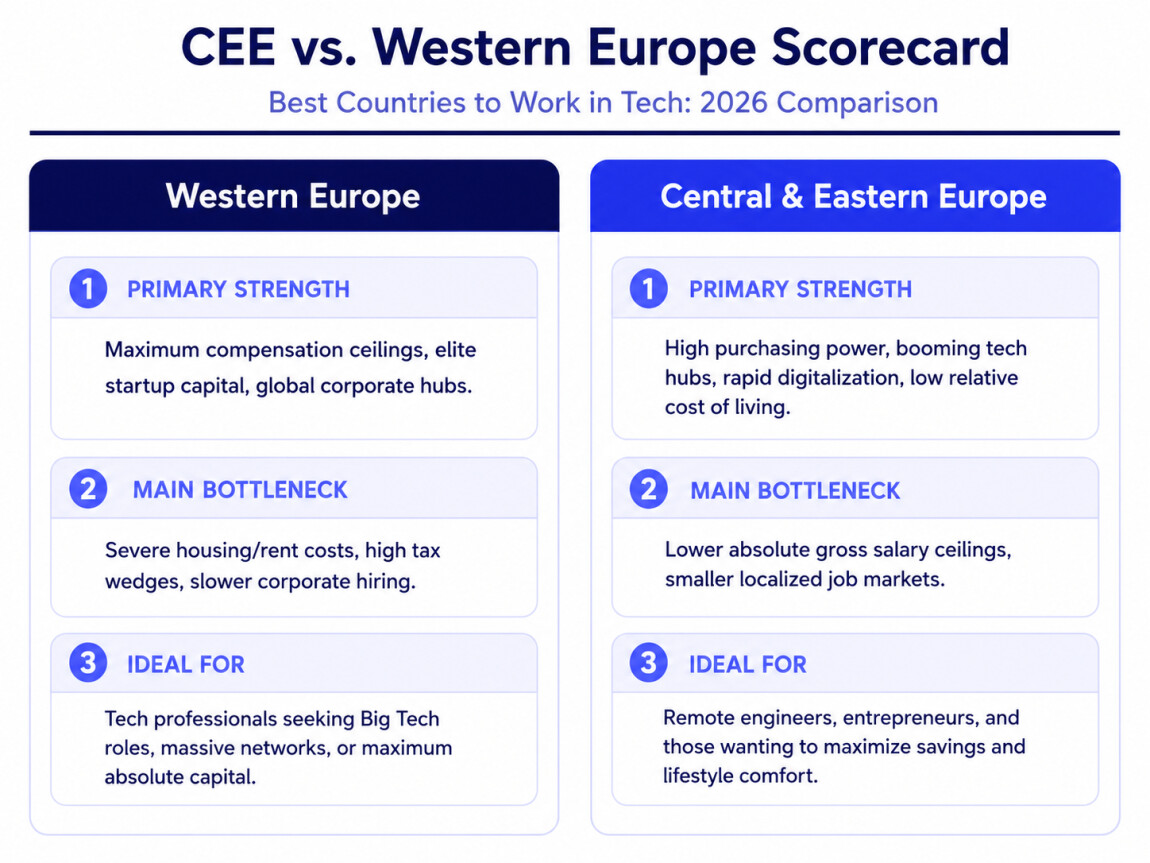
The Editorial Verdict: There is no single "best" country. If your priority is the absolute maximum cash and equity ceiling, choose London or Switzerland. If you want elite remote infrastructure and an international community, look to The Netherlands or Ireland. But if you want your tech salary to yield the highest possible standard of living, luxury, and savings potential, Poland, Czechia, and Romania are unbeatable in 2026.
Frequently Asked Questions (FAQ)
1. Is this ranking based on an official international index? No, this ranking utilizes an editorial composite model. Instead of relying on a single external source, it dynamically blends data from multiple streams, including Levels.fyi wherewework and Glassdoor for salaries, OECD for purchasing power and tax wedges, and Eurostat for digital readiness, applying specific weights to give a balanced career overview.
2. Why isn’t Romania automatically ranked as the number one tech country in CEE? While Romania has phenomenal technical talent and highly competitive local purchasing power across hubs like Bucharest and Cluj, its broader tech ecosystem remains more fragmented compared to countries like Poland (which offers a much larger, multi-city job density) or Estonia (which leads heavily in digital governance and startups per capita).
3. Does Western Europe always guarantee a better tech career than CEE? Only if you are measuring by absolute gross numbers or seeking specific Big Tech corporate headquarters. If you evaluate your career by disposable income (what you keep after paying rent, utilities, and taxes), the lower cost of living in CEE countries often allows software engineers to enjoy a higher relative standard of living compared to peers paying premium rents in hubs like London or Dublin.
Share
What I read is worth it:
Read all the articles about
International Labour market Students Statistics Workforce planning Job opportunitiesArticle written by:
 wherewework.com

Comments
0 comments
No comments! Be the first to comment on this article!

Access your account and add your comment
International


Subscribe to the Newsletter
Read articles of interest from wherewework.com contributors
