Share
Public Holidays in the United States 2027: Official Dates and Long Weekends
10/28/2026
9 min

The 2027 federal holiday calendar delivers a small but real bonus for workers on a standard Monday-to-Friday schedule. The U.S. Office of Personnel Management (OPM), which publishes the official federal holiday schedule under 5 U.S.C. 6103, confirms that federal employees on a Monday-through-Friday workweek get 12 weekday days off in calendar year 2027, compared with 11 in 2026. The extra day lands at the very end of the year, and how it gets there is worth understanding before you start blocking out time.
New Year's Day 2028 falls on a Saturday, so OPM shifts the observed day to Friday, December 31, 2027, and files it under its 2028 schedule rather than the 2027 table. Three other holidays also land on a weekend in 2027: Juneteenth (Saturday, June 19), Independence Day (Sunday, July 4), and Christmas Day (Saturday, December 25). Each shifts to a neighboring Friday or Monday for federal staff. The bottom line: 2027 offers more built-in long weekends than 2026, but the federal calendar is not the same thing as your personal calendar.
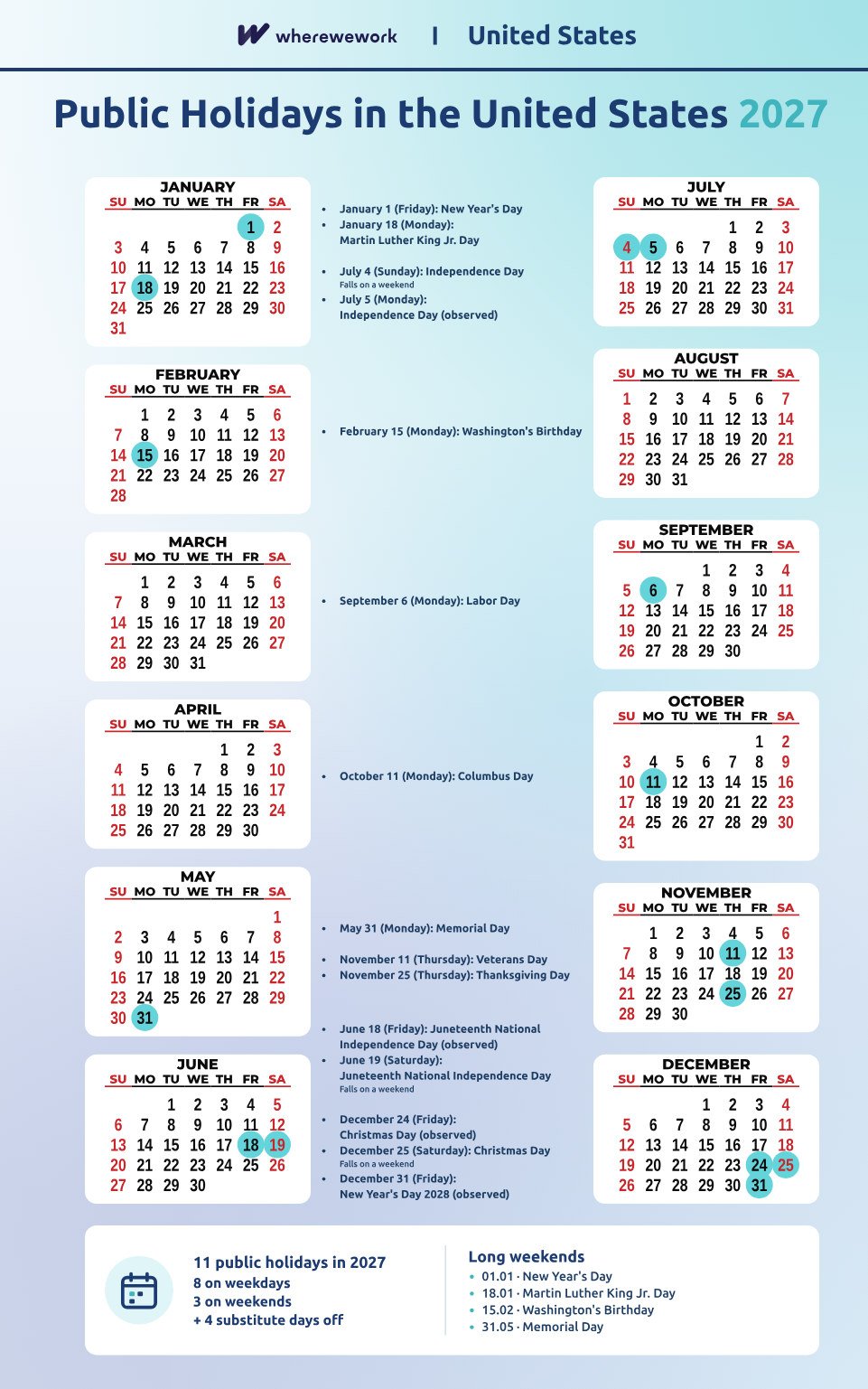
The full list of US federal holidays in 2027
These are the dates on OPM's official 2027 schedule, with the weekday on which federal staff working Monday through Friday observe each holiday. Three of the 11 entries carry OPM's footnote for weekend dates shifted to the nearest weekday under 5 U.S.C. 6103(b) and Executive Order 11582.
- Friday, January 1: New Year's Day
- Monday, January 18: Birthday of Martin Luther King, Jr.
- Monday, February 15: Washington's Birthday (often called Presidents Day in everyday speech, but OPM and federal law keep the original name)
- Monday, May 31: Memorial Day
- Friday, June 18: Juneteenth National Independence Day, observed (June 19 is a Saturday)
- Monday, July 5: Independence Day, observed (July 4 is a Sunday)
- Monday, September 6: Labor Day
- Monday, October 11: Columbus Day
- Thursday, November 11: Veterans Day
- Thursday, November 25: Thanksgiving Day
- Friday, December 24: Christmas Day, observed (December 25 is a Saturday)
- Friday, December 31: New Year's Day 2028, observed (January 1, 2028 is a Saturday) - filed by OPM under its 2028 schedule
There is no Inauguration Day holiday in 2027. That Washington, DC-area observance occurs every fourth year after a presidential election. The next one, January 20, 2029, falls on a Saturday and will not be observed on another day.
Who actually gets these days off
This is the part that surprises a lot of workers, especially those new to the US labor market. The Congressional Research Service (CRS), in its report on federal holidays (report R41990, updated July 1, 2021), notes that although these days are commonly called national holidays, they are legally applicable only to federal employees and the District of Columbia. Each state individually sets its own legal holidays. Neither Congress nor the president holds authority to impose a binding national holiday on the 50 states.
Private employers have even more flexibility. The Department of Labor (DOL) is direct on this point: the Fair Labor Standards Act (FLSA) does not require payment for time not worked, holidays included. Paid holidays are a matter of agreement between you and your employer, or the terms of a collective bargaining agreement.
Most private-sector workers do receive paid holidays, but not all. The Bureau of Labor Statistics (BLS), in its Employee Benefits in the United States survey for March 2026, released September 25, 2026, found that 81% of private industry workers had access to paid holidays and 80% to paid vacation. That means roughly 19%, about one in five private-sector workers, had no paid holidays at all. Among state and local government workers, the BLS figures were 68% for paid holidays and 61% for paid vacation. A federal holiday on the calendar does not automatically mean a day off in your paycheck.
Why an observed Friday is not a day off for everyone
For federal employees, the shift is written into statute. Under 5 U.S.C. 6103(b), a Saturday holiday moves to the Friday immediately before for employees whose basic workweek is Monday through Friday. Executive Order 11582 of February 11, 1971 moves a Sunday holiday to the following Monday. All full-time federal employees, including those on flexible or compressed schedules, receive these in-lieu-of days. Part-time and intermittent federal employees do not.
Outside the federal workforce, those same Fridays can be regular working days:
- Federal Reserve Banks stay open on the Friday before a Saturday holiday. That means Federal Reserve Banks work on Friday, June 18; Friday, December 24; and Friday, December 31, 2027, though they close on Monday, July 5.
- The New York Stock Exchange (NYSE), per NYSE Group's published 2026-2028 holiday and early-closings calendar, does not observe a New Year's Day holiday for 2028 because January 1, 2028 falls on a Saturday. US stock markets are therefore scheduled to trade on Friday, December 31, 2027, the day most federal employees have off. The NYSE's 2027 list also includes Good Friday (March 26) as a market holiday, and does not include Columbus Day or Veterans Day.
- New York State does not shift Saturday holidays to Friday for its executive-branch classified employees. For state workers on a Monday-through-Friday schedule, Juneteenth (Saturday, June 19) and Christmas Day (Saturday, December 25) in 2027 are designated as pass-day holidays: eligible employees earn 7.5 or 8 hours of holiday leave to use at another time, subject to supervisory approval. New York State also lists Lincoln's Birthday (Friday, February 12) and Election Day (Tuesday, November 2) as legal holidays for state employees in 2027, neither of which appears on the federal list.
If you work in the private sector, check your employer's written holiday policy before booking travel around an observed Friday. That Friday may be a normal workday for you.
Working on a public holiday: what the rules say
Federal employees required to work their regular hours on a holiday receive basic pay plus holiday premium pay of an equal amount, for a total of double pay, or 200% of the basic rate, for each hour of holiday work. A minimum of 2 hours of premium pay applies, per OPM guidance grounded in 5 U.S.C. 5546(b) and 5546(c).
In the private sector, there is no federal holiday premium. The FLSA, administered by the DOL's Wage and Hour Division, requires overtime at least one and a half times the regular rate after 40 hours in a workweek for nonexempt workers. It requires nothing extra because the day happens to be a holiday. Any holiday rate in the private sector comes from your employer's own policy or a collective agreement. Some government contracts carry additional requirements: work covered by the McNamara-O'Hara Service Contract Act, for contracts above $2,500, may specify holiday and vacation fringe-benefit terms in the applicable wage determination.
If holiday pay is part of your compensation, start from your gross salary and calculate what the premium actually adds to your take-home pay after federal and state taxes. Use salary benchmark data from verified sources to see how your total package compares with others in the same role and region before your next negotiation.
Extra time off for public servants and families
Full-time federal employees also accumulate annual leave on top of holidays. The accrual rate scales with tenure: 4 hours per pay period with fewer than 3 years of service; 6 hours per pay period, with 10 hours in the final pay period, for employees with 3 but fewer than 15 years; and 8 hours per pay period for those with 15 or more years. You have the right to take that leave, though your supervisor retains authority to schedule when it is taken.
For New York State employees, eligible full-time workers are entitled to 13 holidays a year under the state's Attendance Rules.
On the family side, the Family and Medical Leave Act (FMLA), enforced by the DOL, gives eligible employees at up to 12 workweeks of unpaid, job-protected leave in a 12-month period for qualifying reasons, including the birth of a child or care for a newborn within the first year. Group health benefits continue under the same terms during FMLA leave. To qualify, you need at least 12 months with your employer, at least 1,250 hours worked in the previous 12 months, and a worksite where the employer has at least 50 employees within 75 miles. Note that FMLA leave is unpaid at the federal level; some states and some employers layer paid leave on top of this baseline, so check what applies in your state.
Long-weekend plans for 2027
The plans below follow the federal calendar for a Monday-through-Friday week. If your employer does not observe a listed date, count it as a leave day you will need to use.
- New Year 2027: free 3-day weekend, Friday, January 1 through Sunday, January 3. Take 4 leave days (Monday, December 28 through Thursday, December 31, 2026) for 10 days off starting Friday, December 25, 2026.
- Martin Luther King, Jr. Day and Washington's Birthday: free 3-day weekends, Saturday, January 16 through Monday, January 18 and Saturday, February 13 through Monday, February 15. Add 4 leave days (Tuesday through Friday of each week) for 9 days off each window.
- Memorial Day: free 3-day weekend, Saturday, May 29 through Monday, May 31. Add 4 leave days (Tuesday, June 1 through Friday, June 4) for 9 days off, through Sunday, June 6.
- Juneteenth: free 3-day weekend, Friday, June 18 through Sunday, June 20. Take 4 leave days (Monday, June 14 through Thursday, June 17) for 9 days off from Saturday, June 12. Federal Reserve Banks and NYSE work June 18, so finance workers should verify their employer's calendar.
- Independence Day: free 3-day weekend, Saturday, July 3 through Monday, July 5. Add 4 leave days (Tuesday, July 6 through Friday, July 9) for 9 days off, through Sunday, July 11.
- Labor Day and Columbus Day: free 3-day weekends, Saturday, September 4 through Monday, September 6 and Saturday, October 9 through Monday, October 11. Add 4 leave days in each week for 9 days off each stretch.
- Veterans Day: take Friday, November 12 (1 leave day) for a 4-day stretch, Thursday, November 11 through Sunday, November 14. Or take Monday, November 8 through Wednesday, November 10 and Friday, November 12 (4 leave days) for 9 days off from Saturday, November 6.
- Thanksgiving: take Friday, November 26 (1 leave day) for 4 days off, Thursday, November 25 through Sunday, November 28. Or take Monday, November 22 through Wednesday, November 24 and Friday, November 26 (4 leave days) for 9 days off from Saturday, November 20. NYSE closes early at 1:00 p.m. on Friday, November 26, 2027.
- Christmas: free 3-day weekend, Friday, December 24 through Sunday, December 26. Take 4 leave days (Monday, December 20 through Thursday, December 23) for 9 days off from Saturday, December 18.
- Year-end: free 3-day weekend, Friday, December 31, 2027 through Sunday, January 2, 2028. Take 4 leave days (Monday, December 27 through Thursday, December 30) for 10 consecutive days off, Friday, December 24, 2027 through Sunday, January 2, 2028. If you work in financial services, note that December 31 is a normal NYSE trading day.
The quieter stretches around holidays are also a practical time to update your resume, compare salary data for your role, and review open positions. If you are weighing a job offer, ask during the interview how that employer handles work on public holidays, and whether observed Fridays count as paid days off. The answer tells you more than the benefits summary page will.
Get OPM's official 2027 dates into your calendar now, confirm what your own employer actually observes, and plan your leave requests before the popular weeks fill up.
Share
What I read is worth it:
Read all the articles about
About the crafts Balance Career planning Economic Employee experience Editorial HR Coach HR Metrics Human behaviour Labour market Workforce planning LegislativeArticle written by:
 wherewework.com

Comments
0 comments
No comments! Be the first to comment on this article!

Access your account and add your comment
About the crafts

Subscribe to the Newsletter
Read articles of interest from wherewework.com contributors
