Share
England and Wales bank holidays 2027: confirmed dates, Working Time Regulations and your leave rights
10/30/2026
8 min

England and Wales have 8 bank holidays in 2027, all falling on weekdays, matching the total from 2026. The dates are already confirmed: they rest on Schedule 1 of the Banking and Financial Dealings Act 1971, common-law status (for Good Friday and Christmas Day), and a Royal Proclamation sealed at a Privy Council meeting on 8 July 2026, which appointed Friday 1 January, Monday 3 May and Tuesday 28 December 2027 as bank holidays under section 1(3) of the 1971 Act. Easter arrives early, in March, giving a free four-day weekend without touching any annual leave. Christmas Day falls on Saturday 25 December and Boxing Day on Sunday 26 December, so substitute weekdays take their place on Monday 27 and Tuesday 28 December.
One practical point runs through everything that follows. The calendar is confirmed by statute and Royal Proclamation, but your right to actually take these days off, or to receive extra pay for working them, is not fixed by law. That depends on your contract of employment. Scotland and Northern Ireland follow different calendars, covered below.
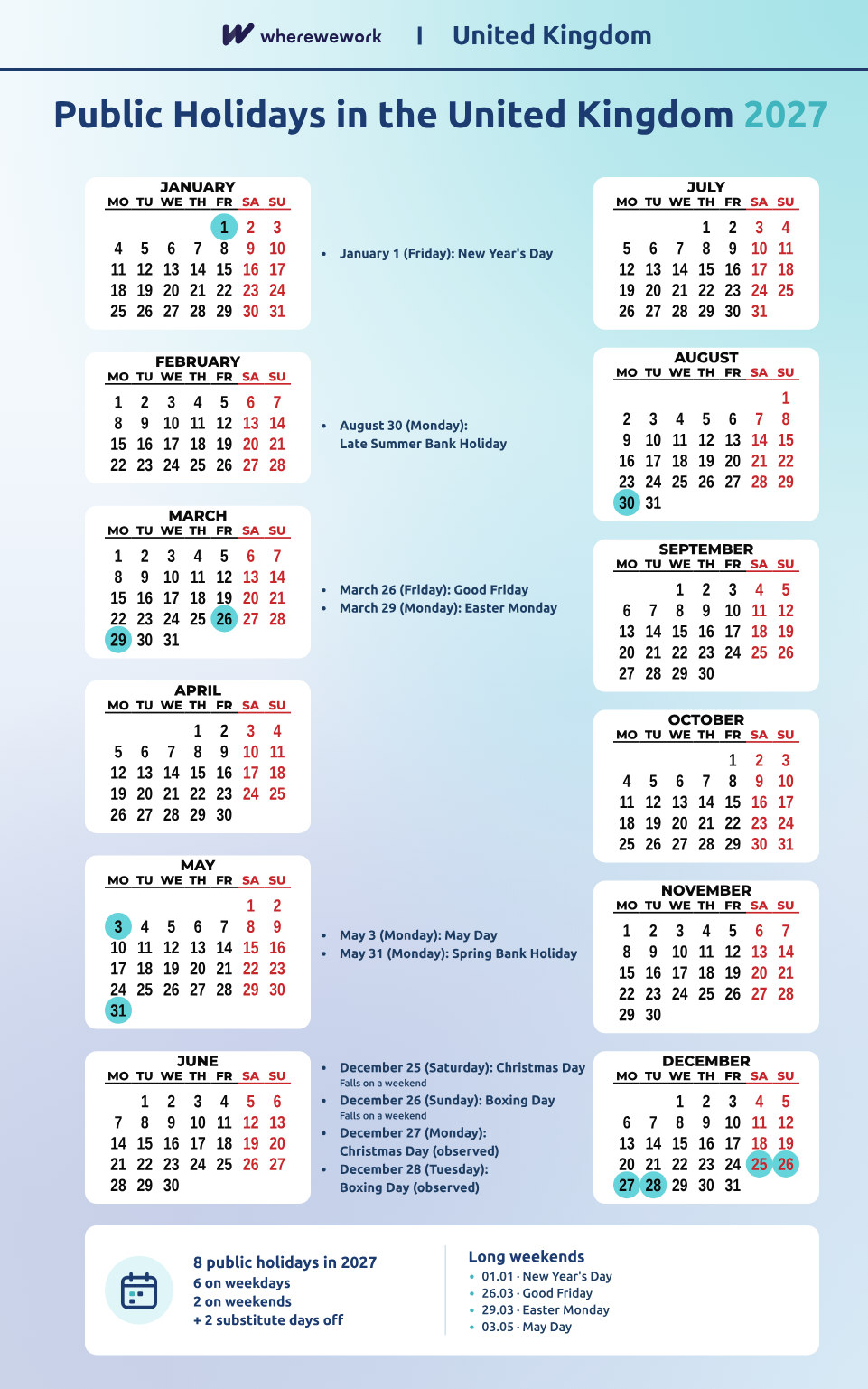
The confirmed list: England and Wales bank holidays 2027
These are the 2027 dates published on GOV.UK, grounded in the Banking and Financial Dealings Act 1971 and the Royal Proclamation issued by the Privy Council on 8 July 2026:
- 1 January 2027 (Friday): New Year's Day
- 26 March 2027 (Friday): Good Friday
- 29 March 2027 (Monday): Easter Monday
- 3 May 2027 (Monday): Early May bank holiday
- 31 May 2027 (Monday): Spring bank holiday
- 30 August 2027 (Monday): Summer bank holiday
- 27 December 2027 (Monday): Christmas Day (substitute day)
- 28 December 2027 (Tuesday): Boxing Day (substitute day)
Christmas Day itself falls on Saturday 25 December 2027 and Boxing Day on Sunday 26 December 2027. GOV.UK's established rule, drawn from Schedule 1 of the 1971 Act, is that when a bank holiday lands on a weekend, a substitute weekday becomes the bank holiday, normally the following Monday. That is why Monday 27 December and Tuesday 28 December end up on the 2027 list. The Monday distribution is pronounced this year: five of the eight bank holidays in England and Wales fall on Mondays, two on Fridays and one on a Tuesday.
Scotland and Northern Ireland: different calendars
Bank holidays are a devolved matter in Scotland, and Northern Ireland has its own statutory additions, so your total depends on where you work. Per GOV.UK's 2027 lists, England and Wales have 8, Scotland 9 and Northern Ireland 10, a count confirmed by the House of Commons Library.
- Scotland: adds Monday 4 January (the substitute for Saturday 2 January, appointed by a separate Royal Proclamation for Scotland on 8 July 2026) and St Andrew's Day on Tuesday 30 November (a bank holiday created by the St Andrew's Day Bank Holiday (Scotland) Act 2007, which stipulates it falls on 30 November itself unless that date is a weekend, in which case the immediately following Monday applies). Scotland's summer bank holiday is Monday 2 August rather than 30 August, and there is no Easter Monday.
- Northern Ireland: takes the eight England and Wales dates and adds St Patrick's Day on Wednesday 17 March 2027 and the Battle of the Boyne (Orangemen's Day) on Monday 12 July 2027, giving ten in total. The 12 July holiday falls on its own calendar date in 2027, unlike the substitute Monday 13 July that applied in 2026.
Scotland has one bank holiday fewer in 2027 than in 2026. A Royal Proclamation issued at Buckingham Palace on 3 February 2026 appointed Monday 15 June 2026 as a one-off bank holiday in Scotland to mark Scotland's men's football team competing at the FIFA World Cup for the first time in 28 years. That day does not recur in 2027, dropping Scotland's count from ten to nine.
Working on a bank holiday: what the law does and does not give you
This is the area where many workers, particularly those new to UK employment, find the position differs from what they expected. There is no statutory right to a day off on a bank holiday, and no statutory right to extra pay for working one. GOV.UK states this plainly:
"Your employer does not have to give you paid leave on bank or public holidays."
The Advisory, Conciliation and Arbitration Service (ACAS) reinforces this: whether a worker has to work on a bank holiday is a matter for the employer and may depend on the industry. Critically, the Banking and Financial Dealings Act 1971 itself carries no obligation on employers to close or to pay a premium; as the explanatory notes to the St Andrew's Day Bank Holiday (Scotland) Act 2007 confirm, the 1971 Act does not give statutory rights to extra pay or time off for those who work on bank holidays.
What the law does guarantee is your annual leave. Regulation 13 and Regulation 13A of the Working Time Regulations 1998 give almost all workers an entitlement of 5.6 weeks' paid holiday a year, which amounts to 28 days for someone on a five-day week, with statutory leave capped at 28 days. Regulation 13A, for leave years beginning on or after 1 April 2009, contributes the additional 1.6 weeks that brings the total to 5.6 weeks, capped at 28 days. Your employer can count bank holidays inside that statutory allowance. If you work a bank holiday, ACAS is clear that you must still receive your full 5.6 weeks as paid time off.
A worker can ask to work a bank holiday and take another day off in lieu, but the employer does not have to agree. Payment in lieu of bank holidays is not permitted unless the days form part of unused holiday entitlement when leaving a job. If your employer closes over Christmas and directs you to use annual leave to cover it, ACAS advises that the employer should give notice of at least twice as many calendar days as the leave being required: four days' notice for two days of leave.
Retail workers have one firm statutory protection. Under the Christmas Day (Trading) Act 2004, section 1(1), large shops in England and Wales must not open on Christmas Day for the serving of retail customers. That closure obligation applies to Saturday 25 December 2027, even though the bank holiday substitute moves to Monday 27 December. The Act applies in England and Wales only, not in Scotland or Northern Ireland, and does not regulate shops with a relevant floor area of 280 square metres (3,000 square feet) or less; exempt premises include pharmacies, petrol stations and shops in transport centres.
Looking ahead into 2027, the Fair Work Agency, which was launched on 7 April 2026, is due to begin enforcing statutory holiday pay during 2027. However, enforcement will not start before April 2027, with the precise timing subject to ongoing public consultation. Until the Fair Work Agency begins that enforcement role, workers with a concern about holiday pay are directed to contact ACAS.
If you are offered a premium rate for working a bank holiday, it is worth calculating the net effect on your salary before agreeing. Checking how your gross pay compares with what others in the same role earn in your sector can inform that conversation, particularly in industries such as retail, hospitality, healthcare and transport that operate continuously over public holidays.
Part-time workers and April-to-March leave years
The Monday-heavy distribution of 2027's bank holidays in England and Wales carries real consequences for part-time workers. ACAS is clear that when a bank holiday falls on a day a part-timer does not usually work, the employer cannot require them to use that day as part of their holiday entitlement. In ACAS's example, two workers each on a three-day week both receive 16.8 days of annual leave including bank holidays. The one who works Mondays will use more of that allowance on bank holidays, because more bank holidays fall on a Monday than on any other day. With five of the eight 2027 bank holidays in England and Wales on Mondays, the arithmetic matters.
For workers on a leave year running from 1 April to 31 March, ACAS notes that the count of bank holidays within the year shifts depending on when Easter falls. The leave year from 1 April 2026 to 31 March 2027 contains ten bank holidays in England and Wales, because both Easter 2026 (3 and 6 April) and Easter 2027 (26 and 29 March) fall inside it, along with 4 May, 25 May, 31 August, 25 December and 28 December 2026 and 1 January 2027. The following leave year, 1 April 2027 to 31 March 2028, holds just six: 3 May, 31 May, 30 August, 27 December and 28 December 2027, plus 3 January 2028, because Good Friday and Easter Monday 2028 fall on 14 and 17 April 2028. If bank holidays sit inside your contractual allowance rather than being additional to it, the swing between ten and six in consecutive leave years is worth raising with your employer before you book.
Long weekend plans for 2027
Here is how to extend each cluster in England and Wales, on the basis that your contract gives you bank holidays off.
- New Year: Friday 1 January gives a free three-day weekend (Friday 1 to Sunday 3 January) for 0 leave days. Book Tuesday 29, Wednesday 30 and Thursday 31 December 2026 and, with Christmas Day on Friday 25 December 2026 and the substitute day on Monday 28 December 2026, you can achieve 10 days off, from Friday 25 December 2026 to Sunday 3 January 2027, using 3 leave days. Monday 3 January 2028 is also a bank holiday (New Year's Day, substitute day) across England, Wales and Northern Ireland, so the same structure applies at the end of 2027.
- Easter: Friday 26 to Monday 29 March is a free four-day weekend. Book Tuesday 30 March, Wednesday 31 March, Thursday 1 April and Friday 2 April for 10 days off, Friday 26 March to Sunday 4 April, for 4 leave days. On an April-to-March leave year, two of those days fall in one leave year and two in the next. Alternatively, book Monday 22 to Thursday 25 March for 10 days from Saturday 20 to Monday 29 March. Easter Monday does not apply in Scotland; adjust accordingly.
- Early May: Saturday 1 to Monday 3 May is a free three-day weekend. Book Tuesday 4 to Friday 7 May for 9 days off, Saturday 1 to Sunday 9 May, for 4 leave days.
- Spring bank holiday: Saturday 29 to Monday 31 May arrives free. Book Tuesday 1 to Friday 4 June for 9 days off, Saturday 29 May to Sunday 6 June, for 4 leave days.
- Late summer: Saturday 28 to Monday 30 August comes free. Book Tuesday 31 August to Friday 3 September for 9 days off, Saturday 28 August to Sunday 5 September, for 4 leave days. Scotland's summer bank holiday is Monday 2 August rather than 30 August, so the equivalent Scotland plan runs from Saturday 31 July to Sunday 8 August, booking Tuesday 3 to Friday 6 August.
- Christmas: Saturday 25 to Tuesday 28 December is a free four-day break. Book Wednesday 29, Thursday 30 and Friday 31 December and, because Monday 3 January 2028 is a bank holiday in England, Wales and Northern Ireland, you can achieve 10 days off, Saturday 25 December 2027 to Monday 3 January 2028, for 3 leave days.
Before you book: the practical checklist
The dates are fixed by the Banking and Financial Dealings Act 1971 and the Royal Proclamations issued on 8 July 2026; no further changes to the 2027 list are expected. What varies is how your employer applies them. Read your contract to establish whether bank holidays are included within your 5.6 weeks' statutory entitlement under the Working Time Regulations 1998, or whether they are additional days on top. Book Easter and the Christmas period early, given that colleagues will be competing for the same windows. If any ambiguity exists about bank holiday pay or time off, ACAS provides free, impartial guidance at acas.org.uk. The quieter stretches around bank holidays are also a practical moment to review your CV and scan for open roles. If you are heading into a job interview, it is reasonable to ask how the employer handles work on public holidays and whether any additional days off are offered beyond the statutory minimum.
Share
What I read is worth it:
Read all the articles about
About the crafts Balance Career planning Economic Guide HR Coach HR Metrics Workforce planning Students Negotiation Labour market Human behavior Employee experienceArticle written by:
 wherewework.com

Comments
0 comments
No comments! Be the first to comment on this article!

Access your account and add your comment
About the crafts


Subscribe to the Newsletter
Read articles of interest from wherewework.com contributors
