Share
Statutory vs. Collective: How Nordic Countries and Austria Beat the Legal Minimum Wage
05/29/2026
7 min

For corporate leadership, global expansion strategists, and international HR executives, a statutory national minimum wage is typically viewed as the ultimate benchmark of worker protection. Conventional economic logic dictates that without a government-mandated legal floor, lower-skilled workers are left vulnerable to wage exploitation.
Yet, when evaluating the world’s most resilient and high-income labor markets, a striking institutional paradox emerges. A select group of European economies—specifically Denmark, Sweden, Norway, Finland, and Austria—completely reject the concept of a single, statutory national minimum wage. Despite the total absence of a federal legal rate, these countries consistently secure entry-level wages, employee benefits, and social protections that comfortably outperform the rigid legal frameworks of most Western nations.
This report analyzes the structural mechanics of how these non-statutory systems operate in 2026, details the institutional dynamics of "social partnerships," and outlines the critical compliance frameworks that international businesses must navigate to successfully hire across these highly specialized markets.
1. The Institutional Core: Statutory vs. Collective Systems
To understand how these countries "beat" the traditional legal minimum wage, it is essential to contrast the two fundamentally opposing philosophies of labor market regulation:
The Statutory Model (The Legislative Approach)
Utilized by nations like the United States, France, Germany, and Romania, this system relies on direct state intervention. The central government passes a statutory law establishing a hard baseline—such as a fixed hourly rate or a nationwide monthly gross ceiling.
-
The Pitfall: These numbers are often subject to intense political gridlock, leading to prolonged periods of stagnation (as seen with the US federal floor of $7.25 per hour). Furthermore, a flat national rate struggles to adapt dynamically to the unique operational realities of different industrial sectors.
The Collective Model (The Social Partnership Approach)
The system utilized across the Nordic bloc and Austria operates on the absolute exclusion of government decrees. The state steps out of the wage-setting process entirely. Instead, the national labor framework relies on a decentralized yet exceptionally strict system of social dialogue driven by two primary entities:
-
Trade Unions: Representing highly unionized, organized pools of labor across specific industries.
-
Employer Federations: Representing corporate interests within those identical sectors.
These two social partners meet regularly to negotiate comprehensive industry agreements known as Collective Bargaining Agreements (Overenskomster in Denmark, Tariffavtaler in Norway, Työehtosopimus or TES in Finland, and Kollektivverträge in Austria). Rather than enforcing a single blunt number for the whole country, these texts establish customized, dynamic wage scales tailored specifically to the economic realities of each individual sector.
2. The Nordic Model: Enforcement Without Legislation
The Nordic block (Denmark, Sweden, Norway, and Finland) represents the global apex of the collective bargaining philosophy. According to 2026 data overviews from Eurostat and Eurofound, these nations successfully maintain an effective wage coverage rate that spans between 85% and 98% of the total formal workforce, despite having zero federal minimum wage laws.
The mechanics of this model rely on two distinct enforcement pathways:
General Applicability (Yleissitovuus / Allmenngjøring)
This serves as the ultimate safety net inside the Finnish and Norwegian labor markets. If an independent trade union and an employer association sign a collective agreement that covers a significant, highly representative majority of workers in a specific industry (e.g., construction or logistics), a specialized government board can officially declare that text "generally binding." * The Compliance Impact: Once a collective agreement receives this designation, its minimum wage charts automatically become the mandatory legal floor for every single business operating in that sector, regardless of whether the company is unionized or entirely independent.
Voluntary Strict Compliance and Direct Market Pressure
In Denmark and Sweden, the concept of a government-backed general extension is entirely rejected. Compliance is driven purely by sheer union density, cultural norms, and direct market self-regulation.
-
The Enforcement Reality: If a foreign enterprise or a cross-border digital platform attempts to establish local operations while paying below the industry's established collective standard, local trade unions will legally initiate targeted solidarity blockades. This means cleaning crews, logistics providers, harbor workers, and IT support teams across independent companies will legally refuse to service the non-compliant business until it signs the standard sector agreement. As a result, market pressure forces a high, uniform floor without requiring a single page of state legislation.
3. The Austrian Model: The Mandatory Chamber Framework
Austria presents a fascinating alternative that achieves near-universal wage protection through a highly structured, mandatory corporate system, rather than the voluntary union density seen in Scandinavia.
-
The Mandatory Membership Rule: In Austria, by federal law, every single legally registered business operating within the country is required to hold a mandatory membership in the Austrian Federal Economic Chamber (Wirtschaftskammer Österreich or WKO).
-
The Universal Coverage Effect: Because the WKO represents 100% of employers, when it sits down annually to negotiate a Kollektivvertrag (collective agreement) with the Austrian Trade Union Federation (ÖGB), the resulting agreement legally binds virtually every workplace in that specific sector.
This institutional framework creates an incredibly stable, predictable, and strike-free business environment. It guarantees that over 98% of all Austrian employees are covered by a high, sector-specific minimum wage floor that automatically incorporates complex professional seniority scaling and mandatory holiday bonuses.
4. Why the Collective Model Secures Higher Pay Floors
When cross-border employers normalize collective bargaining entry rates into standard monthly or hourly equivalents, a clear pattern emerges: collective models consistently secure superior baseline compensation compared to statutory equivalents.
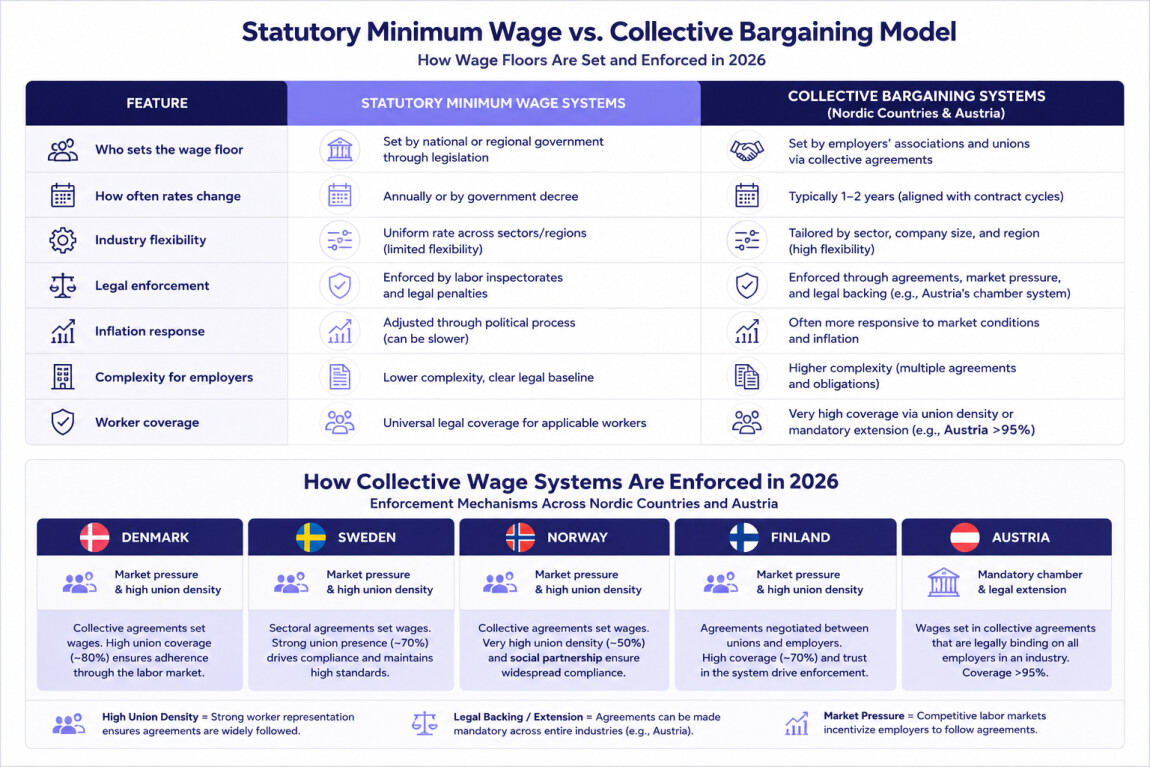
Feature Comparison
- Wage determination
Statutory Minimum Wage Systems:
Set by political decree or national legislation.
Collective Bargaining Systems (Nordic/Austria):
Negotiated through sector-level collective agreements between employers and unions.
- Adaptability to inflation
Statutory Minimum Wage Systems:
Rigid and updated mainly through political or legislative cycles.
Collective Bargaining Systems (Nordic/Austria):
More flexible, with regular adjustments through negotiations, typically every 2–3 years.
- Granularity of wage floors
Statutory Minimum Wage Systems:
Flat minimum applied broadly across roles and industries.
Collective Bargaining Systems (Nordic/Austria):
Multi-tier wage structures based on role, seniority, and qualifications.
- Mandatory bonus integration
Statutory Minimum Wage Systems:
Rarely included in the legal minimum wage definition.
Collective Bargaining Systems (Nordic/Austria):
Often includes mandatory 13th and/or 14th salary payments depending on sector agreements.
Because the minimum thresholds are hammered out by industrial experts who intimately understand the revenue, profit margins, and productivity metrics of their specific sectors, the baseline hourly rates found inside a Danish retail agreement or an Austrian engineering Kollektivvertrag routinely convert into monthly figures that sit far ahead of standard Western European and North American statutory laws.
5. Critical Compliance Pitfalls for International Employers and EORs
For international businesses expanding into these non-statutory markets—whether hiring remote developers or setting up localized corporate branches—relying on standard international HR templates is a high-risk approach. Employers must meticulously audit three core compliance layers:
5.1. The Total Blind Spot of Government Portals
If an international HR team attempts to look up the "minimum wage in Norway" or "minimum wage in Austria" on a standard government database, they will find an official blank space. Writing a standard employment contract based on individual, unguided salary negotiations can lead to severe structural non-compliance. If a generally binding or dominant collective agreement covers that employee's specific job title, the individual contract is legally void if its baseline pay falls beneath the collective floor.
5.2. The Seniority and Qualification Trap
Collective agreements do not feature a single, static entry-level number. They utilize highly complex, legally binding multi-tiered grids. An employer is legally mandated to scale up an employee’s minimum required baseline salary based on:
-
The worker's formal university degrees or specialized vocational certifications.
-
The exact number of documented years of seniority the individual has accumulated within that specific profession, even if those years were spent working for a direct competitor.
5.3. Mandatory 13th and 14th Salary Integration
In many non-statutory systems—most notably within Austrian industry agreements—the collective text legally mandates the distribution of a 14-payment annual structure. This obligates employers to pay a full extra month’s wage as a Summer Holiday Bonus (Urlaubsgeld) and another full month’s wage as a Christmas Bonus (Weihnachtsgeld). Annual corporate budget forecasting and EOR contract configurations must be built around this 14-payment cycle rather than a standard 12-month calendar.
Conclusions
Denmark, Sweden, Norway, Finland, and Austria conclusively demonstrate that a labor market can achieve exceptional worker protections, competitive baseline compensation, and low rates of in-work poverty without the rigid architecture of a centralized federal minimum wage law.
For the global employer, success in these regions requires a total shift in compliance strategy: operational focus must move away from evaluating national labor codes and instead center on meticulously identifying, decoding, and following the specific collective agreement governing their targeted industry sector.
FAQ – Frequently Asked Questions
How can a country have no minimum wage but maintain high salaries? By delegating wage-setting entirely to sector-specific collective bargaining agreements negotiated between trade unions and employer federations. Because these agreements are updated every 2–3 years by industry experts, they establish entry floors that naturally outpace static, politically driven statutory laws.
What happens if a company refuses to join a union in Denmark or Sweden? While joining a union or employer association is legally voluntary, non-unionized companies are still subject to immense market and social pressure. If a business attempts to underpay staff, local unions can legally initiate powerful solidarity blockades, halting all essential external B2B services (such as logistics, waste disposal, or IT support) until compliance is reached.
What is a "Generally Binding" collective agreement? A legal mechanism utilized in countries like Finland and Norway where a major collective agreement, once proven to cover a significant majority of an industry's workforce, is extended by a government board to apply to all employers in that sector—including completely non-unionized businesses.
Share
What I read is worth it:
Read all the articles about
International Labour market Statistics Guide Economic Legislative Human behavior Career planning Ethics StudentsArticle written by:
 wherewework.com

Comments
0 comments
No comments! Be the first to comment on this article!

Access your account and add your comment
International


Subscribe to the Newsletter
Read articles of interest from wherewework.com contributors
