Compartir
Minimum Wage in the USA 2026: Federal Floor vs. State Reality
12/05/2026
3 min
The minimum wage is a cornerstone of labor protection in the United States, yet it is one of the most complex systems globally due to the dual-layered legislative framework. In a landscape marked by persistent inflation and varying regional costs of living, the minimum wage in 2026 highlights a significant divide between federal requirements and state-level economic realities.
1. What is the minimum wage in 2026 and who does it apply to?
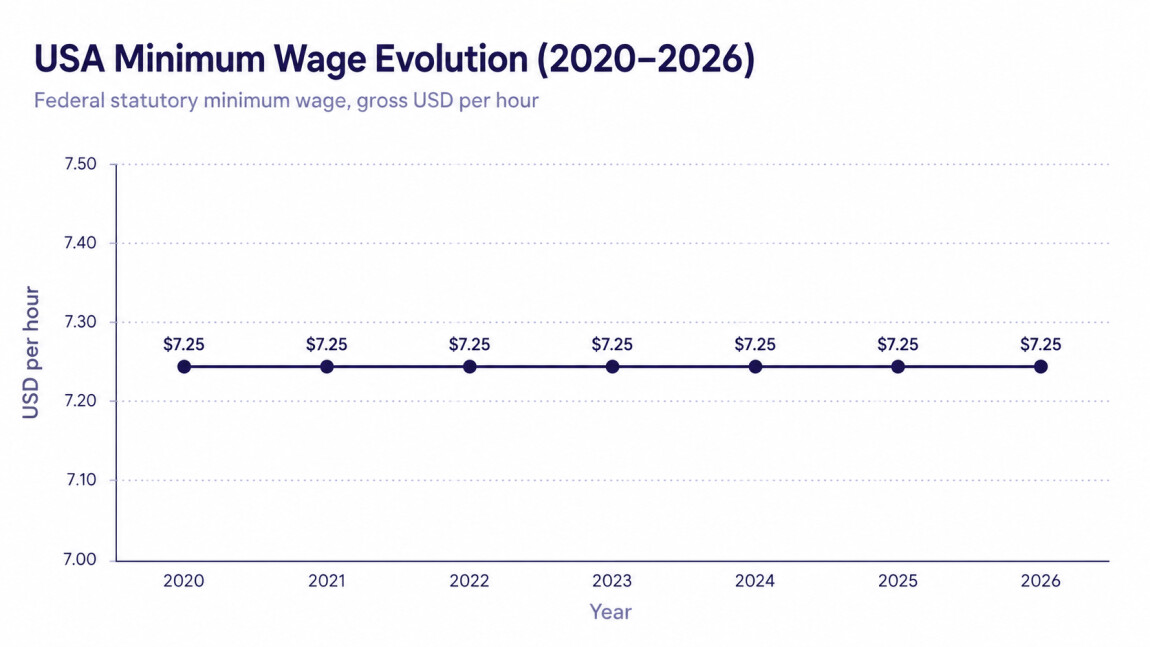
As of January 1, 2026, the federal minimum wage in the United States remains at $7.25 per hour. This rate has been unchanged since July 2009, making it the longest period without a federal increase in U.S. history.
Key figures for the federal level in 2026:
-
Hourly Rate: $7.25.
-
Monthly Equivalent (Gross): Approximately $1,256.67 (based on a standard 40-hour workweek), which translates to roughly €1,068 at current exchange rates.
-
Applicability: Most employees covered by the Fair Labor Standards Act (FLSA).
-
Tipped Minimum Wage: Remains at $2.13 per hour federally, provided tips make up the difference to the full minimum wage.
-
Youth Wage: A training wage of $4.25 can be paid to employees under 20 for their first 90 days of employment.
2. Evolution of the minimum wage (2022–2026)
While the federal floor has remained stagnant at $7.25 throughout the 2022–2026 period, the national "effective" minimum wage has risen due to state actions. In 2022, many states began aggressive indexing to inflation, a trend that continued through 2025 and 2026. While Congress has debated the "Raise the Wage Act" multiple times, no federal adjustment was enacted for 2026, leaving the base level at its 2009 value.
3. The "Real" Minimum Wage: State and Local Exceptions
The most important takeaway for 2026 is that the federal rate is merely a floor. Currently, 30 states and the District of Columbia mandate higher rates. For a worker in Seattle or California, the "minimum" wage is more than double the federal requirement.
Highest State-Level Rates in 2026:
-
District of Columbia (DC): $17.95/hour (increasing to $18.40 on July 1, 2026).
-
Washington State: $17.13/hour.
-
California: $16.90/hour (with sector-specific rates like $20 for fast food workers).
Local Record-Holders: Some cities have pushed even further. In 2026, the highest local rates are found in Tukwila, WA ($21.65) and Seattle, WA ($21.30).
4. Purchasing Power and Economic Context
A federal wage of $7.25 (approx. $1,068/month) is widely considered insufficient for a basic standard of living in most of the country. In states with a lower cost of living, like Mississippi, a "living wage" for a single adult is estimated at roughly $15/hour, while in high-cost states like Massachusetts or California, it exceeds $30/hour.
The gap between the federal minimum and the average wage is also stark. As of March 2026, the average hourly earnings for all private employees in the U.S. reached $37.38. This means a federal minimum wage worker earns less than 20% of the average national hourly rate.
5. Challenges and Limitations – What the minimum wage doesn’t cover
The primary challenge in 2026 is the erosion of purchasing power due to cumulative inflation. For workers in the 20 states that still follow the federal $7.25 rate, essential costs such as housing, healthcare, and transportation have outpaced wage growth.
Furthermore, the "tipped credit" system remains a point of contention. In many states, employers can still pay as little as $2.13 per hour, shifting the burden of compensation onto customers through tips. While seven states have banned this "subminimum wage" for tipped workers as of 2026, it remains legal under federal law.
Conclusions
The U.S. minimum wage in 2026 is a "tale of two countries." While the federal rate of $7.25 offers a basic legal protection that has become economically obsolete in many regions, state and local governments have stepped in to create a diverse patchwork of wage floors. For employers and employees alike, the "real" minimum wage is increasingly determined by zip code rather than federal mandate. Ready to take the next step? Create your CV, browse job opportunities, or get ready for your job interview
FAQ – Frequently Asked Questions
Is the federal minimum wage increasing in 2026? No, the federal minimum wage remains at $7.25 per hour in 2026, where it has stayed since 2009.
Which state has the highest minimum wage in 2026? Washington State has the highest state-level rate at $17.13/hour, though the District of Columbia is higher at $17.95 (rising to $18.40 in July).
What is the tipped minimum wage in 2026? The federal tipped minimum wage is $2.13/hour, but many states (like California and Washington) require the full standard minimum wage for tipped employees.
Can a city have a higher minimum wage than the state? Yes. Local jurisdictions like Seattle, WA, and West Hollywood, CA, have established local minimum wages that exceed their respective state requirements.
Compartir
Lo que he leído merece la pena:
Artículo escrito por:
 wherewework.com

Comentarios
0 comentarios
¡No hay comentarios! ¡Sé el primero en comentar este artículo!

Accede a tu cuenta y añade tu comentario
Internacional


Suscribirse a la newsletter
Lee artículos de interés de los colaboradores de wherewework.com
