Compartir
Pennsylvania's FLSA floor at $7.25: what the Senate vote means for workers and HR teams
03/07/2026
6 min
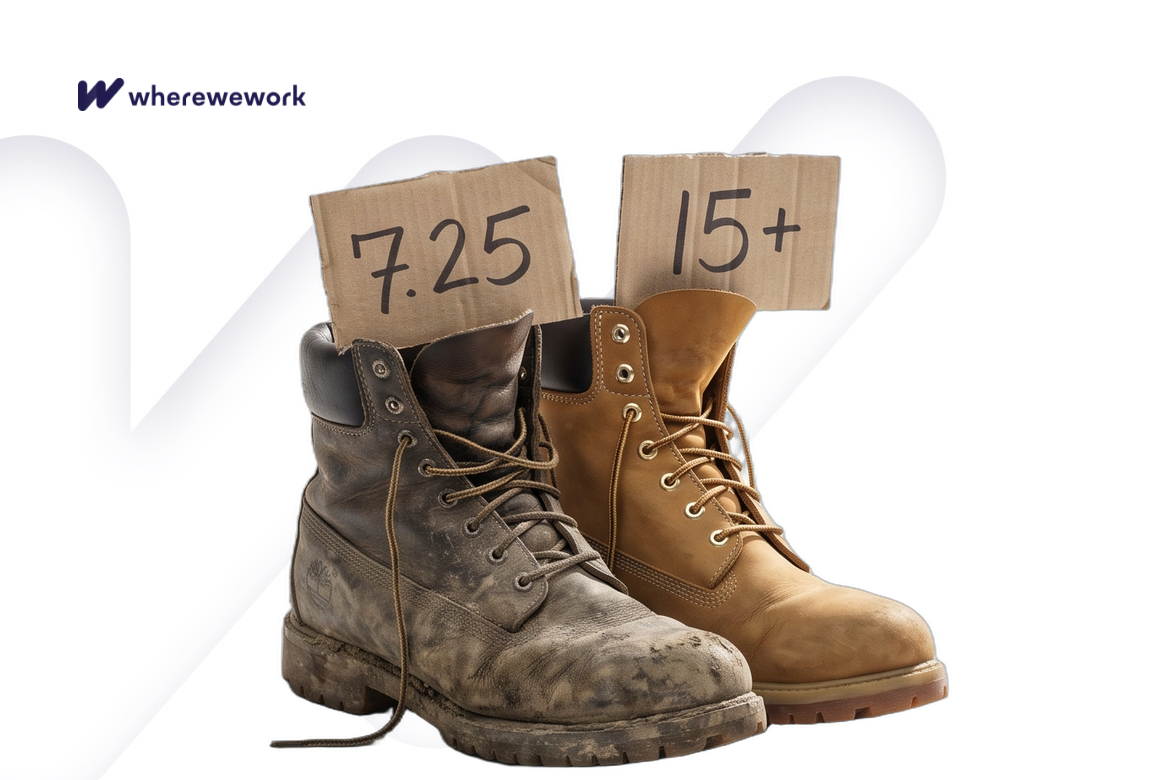
Pennsylvania's minimum wage sits at $7.25 an hour, tied to the federal floor set by the Fair Labor Standards Act (FLSA) in 2009 and never moved since. Cross the Delaware River into New Jersey and the legal minimum is $15.49. Cross into Delaware or Maryland and it is $15.00. New York State floors it at $16.00, and $17.00 inside New York City. That geography tells the workforce story faster than any legislative calendar can.
On June 10, Senate Democratic Leader Jay Costa forced a procedural vote on a discharge petition designed to push a $15 minimum wage bill out of committee and onto the Senate floor. Senate Republicans blocked it. The bill did not fail on a floor count of votes for or against; it failed on a vote to even schedule a count. For anyone tracking whether Pennsylvania is about to converge with its neighbors, that distinction matters. Not this session.
What actually failed in Harrisburg
A discharge petition is a procedural lever available in many state legislatures. It forces a bill out of committee when majority leadership will not schedule it voluntarily. Costa deployed it to release a $15-per-hour minimum wage proposal that Pennsylvania Democrats have made a recurring priority. Senate Republicans, who control the chamber, blocked the move. Pennsylvania Democrats publicly called on Senate Republicans to support the increase, and the effort failed on party lines.
Pennsylvania's minimum wage has been frozen at $7.25 for roughly 20 years. The FLSA, under 29 U.S.C. § 206(a)(1), sets $7.25 as the federal floor. States and some localities may exceed it; Pennsylvania has not. Every neighboring state has. The political fault line that killed this vote has held for two decades, but the labor market has not waited for it to break.
For employees
If you are working retail, hospitality, warehouse, food service, or care in Pennsylvania at or near the state minimum, here is what the failed vote changes in the near term: nothing statutory. The floor stays at $7.25. Tipped workers remain on a cash wage of $2.83 per hour under Pennsylvania's tip-credit provision, with the expectation that tips bring total hourly earnings to at least $7.25 over the pay period.
What has changed, steadily and without a legislative vote, is the purchasing power of $7.25. The Bureau of Labor Statistics (BLS) Employment Cost Index and Consumer Price Index data consistently show that wages frozen in nominal terms lose real value every year that rents, groceries, and utilities keep climbing. A nominal wage frozen since 2009 represents a substantial real-terms cut by 2026. It is also a widening gap with the wage on offer thirty minutes across a state line.
Practical steps for workers and candidates right now
- Check what the same role actually pays in border markets. A cashier, warehouse picker, or line cook posted in Cherry Hill, NJ; Wilmington, DE; or Elkton, MD is legally floored at $15.00 or above. The identical role posted in Philadelphia or Scranton can legally start at $7.25. The pay difference on equivalent work is often the cost of a commute, not the cost of a different career.
- Look at the posted starting wage, not the listed range. Many Pennsylvania employers are already advertising starting rates well above $7.25 to compete for workers, particularly in logistics and healthcare. The market rate is frequently higher than the statutory floor. Anchoring your salary ask to $7.25 leaves money on the table before the negotiation begins.
- If you are a tipped worker, keep your own record of hours and tips per shift. Under FLSA § 203(m) and Pennsylvania's parallel tip-credit rules, employers are required to make up the difference when tips fall short of the minimum. Your own records are the documentation that makes that guarantee enforceable in practice. The Department of Labor (DOL) Wage and Hour Division handles complaints at the federal level if your employer does not comply.
- Before accepting or renegotiating an offer, compare against verified pay data from workers in the same role and region. Pay transparency benchmarks from real workers are one of the few practical counters to a stagnant statutory floor, especially in a state that has not enacted pay-range disclosure requirements comparable to California's SB 1162 or New York's pay transparency law.
The political reality is that a $15 Pennsylvania floor is not arriving this legislative session. The practical reality is that a significant share of Pennsylvania employers are already paying above $7.25 because the labor market in competitive hiring areas demands it. The job for any worker or candidate is to find those employers, verify what they are actually paying, and negotiate against their real posted rate, not against the statute.
For HR and hiring managers
If you hire hourly workers in Pennsylvania, the failed discharge petition vote is a planning input, not a permanent reprieve. Two dynamics are worth building into your compensation modeling now.
1. Border-state wage arbitrage is already restructuring your labor pool
Every Pennsylvania county that borders New Jersey, New York, Delaware, Maryland, or Ohio is a commutable labor market for the higher-floor state. Workers within driving distance of a $15 to $17 legal minimum in a neighboring jurisdiction will not accept a $7.25 to $10 posting for comparable work when the alternative is a reasonable commute away. The statutory floor may be $7.25, but the effective hiring floor in Bucks, Delaware, Chester, Philadelphia, Northampton, and Erie counties is materially higher. Compensation bands still anchored to the state minimum are benchmarked against a labor market that no longer exists in those geographies. SHRM's annual compensation planning guidance consistently notes that effective market floors in border-metro areas diverge from state statutory floors by meaningful margins in high-competition sectors.
2. The legislative risk is one election or one compromise away
A twenty-year wage freeze is structurally unusual. Every neighboring state has moved. Pennsylvania Democrats have made the $15 push a repeated priority and deployed a procedural forcing mechanism to keep it on the record. A future shift in Senate control, or a phased compromise bill with regional carve-outs or a tipped-wage reform component, can move the floor materially in a single legislative session. The Economic Policy Institute (EPI), which tracks low-wage labor market data and has consistently published research on the real-wage erosion of frozen minimum wages, estimates that a federal or state minimum wage frozen at $7.25 has lost substantial purchasing power since 2009. HR teams treating the current freeze as a stable long-run condition are taking on scenario risk that is not priced into their workforce planning.
Practical implications for HR teams and compensation leads:
- Model the wage-bill impact at $12, $15, and a phased scenario before any bill clears committee. Finance business partners will ask for this analysis the day legislation moves; building it in advance gives you a credible answer instead of a rushed estimate.
- Audit exposure by role and site. Identify which locations and job categories are currently posting below what a $12 or $15 floor would require, and map the compression effect on the next pay band up. Compression is often a larger cost than the base-wage increase itself.
- If you operate across state lines, align pay on the highest applicable floor for cross-border roles. The retention cost of paying a Pennsylvania warehouse worker $9.50 while the same organization pays $15.49 across the Delaware River is a story your workforce notices and tells. That perception gap is a turnover driver even when the legal differential is valid.
- Review your tipped-worker practices now. Pennsylvania's $2.83 tip-credit rate is one of the lowest in the country. Any credible Pennsylvania wage bill is likely to narrow or phase out the sub-minimum tipped wage. States that have raised base wages over the past decade have, almost uniformly, also compressed or eliminated the tip credit. The FLSA's tip-credit framework under 29 U.S.C. § 203(m) sets the federal ceiling on tip-credit usage; state law can only be more protective, not less. Pennsylvania employers relying on the $2.83 rate as a structural labor-cost assumption carry legislative exposure on two fronts.
The signal, in one line
Pennsylvania's minimum wage remains at $7.25 not because the labor market has validated that number, but because a discharge petition failed in the state Senate on party lines. The FLSA sets the federal floor and Pennsylvania has chosen, for two decades, to sit on it rather than exceed it, while every bordering state has moved above it. Workers in competitive Pennsylvania markets should treat the statute as a baseline that many employers in logistics, healthcare, and food service are already exceeding to hire at all. HR teams should treat the freeze as a temporary condition, run the scenario models before the vote forces the issue, and stop anchoring hourly compensation bands to a number the regional labor market has already priced past.
Compartir
Lo que he leído merece la pena:
Lee todos los artículos sobre
Planificación de carrera Crear perfil de candidato Económico Editorial Ética Guía Métricas de RRHH Internacional Oportunidades laborales Mercado laboral Legislación Estadísticas Planificación de personalArtículo escrito por:
 wherewework.com

Comentarios
0 comentarios
¡No hay comentarios! ¡Sé el primero en comentar este artículo!

Accede a tu cuenta y añade tu comentario
Planificación de carrera


Suscribirse a la newsletter
Lee artículos de interés de los colaboradores de wherewework.com
